
Best 10 Inch Subwoofers can transform weak car audio into heart-pounding, room-shaking bass without distortion or huge enclosures. If you crave deep, punchy low end but worry about space or budget, this expert-tested guide delivers easy picks, clear comparisons, and honest power-handling advice. You’ll get confident, money-smart choices and thrilling sound you can feel. Ready to upgrade? Let’s dive into the top models and buying tips.
Contents
- Top 7 10 Inch Subwoofers:
- 7: Skar Audio SDR-10 D2 10″ 1200 Watt Max Power Dual 2 Ohm Car Subwoofer
- 6: Rockford Fosgate R2D2-10 Prime R2 2-Ohm DVC 10” Subwoofer
- 5: Rockville SS10P 10″ Slim Under-Seat Powered Car/Truck Subwoofer
- 4: Skar Audio VD-10 D4 10″ 800W Max Power Dual 4 Ohm Shallow Mount Car Subwoofer
- 3: Skar Audio EVL-10 D2 10″ 2000 Watt Max Power Dual 2 Ohm Car Subwoofer
- 2: KICKER 46HS10 Hideaway Compact Powered Subwoofer, 10-Inch
- 1: Rockford Fosgate Punch P300-10 Amplified 10″ Subwoofer in Enclosure
- Things to Consider Before Buying a 10 Inch Subwoofer:
- Active vs. Passive Configurations
- Component vs. Enclosed Systems
- RMS Power and Peak Wattage
- Frequency Response and Impedance
- Advantages in Responsiveness and Speed
- Limitations in Extreme Low-End Output
- Selecting the Optimal Enclosure Location
- Connecting to the Amplifier and Power Source
- Adjusting Crossovers and Gain Settings
- Managing the Initial Break-in Period
- Final Words
Top 7 10 Inch Subwoofers:
7: Skar Audio SDR-10 D2 10″ 1200 Watt Max Power Dual 2 Ohm Car Subwoofer

Skar Audio’s SDR-10, a top-tier 10-inch subwoofer that won’t break the bank.A low end does not exist in factory systems. The SDR-10 is the starting point for genuine bass.The first is a power rating of 600 WRM and 1,200 W peak. Impressive strength for a novice driver.A 2.5-inch voice coil made of four layers of copper and cooled by airflow follows. On lengthy drives, it sounds clean.
Lastly: a high-flux ferrite motor-driven frequency response from 28 to 300 Hz.One drawback is that you will still want an amplifier and an enclosure because it is a raw driver. It requires actual electricity because to its low sensitivity of 82 dB.Good for: those on a low budget, first-time builders. Discontinued: tiny amplifiers and plug-in users.
6: Rockford Fosgate R2D2-10 Prime R2 2-Ohm DVC 10” Subwoofer

The R2D2-10 from Rockford Fosgate is the top-tier subwoofer for compact amplifiers.No amount of power is useful if your amplifier is unable to handle the load. Modest power is required to run the R2.Starting with 250 watts RMS. It is driven correctly by a little mono amp.The next step is to ensure the motor stays cool by using a stamp-cast basket with spider venting and a mica-injected polypropylene cone.
The 4.3-inch mounting depth allows it to function in both sealed and vented environments.Downside: these raw subs have the weakest power handling. See if your amplifier can handle dual 2-ohm coils wired to 1 or 4 ohms. Must have a container.Ideal for: automobiles used for commuting, modest amplifiers, and customers who choose tried-and-true brands. Inappropriate for: bassists seeking peak performance.
5: Rockville SS10P 10″ Slim Under-Seat Powered Car/Truck Subwoofer

The top powered under-seat subwoofer on a budget is the Rockville SS10P.Not got a spare trunk? Would you rather not construct a box? Neither of these is necessary for the SS10P.To start, there is an internal amplifier with a 200 watt RMS rating. Not a matching amplifier to purchase.Another thing: it’s only three inches tall. The cast-aluminum chassis remains cool and can slide beneath the majority of seats.
Lastly, it connects to a factory stereo via high-level and RCA inputs, which have auto-turn-on capabilities. Included is a remote bass knob.The 200 watts won’t go as far in a compact enclosure as they would in a full-size one. A battery cable is still required to power it.Considered ideal for: full trunks, leased automobiles, and trucks. People seeking bass that will shatter mirrors should not listen.
4: Skar Audio VD-10 D4 10″ 800W Max Power Dual 4 Ohm Shallow Mount Car Subwoofer

The top shallow-mount subwoofer for vehicles and confined areas is the Skar Audio VD-10.A deep box is required for a conventional subwoofer. Such depth is just not there when one is seated behind a vehicle seat.A mounting depth of 4.41 inches is the first requirement.It is designed for narrow spaces, such as those behind or under a seat.
Following that, 800 watts peak and 500 watts RMS. Powerful control with a compact design.Last but not least: two 4-ohm voice coils. Attach it to a 2 ohm or 8 ohm load.Downside: you’ll need an external amplifier and a housing because it’s passive. It needs actual electricity because its sensitivity is 85.1 dB.Fits best with: standard-cab trucks, hatchbacks, and bespoke slimlines. Those looking for a pre-built system should look elsewhere.
3: Skar Audio EVL-10 D2 10″ 2000 Watt Max Power Dual 2 Ohm Car Subwoofer

When it comes to powerful 10-inch subwoofers, nothing beats the Skar Audio EVL-10.A little extra bass isn’t something that everyone wants. Everyone in the car wants to hear it.An initial 1,000 watts RMS and 2,000 watts peak are required. In terms of power handling, that is the top of the list.Next up are the two-layer spider and the 3-inch high-temperature voice coil. Designed to withstand damage.
Lastly, a cone with a one-way movement of 23.5 mm and a response frequency of 28 Hz is available.Downside: a powerful amplifier and matching cables are required. It has a poor sensitivity of 82.1 dB. See if your amplifier can handle dual 2-ohm coils wired to 1 or 4 ohms.Who it’s best for: racers and bassists. Standard electrical systems and low-amp loads are not compatible.
2: KICKER 46HS10 Hideaway Compact Powered Subwoofer, 10-Inch
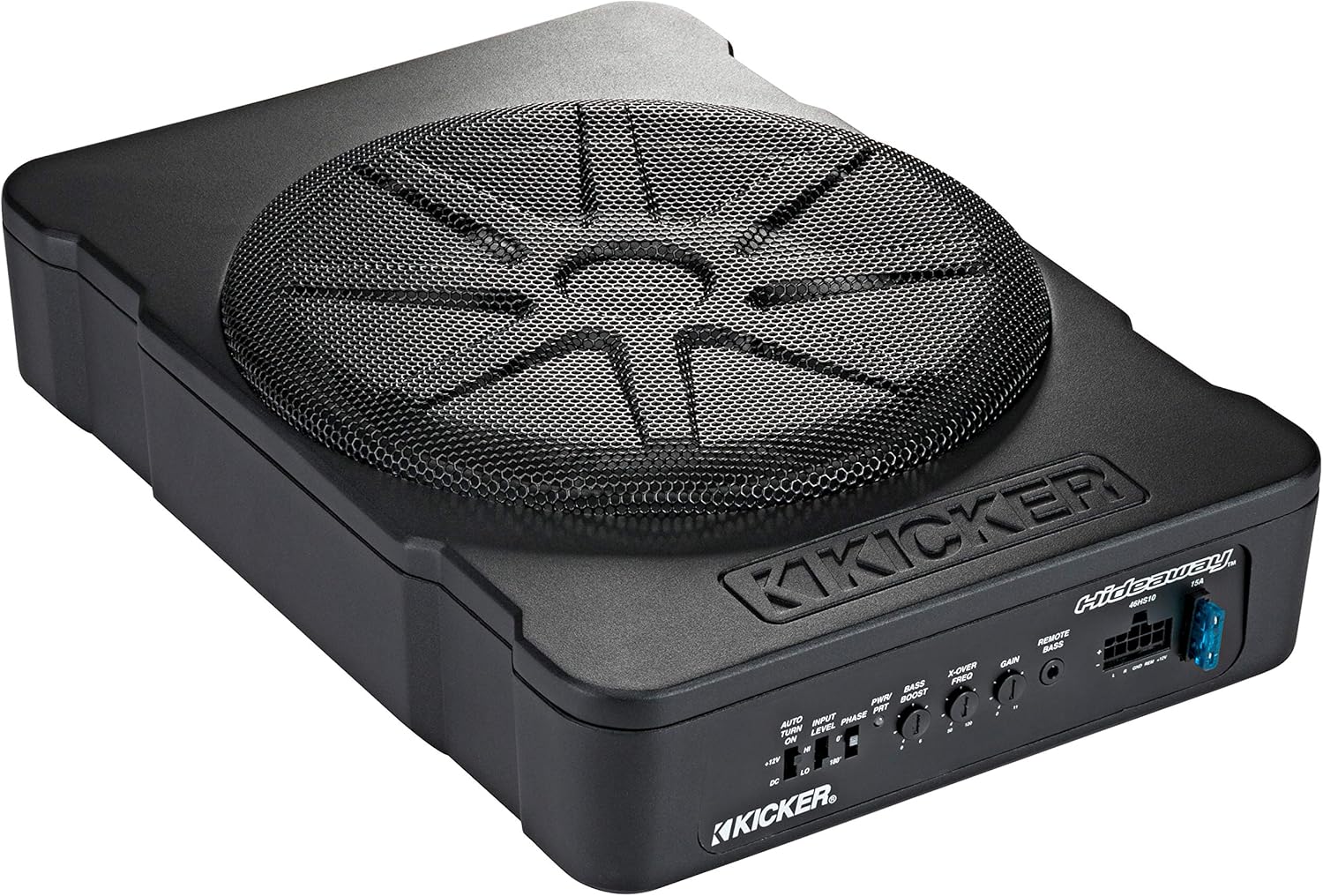
When it comes to factory systems, nothing beats the Kicker Hideaway HS10, a quality compact powered subwoofer.Your factory stereo is fine with you. Without sacrificing packing space, all you want is bass.To begin, a single plug handles all three functions of power, signal, and on/off in a quick-connect harness. Compatible with a wide range of OEM and aftermarket head units.Up next: an all-aluminum chassis housing an internal amplifier capable of 180 watts. Adaptable enough to call a seat home.
Lastly, a remote bass control is provided. Modify the bass level independently of the radio’s volume control.Disadvantage: the most expensive option here. One of the three powered options has the lowest power at 180 watts.The ideal installation method for OEM stereo owners is a clean, concealed one. Buyers seeking maximal output should not purchase this.
1: Rockford Fosgate Punch P300-10 Amplified 10″ Subwoofer in Enclosure
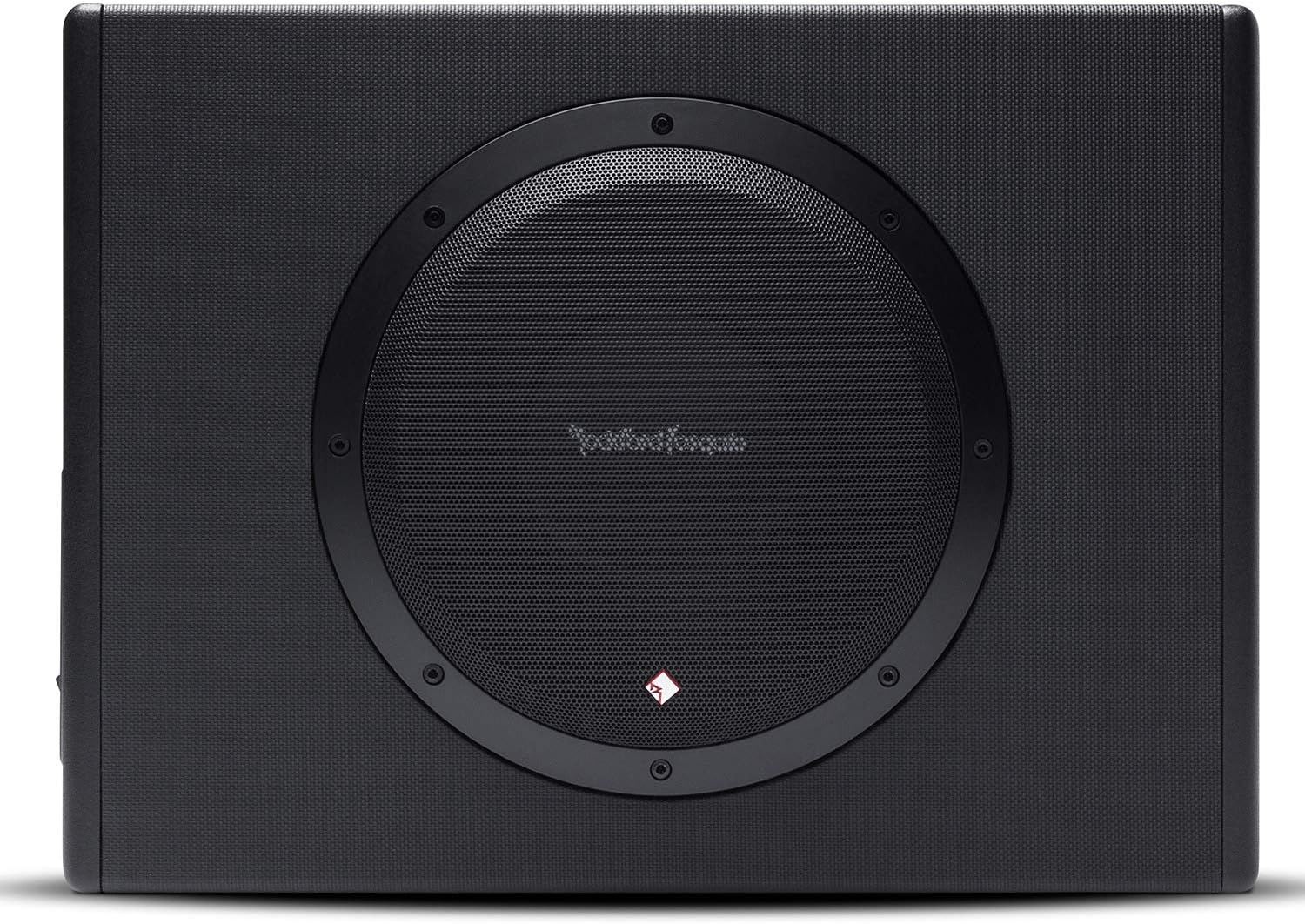
The Rockford Fosgate Punch P300-10, a top-tier all-in-one bass system, is the greatest 10-inch subwoofer available.You will be given homework by every single raw sub on this list. Pick an amplifier. Make a crate. This is taken care of by the P300-10.At the top of the list is an integrated 300-watt amplifier, a Punch 10-inch woofer, and a specially designed sealed enclosure. All three are not included in any other full-size sub here.To follow: a closed-loop system. Nothing is out of whack because the woofer, amplifier, and cabinet were all designed to work together.
Thirdly, power, ground, and a signal are all that are required for installation. You can use either the RCA or speaker-level inputs.Lastly, there is a phase switch, a bass equalizer, a low-pass crossover that can be adjusted, and a remote bass control that is supplied.Drawbacks: The wedge enclosure occupies a considerable amount of trunk space due to its 18-inch width. No future upgrades are possible with the built-in amp.If you want killer bass without having to build a system, this is the one for you. Not suitable for: individuals with small hands or small trunks.
Things to Consider Before Buying a 10 Inch Subwoofer:
Selecting the right 10-inch subwoofer can significantly enhance your audio experience, whether for home theater, music, or gaming. Understanding what features to prioritize ensures you make an informed choice, allowing bass to resonate in a way that immerses you in sound, rather than just filling the room with noise.
Active vs. Passive Configurations
Active configurations typically feature built-in amplifiers designed specifically for the subwoofer, which enhances efficiency and sound quality. With this setup, one unit handles both amplification and audio processing, streamlining integration into your system. Passive configurations require a separate amplifier, giving you more control over the power and performance characteristics. This flexibility might suit users who prioritize customization and already possess high-quality amplifiers.
Component vs. Enclosed Systems
Component systems consist of individual subwoofer drivers that can be tailored to various enclosures, thereby allowing customization to suit specific audio preferences. Such flexibility is ideal for those wanting to fine-tune their sound. Enclosed systems, however, come pre-packaged in a box, providing ease of use and assuring compatibility. Opting for an enclosed unit generally simplifies installation while sacrificing some control over sound quality and tuning.
RMS Power and Peak Wattage
RMS power ratings illustrate the realistic performance of a subwoofer under continuous use, essential for day-to-day listening. For instance, a subwoofer rated at 300 watts RMS provides a solid base for most home audio systems. Peak wattage, however, represents short bursts of power that can lead to distortion if not managed properly. Ensuring that the peak rating doesn’t cause an imbalance with your amp’s output safeguards against potential damage and enhances listening experience.
Frequency Response and Impedance
Frequency response defines the range of sounds a subwoofer can reproduce, making it a key consideration for overall audio quality. A typical 10-inch subwoofer often operates effectively between 20 Hz and 200 Hz, which adequately covers the bass spectrum. Impedance plays a crucial role as well; compatibility with the amplifier’s impedance rating affects power efficiency. A subwoofer with a lower impedance rating can draw more power, leading to louder output but also requiring careful matching to avoid overloading your amplifier.
Advantages in Responsiveness and Speed
Ten-inch subwoofers typically excel in responsiveness, leading to clearer sound reproduction for both music and movies. The smaller cone size allows for quicker movement, which enhances transient response-the ability to produce quick, sharp sounds accurately. Many users enjoy the fast punch and definition offered by these units, which can be particularly impressive in genres like rock or jazz where detail is paramount. Examples from well-reviewed brands demonstrate how a 10-inch subwoofer can keep up with rapid beats, ensuring the experience remains engaging and dynamic.
Limitations in Extreme Low-End Output
Even with their strengths, 10-inch subwoofers tend to struggle with producing extremely low frequencies. Models in this size range often fall short in delivering the deep rumble found in larger subwoofers, which can be especially noticeable in genres such as hip-hop or cinematic soundtracks that emphasize low-end bass. Audiophiles might find this lacking in a home theater setup, where those deep notes enhance immersion. Sound tests frequently reveal that while a 10-inch sub makes for an excellent all-rounder, it may not satisfy listeners looking for bone-rattling lows.
Selecting the Optimal Enclosure Location
Identifying the perfect spot for your subwoofer enclosure significantly impacts sound performance. Aim to place it near the center of the vehicle to allow for better bass response. Ensure that it is clear of obstructions, which can muffle sound or lead to rattles. Testing various locations can reveal that even minor adjustments can make a significant difference in overall sound quality. A balanced approach between aesthetics and acoustics will yield the best results.
Connecting to the Amplifier and Power Source
Establishing a reliable connection between the subwoofer, amplifier, and power source is crucial for optimal performance. Begin with quality cables that can handle the power output without degrading audio fidelity. Securely attach the positive and negative leads from the amplifier to the respective terminals on the subwoofer. Additionally, a solid ground connection prevents hum and interference, ensuring the subwoofer operates efficiently. Consistent checks during installation can save time and enhance sound quality.
Adjusting Crossovers and Gain Settings
Finding the right crossover and gain settings is essential for blending your subwoofer with other speakers. Start by setting the crossover frequency between 70 Hz and 100 Hz, allowing your subwoofer to handle low frequencies while smaller speakers manage mid to high frequencies. Gain settings should be adjusted to match the output levels of your other speakers, providing a balanced audio experience. Making these adjustments enables more natural sound reproduction and prevents distortion, ultimately enhancing your listening enjoyment.
Managing the Initial Break-in Period
During the break-in period, give your subwoofer time to settle into its optimal performance. This initial phase can take anywhere from 20 to 40 hours, allowing the subwoofer’s components to loosen and adapt. Playing a variety of music at moderate volumes can help in this process, ensuring a well-rounded sound. Monitoring how your subwoofer responds during this time can help you avoid overdriving it, which may compromise longevity and efficiency.
Final Words
Considering the various factors before purchasing a 10-inch subwoofer can significantly impact your audio experience. Assessing specific features like power handling, frequency response, and enclosure type is essential for maximizing sound quality. Budget constraints also play a role; understanding the balance between cost and quality will guide your choice. By prioritizing your unique listening preferences and requirements, you increase the likelihood of selecting a subwoofer that not only fits your system but also enhances your overall enjoyment of music and films.
Leave a Reply