
Are you hunting for the best Anker power bank to rescue your dying devices? Nothing sparks panic quite like a 1% battery warning when you need it most. You deserve a reliable portable charger that guarantees total freedom from wall outlets. We analyzed top-rated models to bring you the ultimate guide for fast charging on the go. Ready to banish low-battery anxiety forever? Let’s plug into the top picks.
Contents
- Top 5 Anker Power Bank:
- 1. Anker Prime Power Bank
- 2. Anker Laptop Power Bank
- 3. Anker MagGo Power Bank
- 4. Anker Travel Essential Power Bank
- 5. Anker PowerCore 10K Power Bank
- Things to Consider Before Buying a Anker Power Bank:
- Portable vs. Stationary
- Capacity and Output Options
- Battery Capacity
- Number of Ports
- Advantages
- Disadvantages
- Assessing Your Needs
- Brand Reliability
- Proper Charging Techniques
- Storage Methods
- Conclusion
Top 5 Anker Power Bank:
1. Anker Prime Power Bank
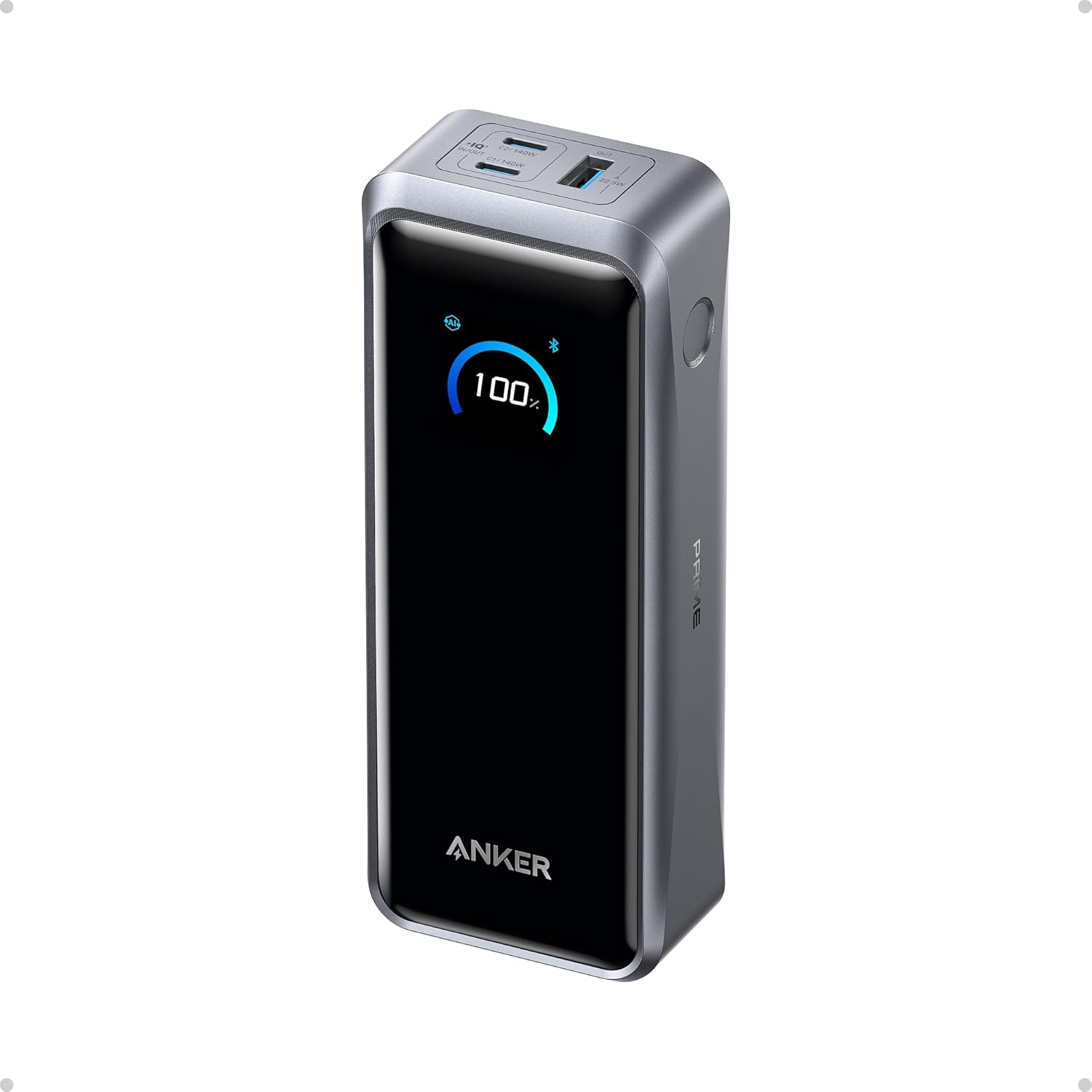
Anker Prime Power Bank is designed to keep you charged through it all if you depend on your gadgets to get actual work done on the fly. The 26,250 mAh battery can power up to 300W across two USB-C ports and one USB-A port, which means you can charge another device while two MacBook Pros are running at full speed.
For those times when every second counts, a single USB-C connector and a 5A cable may provide rapid charging of up to 140W. Useful for those times when you’re in the middle of meetings, flights, or classes—it can fully charge a MacBook Pro (M4 Pro) in approximately 27 minutes or an iPhone 16 Pro in about 26 minutes.
In addition, it may recover fast. This portable charger has two USB-C ports and a maximum input power of 250W; it takes only 13 minutes to charge to 50% and roughly 60 minutes to reach full capacity. That implies you can get hours of usable power back with just a little break.
You get more information and control than with a regular power bank thanks to the clever digital screen and app. The app allows you to monitor the charging status of the charging station and the power bank in great detail, and you can even tailor the output power to meet the specific demands of each device.This is the perfect smart power bank to anchor your trip or daily carry gear if you’re looking for a high-capacity, rapid option.
2. Anker Laptop Power Bank
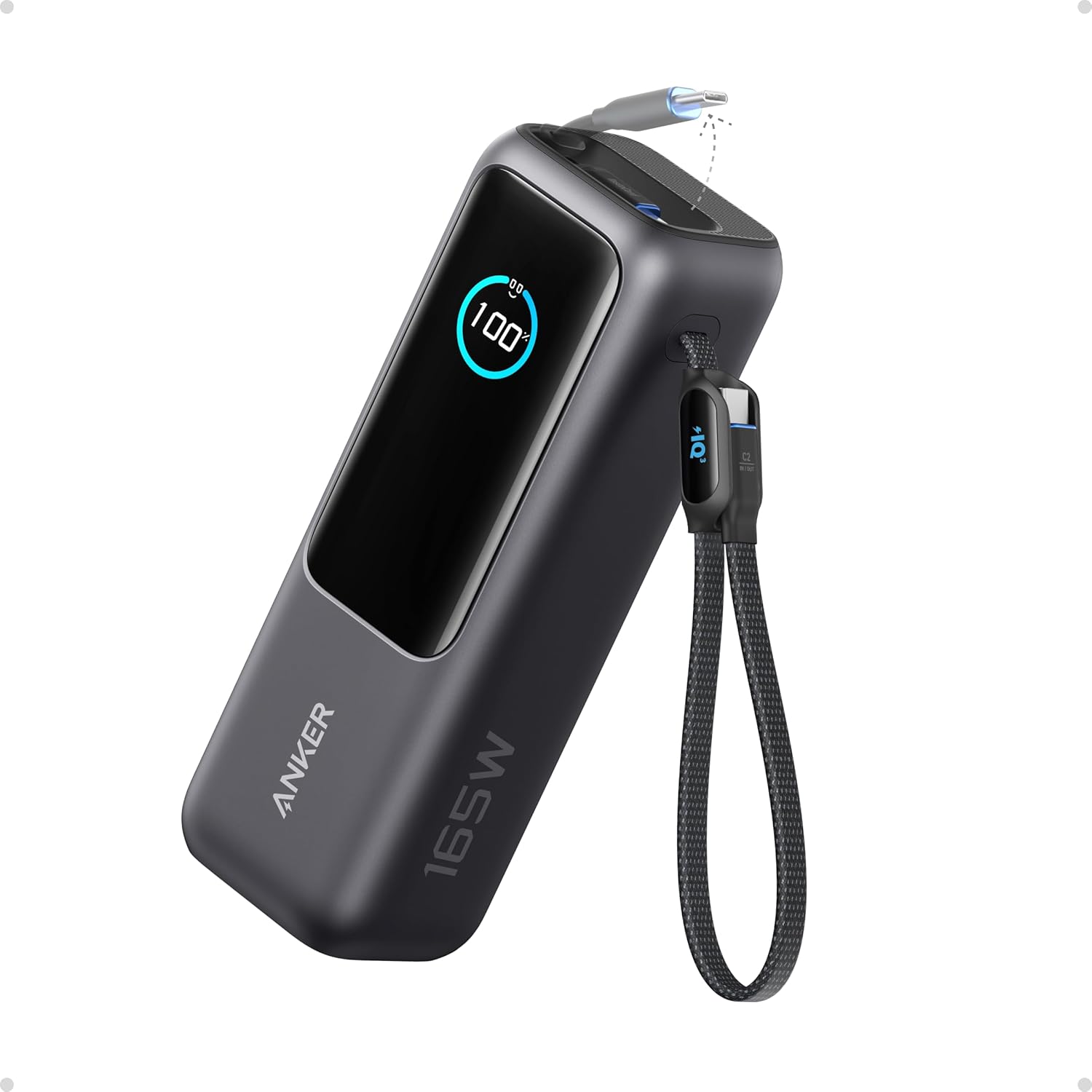
The Anker Laptop Power Bank is designed to keep several devices working smoothly, whether you’re juggling a laptop, phone, tablet, and more. You won’t have to pick between charging your MacBook and other devices thanks to the three USB-C ports, each of which can supply up to 100W.
Long days and journeys are no match for the 25,000mAh battery. You can charge your laptop, phone, or tablet numerous times, and when the power bank runs out, you can get it back to 30% in 22 minutes with the 100W ultra-fast recharging feature—ideal for those little breaks in the middle of a long day of meetings, flights, or lectures.
Look, there’s no need to dig for additional cables. You can always use the two built-in USB-C cables. An option that has been tested for more than 20,000 retractions may stretch up to 2.3 feet, providing you with more reach whether you’re working at a desk, in an airport, or at a café. A sturdy carrying strap that can endure over 20,000 twists and still makes the power bank easy to grab and go is built into the shorter 0.98-foot cord.
At a glance, you can view the charging state and remaining power on the clear digital display, so you know exactly how much backup you have.If you’re looking for a portable power bank that’s ready to go, has a large capacity, and can do multiple tasks at once, this one is a great choice.
3. Anker MagGo Power Bank

The Anker MagGo Power Bank is ideal for people who are constantly on the go but despise being tethered to a cord. Quicker, safer, and more efficient power is yours with Qi2-certified 15W wireless charging compared to regular wireless pads. It just takes about 44 minutes to charge an iPhone 15 series device from zero to fifty percent, which is great for those times when you only have a short break.
You can rest easy during long days, trips, or evenings out on the town thanks to the 10,000mAh capacity, which provides enough backup power to secure about 1.8 charges for your iPhone 15 Pro. Is there no electrical outlet? There is no need to worry; you have dependable power on hand.
Your battery state is always visible, so there’s no room for guesswork. To help you select when to charge your phone or power bank, the smart display offers important facts like remaining power and expected recharging times.
An additional level of practicality is provided by the integrated stand. Watch videos, join video conversations, follow recipes, or navigate without holding your phone—all while it charges—in either portrait or landscape mode.This MagGo model is ideal if you’re looking for a small power bank that offers quick wireless charging, easy-to-understand data, and everyday convenience—it will blend in with your bag, workstation, and routine with ease.
4. Anker Travel Essential Power Bank

The Anker Travel Essential Power Bank can keep your gadgets powered up no matter where you are, perfect for those who are always on the move and despise worrying about running out of juice. You can charge your laptop, tablet, and phone all at once with the 87W total output that can be split among three devices. With 65W available to a single device, you can rapidly charge a 14″ MacBook Pro to 50% in less than 40 minutes—ideal for in-flight or classroom use.
Charging is made more easier with the built-in USB-C connection. In under thirty minutes, you can get your MacBook Air or iPhone 15 Pro up to around 52% without taking out any more wires from your backpack. Short breaks nevertheless provide plenty of backup power since when the battery bank runs low, it can be fully recharged in around 1.5 hours when paired with a 65W charger.
You may keep it in your carry-on without worrying about screening at airport security because to its 20,000mAh capacity and the fact that it provides longer use for all your critical devices.With a built-in USB-C cable that can endure over 10,000 bends, you can charge your device reliably every day without worrying about it getting tangled up in your backpack.
You may easily incorporate this power bank into your daily carry and travel routine if you’re looking for one that is fast, sturdy, and truly portable. It enables actual multitasking, meaning it can charge not only phones but laptops as well.
5. Anker PowerCore 10K Power Bank
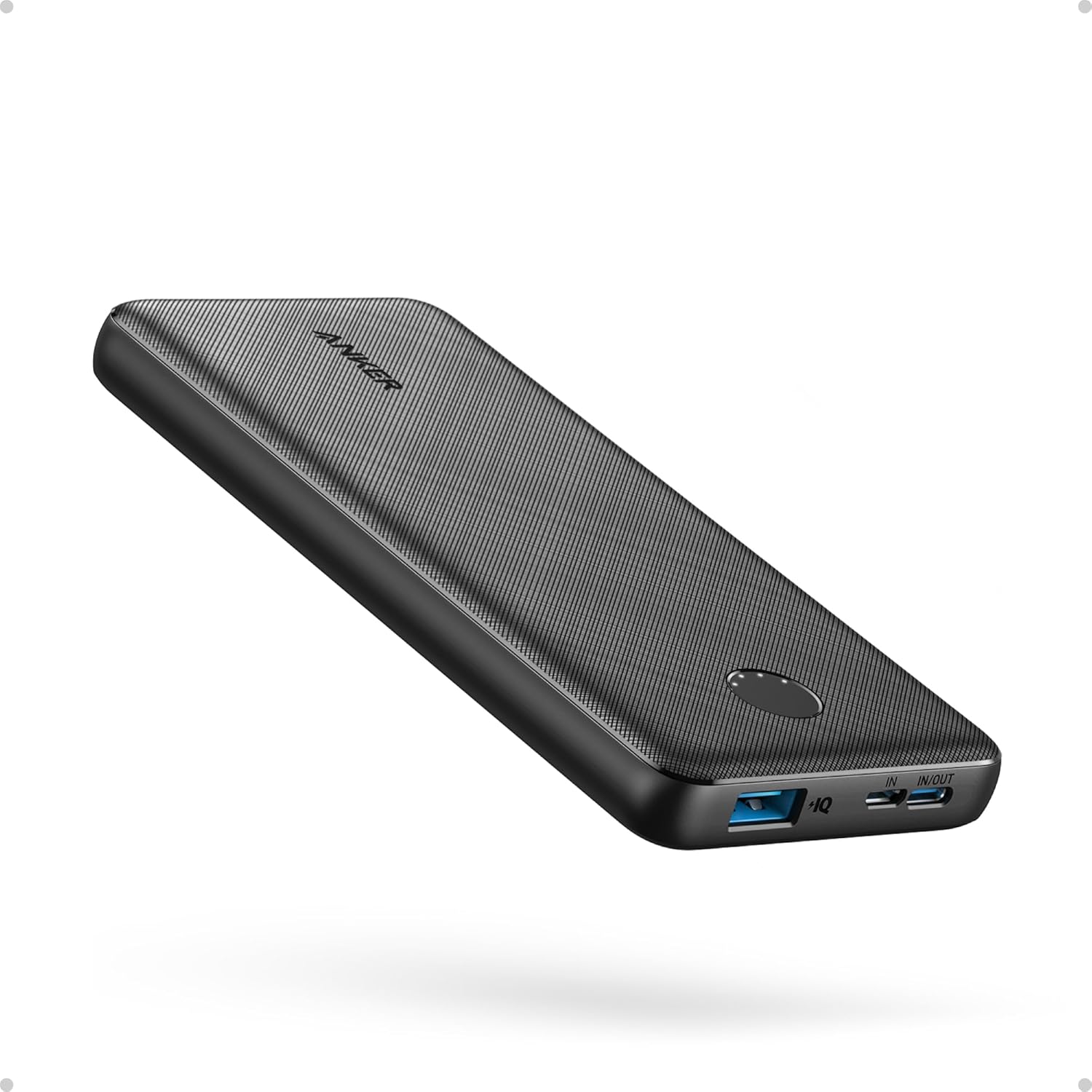
The Anker PowerCore 10K is created to provide ample power without adding unnecessary weight, making it an ideal choice for those who desire a portable backup solution. You can get through long days, travel, or back-to-back meetings with ease because to the 10,000mAh capacity. It can charge an iPhone 15 approximately two times, a Galaxy S23 about 1.93 times, or an iPad mini 6 around 1.23 times.
It retains its small profile and light weight of 8.6 oz., even if it has a large capacity. You won’t feel like you’re lugging around a brick to keep your phone charged because it fits conveniently into a tech pouch, small backpack, or pocket.Everyday use—whether it’s slipping across a desk, riding in a backpack, or bouncing around in a carry-on—will not damage the shell because of its engineering that prioritizes robustness and scratch resistance.
Your setup will be simplified by the USB-C port’s ability to handle both input and output. Streamline your gear and routine by using the same USB-C cable to rapidly charge the power bank and then reverse the process to fast charge compatible devices.If you’re in the market for a thin, dependable power bank that strikes a good mix between portability and practical capacity, the PowerCore 10K is an excellent choice.
Things to Consider Before Buying a Anker Power Bank:
Anker power banks vary in capacity, output, and features, so before you buy assess your charging needs, device compatibility, charging speed, battery capacity (mAh), port types, pass-through charging, build quality, warranty, and portability to ensure the model matches how you use and carry power on the go.
Portable vs. Stationary
You should pick portable banks (5,000-20,000 mAh) when you need daily mobility-most weigh 150-400 g and support PD 18-30 W for phones and small laptops. Stationary units or power stations (>300 Wh) serve home backup and extended off‑grid use, offering AC outlets, higher continuous wattage (300-1500 W), and slower recharge times; plan for size and transport limits if you travel with them.
Capacity and Output Options
You want capacity and per‑port output to match your devices: a 10,000 mAh pack typically yields ~2 full phone charges, 20,000 mAh handles tablets and multiple phones, while 30,000+ mAh can support laptops paired with 45-100 W PD. Check simultaneous output – a bank rated 65 W total may split into 45 W + 18 W across ports, reducing speed when both are used.
Delve deeper into specs by converting mAh to watt‑hours: multiply mAh by battery voltage (nominal 3.7 V) and divide by 1000 – e.g., 20,000 mAh ≈ 74 Wh, which is under the 100 Wh airline limit; between 100-160 Wh requires airline approval, and >160 Wh is typically prohibited in carry‑on. Also factor in conversion losses (roughly 10-15%) and cable quality: a USB‑C 100 W cable with PD 3.1 enables laptop charging at full speed, while older cables cap at 60 W. You should verify per‑port protocol support (PD, PPS, QC) and rated simultaneous output to ensure your phone, tablet, and laptop all charge at expected speeds.
Battery Capacity
You’ll want to match mAh to your usage: a 10,000 mAh Anker typically yields about 2-3 full charges for a 3,000-3,500 mAh smartphone after conversion losses, while 20,000-26,800 mAh units can provide 4-8 charges. Consider that power conversion efficiency is often 60-75%, so a 20,000 mAh bank rarely delivers the full advertised amount; factor that when planning multi‑day trips or charging power‑hungry tablets and laptops.
Number of Ports
Check both port count and per‑port output: many Anker models offer 2-3 ports, including at least one USB‑C PD port delivering 18-45W and one or two USB‑A ports at 5-12W. Prioritize banks that list simultaneous output limits-if a model states 45W total, two devices sharing it will charge slower than when used alone. You should align port types with your devices for fastest charging.
For more detail, consider use cases: if you routinely charge a laptop, your bank needs a single USB‑C PD port capable of 30W+ (some Anker PD units hit 60W+), whereas charging multiple phones benefits from several 12W+ ports. Also verify whether the bank supports dynamic power distribution-some models limit total output so two devices at once split available watts, which elongates charge times; choose a model whose simultaneous output matches your typical device mix.
Advantages
You get proven performance across capacities, with models from 10,000 mAh for daily use to 26,800 mAh for multi-day travel, plus MultiProtect safety and an 18-month warranty. Many units support USB-C Power Delivery or Quick Charge, so you can refill a phone to 50% in ~30 minutes on capable models, and simultaneously top up multiple devices without large efficiency losses.
Disadvantages
You’ll notice weight and recharge time grow as capacity increases-20,000 mAh packs often weigh 350-450 g and can take 6-10 hours to refill on an 18W charger. Pricing also skews higher than budget brands, and not every model supplies enough wattage for larger laptops.
In practice, if you need laptop charging, check for PD ratings of 30W or higher; otherwise a phone-focused 18W Anker will be slower for MacBook or larger Ultrabook charging. Likewise, expect a trade-off when charging multiple devices: a 45W-capable model may split output and slow individual ports. For travel, weigh capacity versus carry weight-if you prioritize pocketability, the 10,000 mAh Slim series is a better fit than a 26,800 mAh power house that can exceed airline carry-on allowances in checked baggage rules in some jurisdictions.\
Assessing Your Needs
Estimate real usage: a 3,000mAh phone typically gets about 1.8-2 full charges from a 10,000mAh bank after 60-70% conversion losses, while a 20,000mAh bank may yield ~3-4 charges. For laptops, target USB‑C PD at 45-60W and 20,000-30,000mAh depending on battery size; if you need a single full notebook charge, plan on 30,000mAh+. Factor how often you can access mains and whether fast recharge matters to you.
Brand Reliability
When evaluating Anker, inspect safety suites and support: its MultiProtect system (temperature control, surge and short‑circuit protection) plus standard UL/CE/FCC certifications lower failure risk. You should filter for models with thousands of verified reviews and average ratings above 4 stars; Anker commonly offers an 18‑month warranty and responsive customer support to handle defects or capacity issues.
Dig deeper by checking independent tests and lifecycle specs: look for published cycle counts (some banks list 300-500 cycles) and throughput tests showing ~60-70% energy transfer-meaning a 20,000mAh unit often delivers about 12,000-14,000mAh usable. Scan forum threads for RMA turnaround times and verified replacement experiences, since quick, documented support indicates the brand will back higher‑end units over time.
Proper Charging Techniques
You should match the charger to the power bank’s labeled input-many Anker models accept USB‑C PD 18W or up to 20W-use a short, high‑quality USB‑C cable to minimize voltage drop, and avoid charging in ambient temperatures above 45°C; charging while the pack is powering heavy loads can raise internal temperature by 5-10°C, so pause heavy discharge during top‑ups to reduce thermal stress and preserve cycles.
Storage Methods
You should store your power bank at 40-60% state of charge in a cool, dry place around 15-25°C (59-77°F) with humidity under 60%; expect Li‑ion self‑discharge of roughly 2-5% per month, so plan to check and top up every three months, and never leave the unit fully discharged for extended periods.
For long‑term storage beyond six months, set the pack to ~50% SOC, place it in a padded container away from heat sources and direct sunlight, and avoid trunks or attics where temperatures swing; note that battery aging roughly doubles for every 10°C rise, so storing at 25°C instead of 35°C can materially preserve capacity over years.
Conclusion
So you should weigh capacity, output power and charging speed against size and weight, confirm compatibility with your devices and cables, check safety features and warranty, and consider real-world reviews to verify performance; by prioritizing what you need, you’ll choose an Anker power bank that reliably matches your usage and travel habits.
Leave a Reply