
Best Car Amplifiers can turn weak factory audio into powerful, clear sound you’ll love on every drive. If your stereo feels flat or lacks bass punch, this guide cuts through confusing specs to show real-world top picks and buying tips. From hands-on tests and expert reviews, we highlight car audio and subwoofer amp options that boost power and clarity. Get ready for thrilling, jaw-dropping sound – read on to find the perfect amp.
Contents
- Top 7 Car Amplifiers:
- 7: Taramps TS 400X4 400W RMS 4-Channel Car Audio Amplifier
- 6: BOSS Audio Systems R1100M 1100 Watt Monoblock Car Amplifier
- 5: Pioneer GM-A3702 500W Max Class AB Bridgeable 2-Channel Car Amplifier
- 4: Skar Audio RP-1200.1D Monoblock Class D MOSFET Amplifier
- 3: Stinger Audio MT-1000.5 Compact 5-Channel Class D Car Audio Amplifier
- 2: Rockford Fosgate Prime R2-500X4 500-Watt 4-Channel Amplifier
- 1: Kicker 47KEY2004 KEY 4-Channel DSP Smart Amplifier
- Things to Consider Before Buying a Car Amplifier:
- Mono and Multi-channel Units
- Bridgeable Options
- RMS vs Peak Power Ratings
- Impedance Compatibility
- Assessing Current System Needs
- Measuring Available Space
- Class A/B vs Class D Performance
- Compact vs Full-Size Chassis
- Wiring Gauge Selection
- Cooling and Ventilation
- Summing up
Top 7 Car Amplifiers:
7: Taramps TS 400X4 400W RMS 4-Channel Car Audio Amplifier

If you want to get the most out of your factory speakers on a tight budget, go no further than the Taramps TS 400X4.A few feeble watts are sent to each door by your stock radio. Boost the volume and the sound becomes warped. That is resolved by the TS 400X4.First, 100 watts each channel at 2 ohms, for a total of 400 watts of Class D power.Up next: remote controls with automatic power on. It eliminates the need for a new head unit by connecting directly to the factory speaker cables.
At long last, there’s an integrated crossover with high-pass, low-pass, and full-range modes. This way, each speaker can focus on its strengths.Downside: There’s only 2 ohms of power, so 4-ohm speakers won’t get the full effect. There is no subwoofer beef.This is the best option for budget-conscious OEM stereo owners. Buildings with a lot of bass components are not recommended.
6: BOSS Audio Systems R1100M 1100 Watt Monoblock Car Amplifier
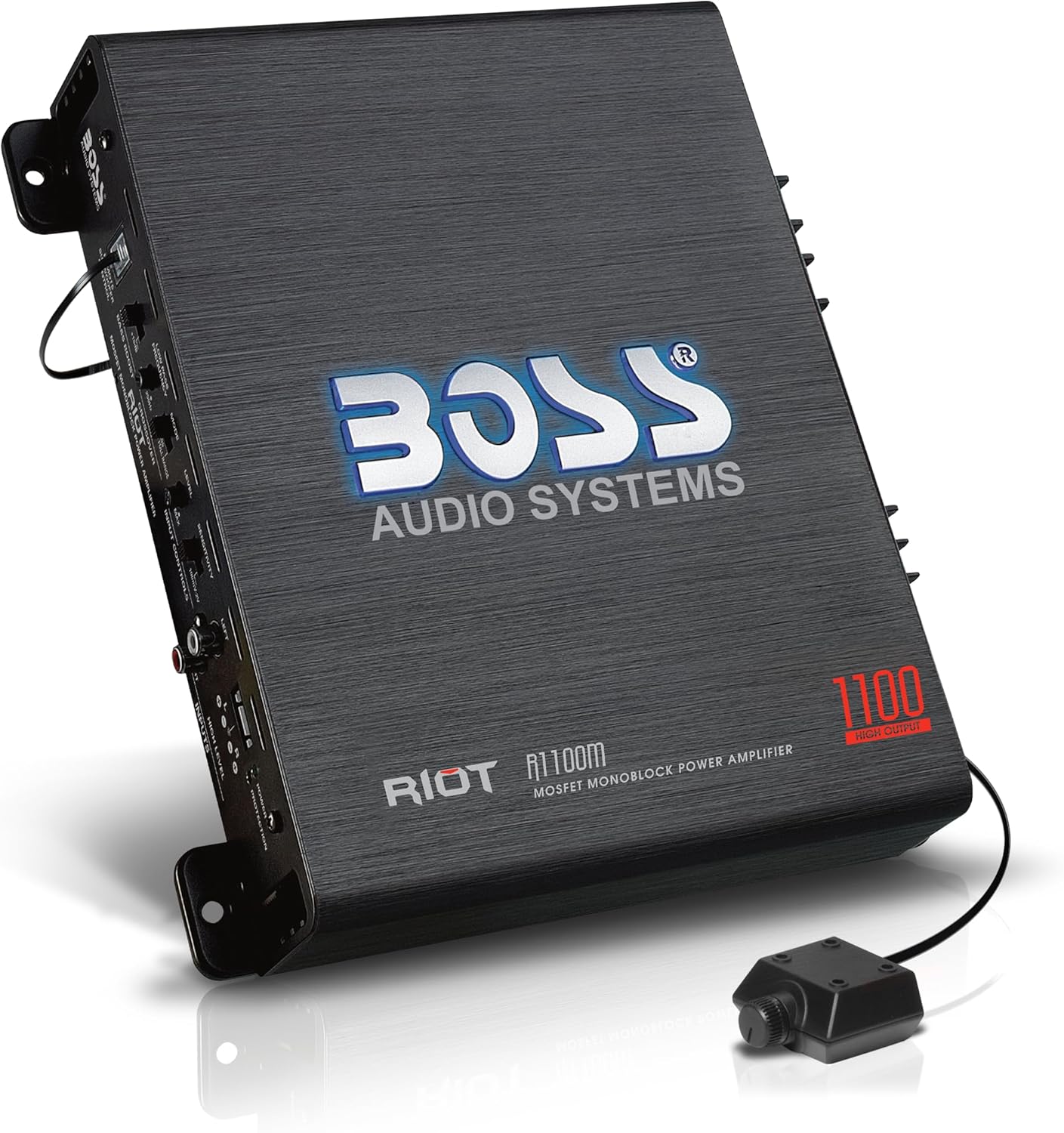
The finest entry-level subwoofer amplifier on a budget is the BOSS Audio R1100M.Doorstop speakers aren’t designed to handle low-frequency audio. A subwoofer is required, and each subwoofer requires its own amplifier.The first component is a bass-specific monoblock amplifier with a maximum power rating of 1,100 watts at 2 ohms.The next step is to connect the subwoofer to the system remotely. From your seat in the driver’s seat, you can adjust the bass level.
Lastly, it is compatible with both factory and aftermarket stereos; it has speaker-level and RCA inputs, as well as a low-pass filter and bass booster.Downside: regular use will use significantly less power than the maximum of 1,100 watts (not continuous RMS). Violating stability at 2 ohms may be problematic.Apt for: novice bass makers using a single entry-level subwoofer. Understood: subwoofers with a high output.
5: Pioneer GM-A3702 500W Max Class AB Bridgeable 2-Channel Car Amplifier

Among well-known brands, the Pioneer GM-A3702 stands out as the top 2-channel amplifier.Upgrading with four channels isn’t always necessary. The front speakers should be louder and clearer sometimes.To start, it has a significant improvement over any factory radio at 60 watts RMS per channel.The next step is to add 190 watts RMS by bridging the two channels, which will give you enough power to run a single compact subwoofer instead of two.
Last but not least: a subwoofer-optimized Class AB design with adjustable 80 Hz low-pass filter and little crossover distortion.Two channels only; the back speakers continue to use the factory settings. The maximum power rating, not the RMS, is 500 watts.Ideal for: compact single-sub configurations and front-stage modifications. Intended use: systems with all four speakers.
4: Skar Audio RP-1200.1D Monoblock Class D MOSFET Amplifier

When it comes to powerful bass, nothing beats the Skar Audio RP-1200.1D.Installing a decent subwoofer quickly exhausts a cheap amplifier. That load is designed into the RP-1200.1D.First, real continuous power for demanding subwoofers: 1,200 watts RMS at 1 ohm and 1,600 watts peak.Up next: stability at 1 ohm. Connect numerous subwoofers in series without sacrificing output.
Lastly, there’s a bass equalization switch and a remote control for the volume; you can adjust the boost from 6 to 12 dB at 45 Hz.The response stops at 250 Hz, which means it can’t power door speakers; it just plays bass. Power wire that is heavy-gauge is required.Those who enjoy deep bass should run a pair of high-output subwoofers. Not for: those seeking only more audible speakers.
3: Stinger Audio MT-1000.5 Compact 5-Channel Class D Car Audio Amplifier

One of the greatest amplifiers for a full system is the Stinger MT-1000.5.With a subwoofer and four speakers, you’ll often need two amplifiers and double the amount of wire. With just one chassis, the MT-1000.5 can manage everything.First, there are five channels: 75 watts each speaker + 300 watts per 4 ohm subwoofer.Afterward, a little Class D chassis that can tuck beneath a seat and stands about two inches tall.
And lastly, a remote bass knob is featured, and there are inputs for both factory and aftermarket stereos.The length (more than 13 inches) still necessitates preparation. Dedicated monoblocks are more suitable than the sub channel.Ideal for: completely enclosed systems with little room to spare. Not recommended for: high-powered bass-heavy setups.
2: Rockford Fosgate Prime R2-500X4 500-Watt 4-Channel Amplifier

The top-tier Rockford Fosgate Prime R2-500X4 4-channel amplifier for precise, undistorted sound.The gain is usually off, which is the main cause of an amp’s poor sound quality. It clips and distorts if it’s too high. The uncertainty is taken away with the R2-500X4.To start, the C.L.E.A.N. circuitry provides maximum power without clipping, allowing you to fine-tune the gain to your sound system.
Next, each channel can handle 75 watts RMS at 4 ohms, 155 watts at 2 ohms, or 250 watts when connected to a subwoofer via a bridged pair of channels.Last but not least, Punch EQ fixes the car’s acoustics’ weak points and adds adjustable crossovers on top.The most costly option here is a drawback. Bridging or adding a second amplifier is what a subwoofer is. Mechanical tuning is still used.that it’s best for: customers that value longevity and accuracy in tuning. Do not use: when money is tight.
1: Kicker 47KEY2004 KEY 4-Channel DSP Smart Amplifier
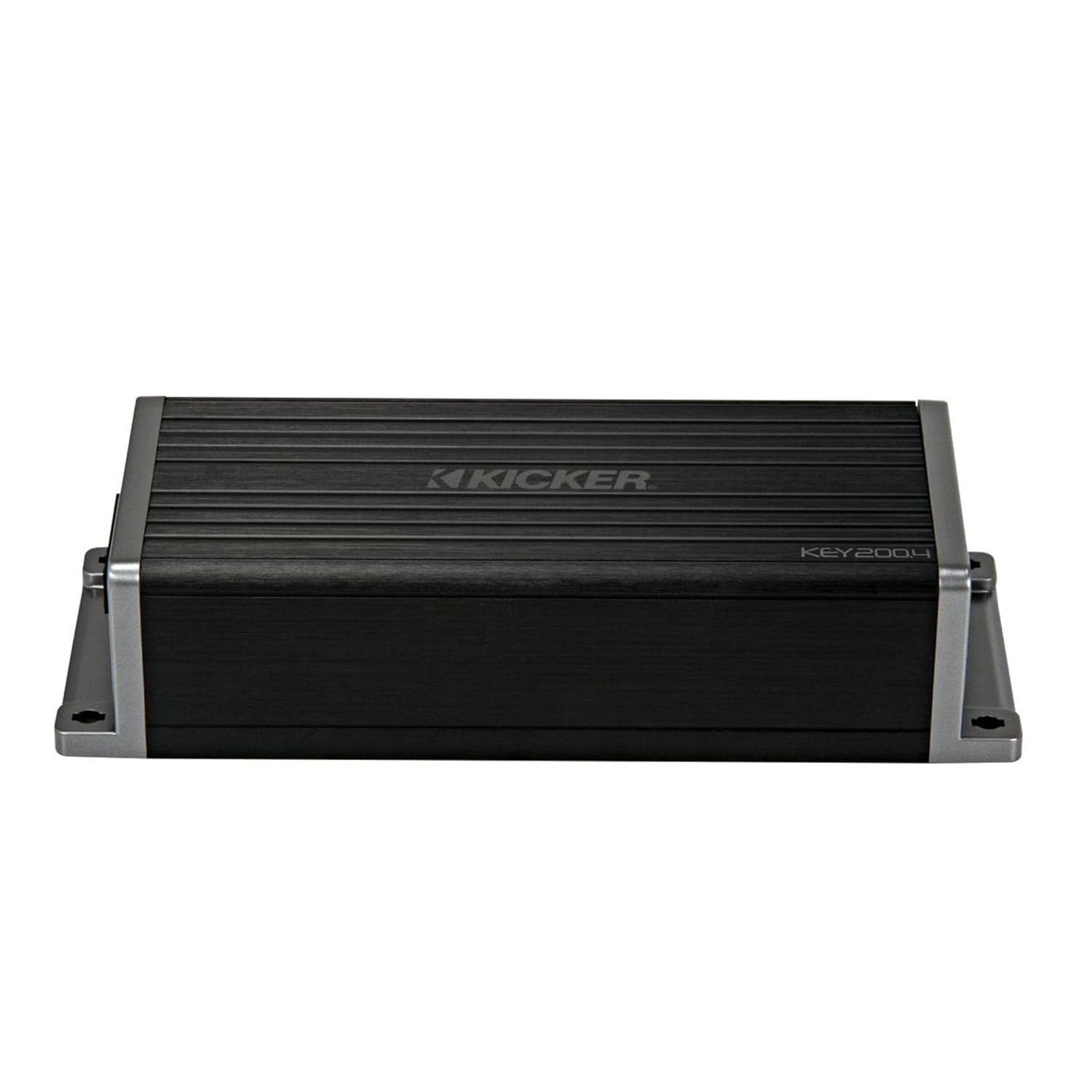
The Kicker KEY200.4 is the best vehicle amplifier because it is a smart amp that can upgrade a stock radio.Having power is the simple part.To get a system to sound well, tuning is required, and it usually requires an expert and a lot of time.It is done autonomously by the key.A first step: adjusting by itself. With the push of a button, the integrated processor and microphone will quickly assess your cabin and fix the noise. Nobody else’s amplifier performs what this one does.
Secondly, the peaks and valleys produced by automobile interiors can be corrected with a 40-band equalization.As a third point, 24-decibel crossovers ensure that each speaker receives only audible frequencies.Fourth, a small chassis delivering 50 watts to each of its four channels.Downside: The amp prioritizes clarity over volume, and its 50 watts per channel are somewhat small. No separate output for the subwoofer.The ideal choice for factory stereo owners seeking the most significant improvement in sound quality with minimal effort.Avoid: constructions that prioritize bass.
Things to Consider Before Buying a Car Amplifier:
Investing in a car amplifier can significantly enhance your audio experience, transforming ordinary sound into high-quality audio. Before making a purchase, consider key factors like power output, channel configuration, and compatibility with your existing system. Each choice influences not only sound quality but also the overall value of your investment.
Mono and Multi-channel Units
Mono units, composed of a single channel, excel in driving subwoofers, delivering powerful bass. In contrast, multi-channel amplifiers can support multiple speakers within a system, allowing for a broader soundstage. For instance, a 4-channel amplifier can manage front and rear speakers, creating a more immersive listening experience. Choosing between these options depends largely on your specific audio setup and how many speakers you intend to connect.
Bridgeable Options
Bridgeable amplifiers allow for flexible configuration by combining two channels into one, effectively doubling the output power applied to a single speaker. This option can be particularly beneficial when pairing with subwoofers that require increased power. For example, a typical 2-channel amplifier that can operate in bridge mode may deliver twice the power to a single subwoofer compared to its standard output. Evaluating whether this configuration fits your audio needs can significantly enhance your system’s performance.
RMS vs Peak Power Ratings
A clear distinction between RMS and peak power ratings will inform your purchasing decision. RMS power reflects the continuous power output an amplifier can deliver, whereas peak power indicates the maximum output for short bursts. Relying on RMS ratings is more reliable for evaluating the performance you can expect during regular use. Confirming that the RMS power output aligns with your speakers’ handling capability helps prevent damage and ensures a harmonious audio experience.
Impedance Compatibility
Impedance compatibility between the amplifier and speakers plays a significant role in sound quality. Most amplifiers operate at either 2, 4, or 8 ohms, requiring you to match these ratings for optimal performance. Installing a speaker with a lower impedance than the amplifier can result in overheating and potential failure. Conversely, using a higher impedance speaker may lead to lower output levels. Ensuring these components align will significantly enhance your listening experience.
Assessing Current System Needs
Evaluating your existing audio system is essential for selecting the right amplifier. Examine the specifications of your speakers, including their power ratings and impedance. Understanding these factors will ensure compatibility, allowing the new amplifier to enhance audio performance without overloading your current setup. Analyze your listening habits, whether it is daily commutes or road trips, to determine the power output required for your typical scenarios.
Measuring Available Space
Measuring the available space in your vehicle should be your next step. Utilize a tape measure to find precise dimensions of potential installation areas, factoring in any obstructions like wiring or components. This careful measurement helps eliminate options that won’t fit and ensures your selected amplifier’s placement allows for optimal airflow. A well-fitted amplifier not only functions better but also maintains longevity within your audio system.
Class A/B vs Class D Performance
Choosing between Class A/B and Class D often boils down to your performance priorities. Class A/B amplifiers provide exceptional sound quality, making them ideal for audiophiles seeking accurate reproduction. However, they can become hot and consume significant power. In contrast, Class D models excel in efficiency and are perfect for smaller, power-sensitive installations. While they may not match the audio fidelity of Class A/B units, advancements in Class D technology continue to close the gap.
Compact vs Full-Size Chassis
Compact chassis models tend to offer space-saving benefits, ideal for smaller vehicles or more minimal installations. Despite their size, some maintain impressive power output and sound performance. Full-size chassis amplifiers usually include larger heat sinks and more robust circuitry, contributing to better overall performance and heat management. Larger units often provide better audio fidelity due to superior components, making them a suitable choice for those prioritizing sound quality over space constraints.
Wiring Gauge Selection
Choosing the right wiring gauge significantly affects your amplifier’s performance. Thicker wires (lower gauge numbers) carry more current without overheating, which is essential for high-output systems. For instance, a mid-sized amplifier may require a 4-gauge wire for optimal performance, while smaller models often suffice with 8-gauge wire. Always double-check the manufacturer’s recommendations to ensure your wiring capacity matches your amplifier’s energy demands.
Cooling and Ventilation
Proper cooling and ventilation are crucial for amplifier longevity, as excessive heat can damage components. Ensure that your amplifier is installed in a well-ventilated area, away from direct sunlight or enclosed spaces. Incorporating additional cooling fans can help maintain an optimal operating temperature, particularly in high-power setups. Adjusting the installation angle of the amplifier may also improve airflow, aiding in heat dissipation for more consistent performance.
Summing up
Purchasing a car amplifier involves several key elements that directly impact sound quality, system compatibility, and overall performance. Understanding power ratings and impedance ensures that your amplifier works harmoniously with your speakers. Budget constraints should also guide your choice, allowing for a balance between cost and feature set. Familiarity with installation options can enhance longevity and functionality, elevating your listening experience considerably. Taking these factors into consideration can lead to a well-informed decision that enhances your audio enjoyment.
Leave a Reply