
Searching for the best Dolby Atmos soundbars to upgrade your setup? Stop settling for flat, tinny TV audio that kills the vibe. We tested the top models to help you create a thrilling home theater experience. You deserve breathtaking, immersive audio that makes every movie night feel cinematic and alive. Ready to hear what you’ve been missing? Let’s dive into the top-rated options available now.
Contents
- Top 5 Dolby Atmos Soundbars:
- 1. SAMSUNG Q990D Dolby Atmos Soundbar
- 2. Polk Audio Signa S4 Dolby Atmos Soundbar
- 3. Bose Smart Dolby Atmos Soundbar
- 4. SAMSUNG S60D Dolby Atmos Soundbar
- 5. Hisense AX3120Q Dolby Atmos Soundbar
- Things to Consider Before Buying a Dolby Atmos Soundbar:
- Soundbar with Built-in Speakers
- Soundbar with External Speakers
- Room Size and Acoustics
- Compatibility with Existing Setup
- Benefits of Enhanced Sound Experience
- Limitations and Drawbacks
- Brand Reputation and Reviews
- Assessing Your Needs
- Comparing Models
- Positioning for Optimal Sound
- Connecting to Devices
- Conclusion
Top 5 Dolby Atmos Soundbars:
1. SAMSUNG Q990D Dolby Atmos Soundbar

Designed to turn your home theater into a genuine surround experience, the SAMSUNG Q990D Dolby Atmos Soundbar will make your TV sound as large and immersive as it appears. Q-Symphony allows the speakers and soundbar of a compatible Samsung TV to collaborate, optimizing each channel for a more expansive and detailed soundscape.
Included in the package is some serious gear: a rear speaker kit, four up-firing channels, a powerful subwoofer, and eleven front-facing speakers.What this implies is that the sound isn’t only focused in the front; rather, it seems as though the music, effects, and speech are emanating from all directions.Enjoy great, height-rich audio without the hassle of additional HDMI cords with Wireless Dolby Atmos. With this setup, you can enjoy expansive sound with crystal-clear effects from every seat in the room thanks to the system’s use of the room’s roof and walls to reverberate and build deep, layered sounds.
A smart hub for controlling your devices is also included in the package. All of your favorite apps and built-in features like AirPlay 2, Chromecast, and Alexa make it easy to stream, control, and manage audio.Finally, the soundbar takes into account your room’s dimensions and automatically modifies its output to provide well-balanced, crystal-clear sound. If you want to elevate your home theater experience with a cinematic, intelligent, and truly immersive upgrade, this Samsung Q990D soundbar is here to support whatever you have.
2. Polk Audio Signa S4 Dolby Atmos Soundbar

Polk Audio’s Signa S4 Dolby Atmos Soundbar is an excellent choice if you’re looking for a way to elevate the sound quality of your TV to a dramatic level. It generates a more expansive and lifelike 3D surround sound environment than your TV speakers could ever hope to achieve, thanks to its powerful 7-driver array and Dolby Atmos processing.
So that sound effects and music don’t drown out conversation, you have a separate full-range center channel. To make talks easier to follow without continually cranking up the volume, you can adjust the voice levels to bring speech forward.You have command over the bass as well. The wireless subwoofer that comes with the bar works in tandem with it to produce powerful bass, and you can customize the bass response to your room’s dimensions and personal preference with Polk’s Bass Adjust technology.
The Signa S4 isn’t too difficult to deal with, even if it’s powerful. Its small height of only 2.36 inches makes it easy to mount on the wall or slide neatly in front of your TV without obstructing the screen. You can connect your phone or tablet to your TV and play music from it with ease thanks to the many available connections, including Bluetooth, optical, USB, and HDMI.The Signa S4 is an ideal upgrade for any movie night if you’re searching for a tiny, easy soundbar that provides immersive sound, crisper voices, and satisfying bass with only one setup.
3. Bose Smart Dolby Atmos Soundbar

The Bose Smart Dolby Atmos Soundbar is designed to enhance the immersive experience of your favorite media without overwhelming your home with unnecessary equipment. Using Dolby Atmos and Bose TrueSpace technology, it produces shockingly large surround sound, making movies, games, and programs feel more immersive.
Also, Atmos content isn’t the only option available to you. With its clever analysis, TrueSpace upmixes standard stereo or 5.1 audio into a roomier, multi-channel masterpiece. The sound is broader and more immersive, making even classic programs, live sports, or online films sound better.Five transducers, including two that fire upward, are housed inside the small frame in an advanced acoustic design. The upward-firing drivers contribute to the layered sound, making it seem more spacious even when there aren’t any other speakers positioned around the room.
Feel free to stream music in any way that suits you when the time comes. Just about any music you can play on your phone can be instantly sent to the speaker with built-in Chromecast, Apple AirPlay 2, or Bluetooth.Look no farther than this Bose model if you’re in the market for a small, stylish soundbar that not only enhances your TV’s audio but also serves as a top-notch music speaker and blends in seamlessly with your living room decor and everyday activities.
4. SAMSUNG S60D Dolby Atmos Soundbar

An all-in-one update for those who need immersive home theater sound but don’t want to clutter their room with gear is the SAMSUNG S60D Dolby Atmos Soundbar. With its integrated subwoofers and 5-channel Dolby Atmos audio, this small bar provides both deep bass and surround-style sound in a streamlined design.
Even without an HDMI wire, you can experience amplified 3D sound with Wireless Dolby Atmos. You may achieve the same overhead and around-you effect with less clutter in your setup.No worries if you like straightforward and intelligent solutions. You can stream music and operate it using the same methods you use your other devices thanks to the S60D’s built-in Alexa, Chromecast, AirPlay 2, and more.
Instead of leaving it up to you to adjust the settings, SpaceFit Sound Pro scans your area and adjusts the audio automatically to make sure it sounds balanced and clear no matter where you sit. Through real-time scene analysis and the lifting of crucial elements like conversation, Adaptive Sound improves voice recognition, even at low volumes.With Samsung TVs, Game Mode Pro activates automatically while you game, providing more accurate 3D sound cues with up-firing speakers and acoustic beam.
5. Hisense AX3120Q Dolby Atmos Soundbar
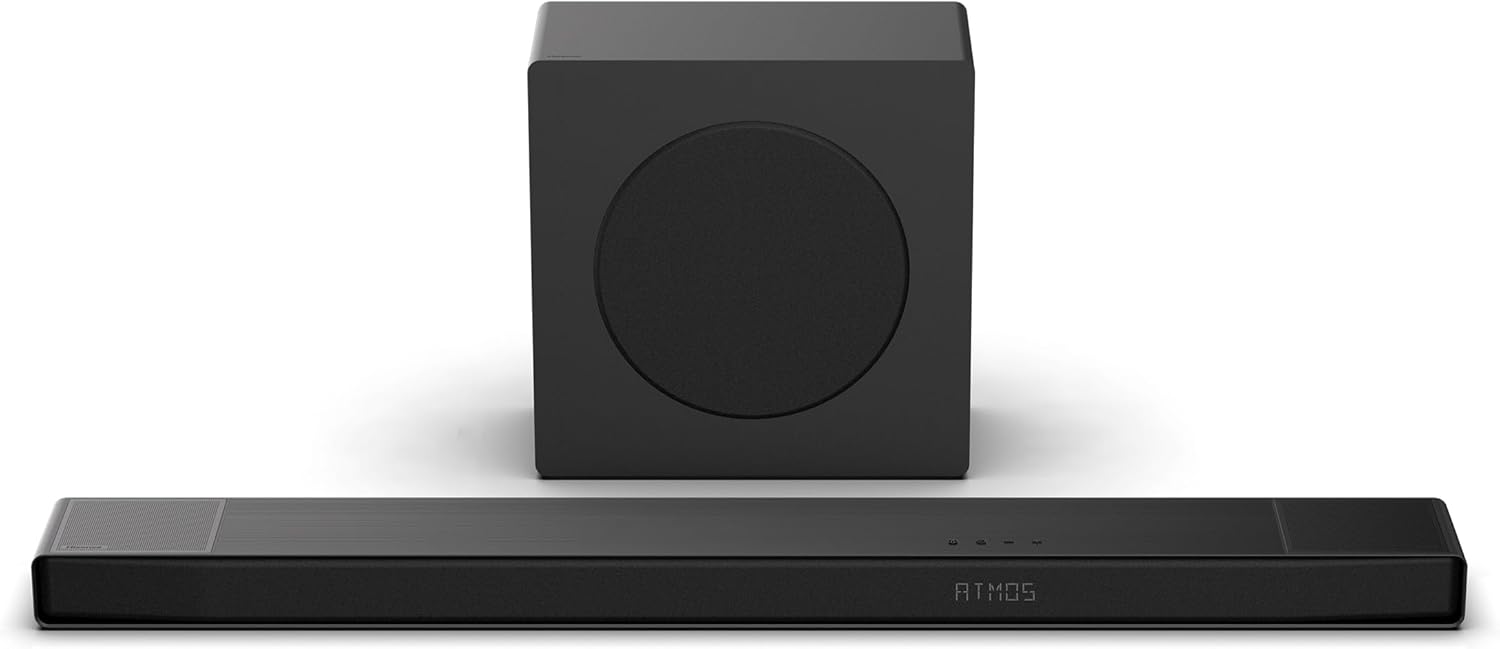
With the Hisense AX3120Q Dolby Atmos Soundbar, you can immerse yourself in the action on screen and hear every nuance of the soundtrack. The 3.1.2-channel configuration, which consists of five front-firing speakers, two up-firing speakers, and a robust 6.5″ subwoofer, allows for 440 watts of dynamic, distortion-free, room-filling sound.
The disparity in space and detail will be apparent to you. Sound, whether it’s effects, music, or dialogue, may now seem more rich and immersive thanks to technologies like Dolby Atmos and DTS:X.Additionally, you maintain command over the overall audio quality. Quick Touch EQ modes and seven on-screen presets make it easy to quickly and easily adjust the sound to suit various media types, including movies, music, news, and more. There is no need to repeatedly access menus, voices remain audible, and music remains interesting.
With the built-in Bluetooth 5.3, you can easily stream music or podcasts directly from your phone, tablet, or laptop, all while enjoying a stable and low-lag connection. You may easily connect to your current setup by HDMI and USB, making everything function together.This Hisense AX3120Q soundbar and subwoofer set is ideal for those who want a simple solution to transform their TV’s narrow sound into a genuine surround-style experience, complete with powerful bass, crystal-clear dialogue, and easy-to-use controls.
Things to Consider Before Buying a Dolby Atmos Soundbar:
There’s a lot to weigh when buying a Dolby Atmos soundbar, so you should assess your room size and acoustics, true height channels versus virtualization, HDMI eARC and pass-through support, compatible devices and codecs, subwoofer and bass needs, placement and calibration options, wireless ecosystem and latency, and how each feature aligns with your budget and listening priorities.
Soundbar with Built-in Speakers
You should pick a built-in model if you want minimal components and clean aesthetics; many use 7-11 drivers in 3.1.2 or 5.1.2 layouts with upward-firing drivers and an integrated or separate subwoofer, delivering good overhead cues and reliable HDMI eARC pass-through while keeping setup time under 30 minutes for most users.
Soundbar with External Speakers
You’ll get true discrete surrounds by adding wireless rear modules or powered satellites, commonly creating 5.1.2 or 7.1.4 layouts; expect a 30-50% price increase versus standalone bars, longer setup and placement decisions, but notably improved channel separation and localization for dedicated listening spaces.
Place rear speakers about 1.5-2.5 meters behind the listening position and 0.5-1 meter above ear level, match timbre between bar and rears, set subwoofer crossover around 80 Hz, and run room correction (e.g., ARC or Dirac) to align delays and frequency response; if choosing wireless rears check for low-latency links and power specs, while wired rears require confirming impedance and amp compatibility.
Room Size and Acoustics
You should match soundbar channels and output to room dimensions: compact 3.1.2 units suit rooms under ~20 m², while rooms above 30 m² benefit from true rear surrounds or multi‑driver 5.1.4+ setups. If ceilings exceed 3 m or surfaces are reflective, height effects will smear-add absorptive panels or rugs and aim for an RT60 near 0.3-0.6 s to preserve imaging; use a phone SPL app or test tones during setup to fine‑tune placement.
Compatibility with Existing Setup
Verify physical and digital compatibility before buying: if your TV lacks HDMI eARC you won’t get full Dolby Atmos from streaming apps-optical will downmix to Dolby Digital. Confirm you have at least two HDMI inputs for a game console and 4K Blu‑ray, and check for HDMI 2.1 if you use 4K/120 Hz gaming. Also check for AirPlay 2, Chromecast, and voice assistant support to fit your ecosystem.
When integrating with an AVR or multi‑device stack, routing matters: source‑to‑TV‑to‑soundbar via HDMI eARC lets streaming apps pass Atmos (Netflix/Disney+/Prime deliver Atmos as Dolby Digital Plus), while Blu‑ray discs use Dolby TrueHD + Atmos and require full bitstream over eARC or a direct source‑to‑soundbar HDMI run. If your TV only supports ARC or lacks eARC, plan to connect consoles/players directly to the soundbar; verify CEC, remote passthrough, and firmware update practices to maintain codec support.
Benefits of Enhanced Sound Experience
You’ll notice object-based mixing (3.1.2 or 5.1.2 setups) places effects overhead and around you, so helicopters and rain move with greater precision. Models such as the Sonos Arc or Samsung HW-Q900 deliver clearer dialogue and immersive atmospheres in movies and newer games, improving spatial cues for action scenes and letting you hear directional details that standard stereo or 5.1 setups typically miss.
Limitations and Drawbacks
You may find that ceilings outside the ideal 8-10 ft range, untreated walls, or sparse furniture weaken the height illusion, and many titles still lack Atmos tracks. Additionally, some budget bars simulate height channels, offering less accurate localization than discrete speakers, and full-resolution passthrough often requires HDMI eARC on both TV and source.
Digging deeper, you should expect variability: up‑firing drivers rely on predictable ceiling reflections, so rooms with acoustic treatments or very high/low ceilings (under ~8 ft or over ~12 ft) can degrade the effect. Streaming support exists across Apple TV+, Disney+, Netflix (select titles and plans), and Blu-ray discs, but catalog coverage is inconsistent, so verify if the content you watch is Atmos-enabled. Calibration tools-like Sonos Trueplay (iOS) or built-in room tuning-help, yet some bars still use virtualization rather than discrete height channels, producing a convincing but less precise 3D image compared with a properly installed ceiling or surround‑speaker system.
Brand Reputation and Reviews
Check specialist labs (Rtings, What Hi‑Fi, Sound & Vision) for measured frequency response, THD, and latency; consumer sites (Amazon, Best Buy) reveal real‑world reliability. Brands such as Sonos, Samsung, Sony, Bose, and Yamaha each have distinct strengths-Sonos often praised for streaming and firmware support, Samsung for channel count and value, Sony for immersive tuning. Use both lab scores and user feedback to weigh trade‑offs.
When digging deeper, look for at least 50 verified user reviews to spot consistent issues, and prioritize units with firmware updates over 12-18 months post‑launch. You should compare lab measurements (on‑axis response, impulse response) against subjective writeups; if multiple reviewers report firmware bugs, warranty claims, or degraded wireless connections, that signals manufacturer or QA problems. Warranty length (1-3 years) and responsive support are concrete indicators of long‑term value.
Assessing Your Needs
You should map your room (150-300 sq ft suits most 3.1.2 or 5.1.2 setups; >300 sq ft often needs 7.1.2 or wireless rears), note seating distance (6-12 ft affects imaging), and list content types-movies, gaming, music. Prioritize features: low-latency passthrough for gaming, eARC for lossless Atmos, and subwoofer power (100-300W) for bass. Set a budget aligned to those priorities so you avoid overspending on unused extras.
Comparing Models
When you compare, line up channel counts (3.1.2 vs 5.1.4 vs 11.1.4), measured SPL and THD from reviews, HDMI/eARC capabilities, and whether rears/subwoofer are included. For example, Sony HT-A7000 (7.1.2) is praised for precise imaging; Samsung HW-Q990C (11.1.4) delivers extensive object channels and deep bass; Sennheiser AMBEO emphasizes virtualization and expansive soundstage. Use side‑by‑side demos and check firmware update history before deciding.
Positioning for Optimal Sound
Center the soundbar under your TV and keep it unobstructed, with your main seat 8-12 ft away for balanced imaging; if the bar has up‑firing drivers ensure a ceiling height of about 8-10 ft so reflections hit at roughly 30-45°, avoid heavy acoustic tiles that absorb reflections, toe the bar slightly toward the listening position, and place the subwoofer within 1-3 ft of a wall for tighter low end.
Connecting to Devices
Prefer HDMI eARC for full Dolby Atmos passthrough-eARC supports lossless object-based formats while ARC or optical often downmix to 5.1; connect consoles like PS5 or Xbox Series X via HDMI 2.1 and enable bitstream/Atmos on the source, and use Wi‑Fi for streaming apps but expect lower latency and potential compression versus wired connections.
Run an Ultra High Speed HDMI 2.1 cable from your TV’s eARC port to the soundbar, enable audio passthrough and set the TV audio to ‘bitstream’ or ‘passthrough’, then choose Dolby Atmos tracks in apps (Netflix Ultra HD plan, Apple TV+, Disney+ when available); if you use multiple HDMI devices prefer the TV’s eARC or an AVR with eARC, set sources to output bitstream, and verify channel mapping with the soundbar’s test tones or an Atmos demo track.
Conclusion
So when choosing a Dolby Atmos soundbar you should weigh room size, speaker and upward-firing driver configuration, compatibility with your TV and source devices, and whether you need a separate subwoofer and wireless surrounds; assess true Atmos decoding and calibration features, available inputs, and budget to ensure the system matches your listening habits and space for immersive, accurate sound.
Leave a Reply