
Finding the best electric tankless water heater can transform your morning by ending those frustrating cold showers forever. Stop wasting money heating a bulky tank you never fully use. These small units provide unlimited on-demand hot water while cutting your power costs. We’ve tested the top models to help you save space and lower your monthly bills. Let’s dive into the top-rated options that will change your life.
Contents
- Top 7 Electric Tankless Water Heater:
- 7: EcoSmart ECO 11 Electric Tankless Water Heater
- 6: Titan Electric Tankless Water Heater
- 5: ECOTOUCH ECO270S 27kW Electric Tankless Water Heater
- 4: EcoSmart ECO 18 Electric Tankless Water Heater
- 3: Rheem RTEX-18 18kW Electric Tankless Water Heater
- 2: Rheem RTEX-24 24kW Electric Tankless Water Heater
- 1: Stiebel Eltron Tempra 24 Plus Electric Tankless Water Heater
- Things to Consider Before Buying a Electric Tankless Water Heater:
- Point-of-Use vs. Whole-Home Units
- Capacity and Multi-Fixture Models
- Calculating Flow Rate and GPM Requirements
- Impact of Regional Groundwater Temperatures
- Advantages of Energy Efficiency and Space Savings
- Limitations Regarding Electrical Load and Demand
- Determining Necessary Temperature Rise
- Determining Necessary Temperature Rise
- Evaluating Breaker Panel Capacity and Amperage
- Wire Gauge and Safety Compliance Standards
- Professional vs. DIY Installation Considerations
- Routine Descaling and Performance Upkeep
- Final Words
Top 7 Electric Tankless Water Heater:
7: EcoSmart ECO 11 Electric Tankless Water Heater

The most cost-effective tankless water heater for a single bathroom—the EcoSmart ECO 11.The water in your tank heater is always being heated, even when no one is in the house, wasting energy.The ECO 11 begins heating up as soon as you turn on the water.To start, in mild climes, a full shower of hot water requires 13 kilowatts at 240 volts.Next, our shower’s patented self-modulating technology ensures a 99 percent efficiency rating by drawing only the amount of power it needs.
One last thing: it can be wall-mounted and fits neatly behind a vanity or under a sink, measuring 11 by 8 inches.Downside: a separate 60-amp breaker is required; an upgrade is necessary for older 100-amp panels. Not big enough to accommodate a shower and a washing machine in the same room. Low-temperature flow decreases dramatically.A second bathroom is a great addition for homeowners in warmer climates. Do not use for: whole-house use or northern winters.
6: Titan Electric Tankless Water Heater

The Titan Electric Tankless, backed by an American brand, is the greatest small step-up option.Half of the inexpensive tankless heaters are generic models shipped in from far away. Titan has been doing this for a long time.Hot water, no applications, and firmware.Put it first: an analog dial that you can simply spin, set, and then leave alone. With no app, there will be no upgrades and no learning curve.
Following that, it has a 54-amp draw on regular 220 volts, so it fits neatly on a 100-amp panel and doesn’t require a service upgrade.Very little, about the size of a tissue box, wall-mount style. Squeezes into cramped utility rooms.Drawbacks: minimal user interface with no digital display or memory. Less flow than premium units operating on 240 volts. Slightly contemporary.Owners and tenants with small bathrooms who want a single task done properly will find this the best option. Do not use for: whole-house sound.
5: ECOTOUCH ECO270S 27kW Electric Tankless Water Heater

In the 27-kilowatt range, the ECOTOUCH ECO270S is your best bet for the money.Typically, a premium brand will be associated with whole-house tankless. You won’t need one to use the ECOTOUCH.For those looking for a no-frills brand that delivers big-time performance.To start, 27 kW at 240 V, which is equivalent to 6.5 GPM. Without any drops in flow, run two showers and a dishwasher.The following section will go over the four-layer protection system: dry-fire prevention, high-voltage block, leakage cutoff, and over-temperature shutdown. ETL approved.
Last but not least, a self-modulating power control system will only draw the amount of power that your tap actually uses. Minimizes wastage with light loads.Drawbacks: An upgrade to the panel is necessary for older homes, and three separate 40-amp breakers are necessary. Plumbers have a limited acquaintance with brands. Little to no control over the software.Who this is ideal for: homeowners in colder climates who are looking for full-house volume from a simple brand. Not recommended for: single-bathroom tenants or tiny houses.
4: EcoSmart ECO 18 Electric Tankless Water Heater

For residences in warmer climates, the most effective mid-range whole-house unit is the EcoSmart ECO 18.If you want to go tankless, you’ll typically have to decide between subpar point-of-use units or fancy whole-house systems. Most houses have middle-floor units.With 18 kW of EcoSmart technology that modulates itself, the ECO 18 is a tried-and-true middle ground option.And first, 18 kW, or more than 2.5 gallons per minute in milder regions. The water runs to the kitchen sink and shower.Here we go: a digital one-degree thermostat with two settings: 105 for children and 120 for the dishes. End of speculation.
At last, the innovative self-modulating technology ensures that your faucet only uses the wattage that it truly requires. The standby losses are reduced to zero.Drawbacks: designed for water temperatures of 62 degrees and higher, producing less water in the winter. Requires wall mounting. Stock is frequently low.Ideal for: houses with three bathrooms or fewer in warm climates. Residences in the snowbelt with chilly entry temperatures are not suitable.
3: Rheem RTEX-18 18kW Electric Tankless Water Heater
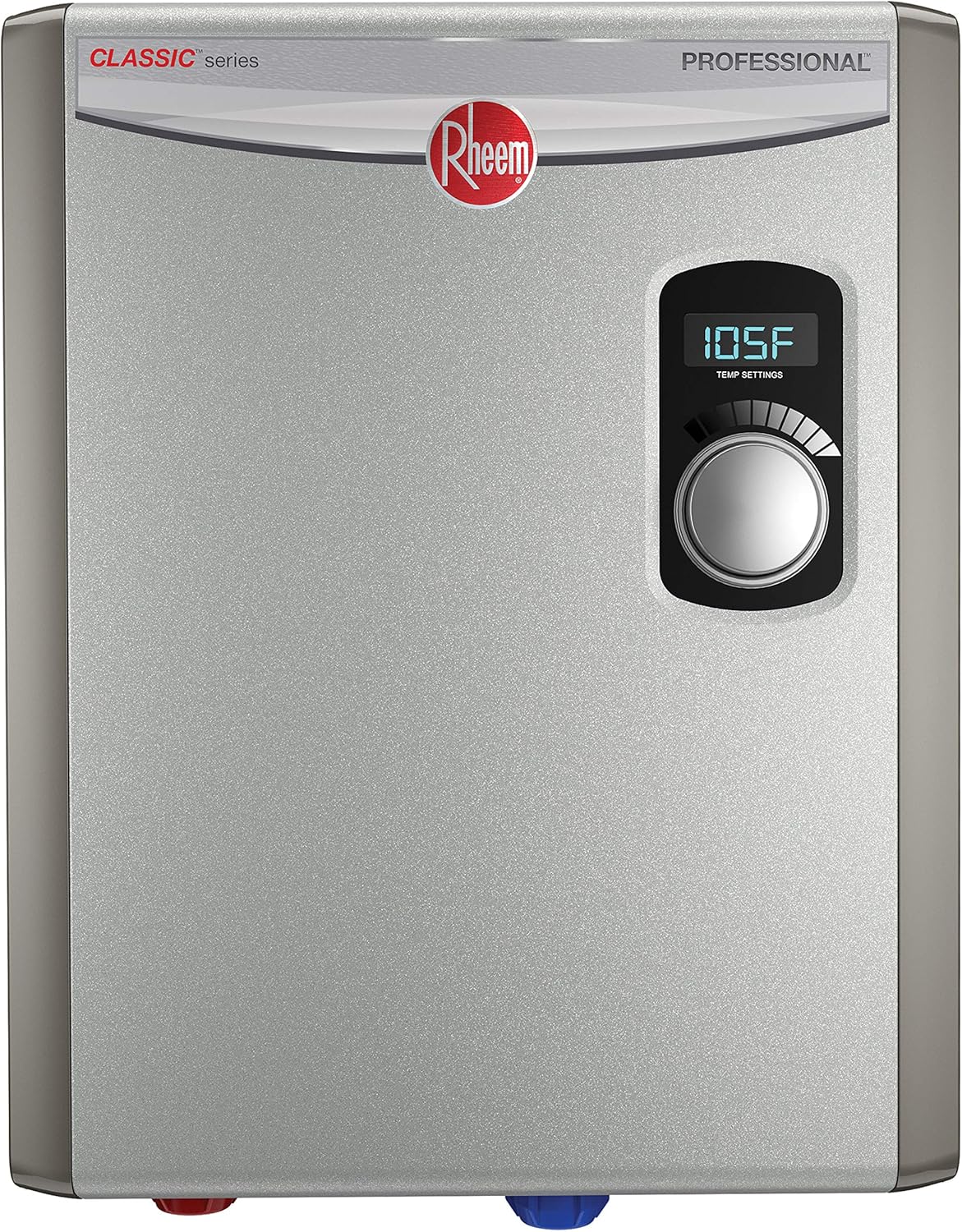
The most reliable 18-kilowatt option is the Rheem RTEX-18, a top-tier model.Cheap tankless heaters don’t last long at all. You have to empty the lines, disable the breakers, and start over when you replace one.From the start, Rheem designs the RTEX-18 to be easily serviced in the field.To start, the long-lasting immersion heating elements made of copper—which can be swapped out by the user in less than an hour. When things break, it’s more of a part swap than a replacement.Now we go on to the external digital thermostatic control, which maintains a temperature within a one-degree range. A constant temperature even when demand fluctuates.
Last but not least: peak flow of 4.4 gallons per minute, the greatest in its 18-kilowatt class. Convenient two-shower setup is available.Downside: updated 100-amp panels are required, in addition to two 40-amp double-pole breakers. Adding a bottom water connection makes top-of-tank retrofits more complicated. Absence of a remote app.Buyers with a long-term homestead or a DIY mindset will find this to be the best option.Those interested in cheap hardware or smart home integration should not use this.
2: Rheem RTEX-24 24kW Electric Tankless Water Heater

The most reliable name-brand whole-house generator available here is the Rheem RTEX-24.Most 18-kilowatt heaters will be crushed by multiple bathrooms running at once. Finally, the person at the back of the line feels the chill of the blast.In actual use, the RTEX-24 can handle two showers at once thanks to its increased power output of 24 kilowatts.To start, it has a heating capacity of 24 kilowatts, which is more than enough for households with three bathrooms in colder regions. On consecutive days, there will be no unpleasant shock of cold water.
The next feature is a digital display that can be adjusted in increments of one degree, spanning from 80 to 140 degrees. Get the sound just right for you.The field-replaceable copper heating elements are the last piece—you only need to swap out the parts, not the entire machine, when they wear out. Expenses remain modest over time.Drawbacks: Two hundred amp service and three 40-amp double-pole breakers are needed. Most houses built before 2000 require new panels. Install solely via hardwire; no wireless connectivity.Houses with three or four bedrooms that can accommodate simultaneous demand are ideal. Not suitable for: modest houses or panels with a low amperage.
1: Stiebel Eltron Tempra 24 Plus Electric Tankless Water Heater

The Stiebel Eltron Tempra 24 Plus, designed for individuals who despise temperature fluctuations, is the best electric tankless water heater currently available.After some time, any tankless system in this area reaches a maximum flow rate. Put the dishwasher on and take two showers; the water gets lukewarm. That is, till presently.You can fix it with the Tempra 24 Plus.To start, there’s the exclusive Advanced Flow Control, which lowers flow rather than lowering temperature in the event that demand exceeds capacity. Whatever temperature you pick for your shower, that’s how it stays. Like, no other tankless system accomplishes this.
Furthermore, there are two temperature memory presets: one for the shower and one for the dishes. A single-button control.No clicking relays or hum—just a completely silent electrical switch. Installs silently in completed areas.Downside: an upgrade to the panel is necessary for older homes since it demands a 150-amp minimum service. The installation requires three separate 40-amp breakers. The service lead times are longer when parts are imported.Highly recommended for: homeowners who take their renovations seriously, those who are sick of settling, and anyone else who is ready to upgrade. Forget about low-amp panels or cheap builds.
Things to Consider Before Buying a Electric Tankless Water Heater:
You should evaluate several key factors before purchasing an electric tankless water heater. Assess your hot water demands, energy efficiency ratings, and installation requirements to ensure a suitable choice for your home. Understanding these elements leads to a more informed buying decision.
Point-of-Use vs. Whole-Home Units
Point-of-use units are compact and ideal for specific locations, ensuring hot water is available exactly where you need it. Whole-home units, conversely, cater to multiple outlets simultaneously, making them a more extensive solution for larger households.
Capacity and Multi-Fixture Models
Capacity matters significantly when selecting a tankless model, especially for households using multiple fixtures. Selecting a unit that can handle simultaneous demands ensures you won’t experience a lack of hot water.
Evaluating capacity and the right multi-fixture model guarantees your household’s needs are met effectively. Focus on factors such as flow rates and incoming water temperatures to determine the best fit for your home. Larger units typically offer higher flow rates, accommodating more outlets simultaneously, which is necessary for families or frequent guests.
Calculating Flow Rate and GPM Requirements
Determining your household’s flow rate and GPM (gallons per minute) requirements is necessary for selecting the right unit. Assess the simultaneous hot water needs, such as showers and appliances, to ensure you choose a heater that meets your consumption patterns efficiently.
Impact of Regional Groundwater Temperatures
Groundwater temperature significantly influences the performance of a tankless water heater. Warmer groundwater typically requires less energy to heat, while cooler climates necessitate a more powerful unit. Knowing your area’s average temperature aids in selecting a model that operates efficiently.
Advantages of Energy Efficiency and Space Savings
Investing in an electric tankless water heater means significant energy savings, as they heat water only when needed. This efficiency reduces your carbon footprint and helps lower utility bills. Their compact design requires less space, making them ideal for small homes or apartments.
Limitations Regarding Electrical Load and Demand
Evaluating your home’s electrical system is imperative before purchasing. Many electric tankless heaters require a higher amperage than standard systems can provide, which could necessitate costly electrical upgrades. Consider your household’s hot water usage patterns, as meeting high demand may exceed the unit’s capacity.
Assessing the limitations in electrical load is key to ensuring optimal performance. If multiple outlets or appliances require hot water simultaneously, the heater might struggle to keep up, potentially leading to a drop in water temperature. This limitation can be particularly frustrating for larger households or during peak usage times, so planning ahead is advisable.
Determining Necessary Temperature Rise
Necessary temperature rise refers to the difference between the incoming water temperature and your desired output temperature. This measurement helps you select a heater that can maintain the required warmth during usage.
Determining Necessary Temperature Rise
Assessing your incoming water temperature and desired hot water temperature will provide the temperature rise needed. For example, if the incoming water is 50°F and you want 120°F, you’ll need a rise of 70°F. This figure directly influences the heater’s capacity.
Evaluating Breaker Panel Capacity and Amperage
Check your breaker panel’s capacity and amperage to ensure compatibility with the new water heater. Each unit has specific requirements, typically ranging from 30 to 60 amps. If your panel lacks sufficient capacity, you may need to upgrade it, incurring additional costs.
Wire Gauge and Safety Compliance Standards
Ensure that the wire gauge is appropriate for the amperage of your electric tankless water heater. Using the correct gauge helps prevent overheating and potential fire hazards. Compliance with local safety standards is vital to maintain a safe and efficient electrical system.
Choosing the correct wire gauge typically ranges from 10 to 6 AWG, depending on the heater’s amperage. Adhering to local safety standards not only guarantees installation quality but also protects your home from electrical issues. Always consult with a professional electrician to confirm compliance and ensure safe operation.
Professional vs. DIY Installation Considerations
Choosing between professional installation and a DIY approach depends on your expertise and comfort with electrical systems. Professionals guarantee compliance with safety standards, while DIY can save money if you possess the requisite skills.
Routine Descaling and Performance Upkeep
Regular descaling is important to maintain efficiency and prolong the lifespan of your water heater. Perform descaling at least once a year, especially in areas with hard water.
Neglecting routine descaling can lead to mineral buildup, which reduces heating efficiency and increases energy consumption. Flushing the system with a descaling solution effectively removes these deposits and promotes optimal performance. Schedule this maintenance to ensure uninterrupted use and enhance your heater’s longevity.
Final Words
Taking this into account, you should evaluate your hot water needs, energy efficiency, space constraints, and installation requirements before purchasing an electric tankless water heater. Understanding these aspects will help you make an informed decision that aligns with your lifestyle and budget for optimal satisfaction.
Leave a Reply