
Finding the best foam cannon can transform your boring weekend car wash into a professional detailing experience. Are you tired of thin soap that slides off before it even cleans? We tested the top models to find the ones that produce thick suds to protect your paint from scratches. Get ready to achieve a stunning, showroom shine right in your driveway with less effort. Here is everything you need to know to choose your perfect match.
Contents
- Top 7 Foam Cannon:
- 7: Tool Daily Foam Cannon 1L
- 6: AstroAI Foam Cannon Wide Neck
- 5: Westinghouse Foam Cannon 3600 PSI
- 4: Tool Daily Short Gun with Foam Cannon
- 3: McKillans Foam Cannon Wide Mouth
- 2: Adam’s Polishes Premium Foam Cannon
- 1: MTM Hydro PF22 Foam Cannon
- Things to Consider Before Buying a Foam Cannon:
- High-Pressure Washer Attachments
- Standard Garden Hose Foam Guns
- Minimum PSI and GPM Requirements
- Orifice Size and Connector Compatibility
- Benefits for Paint Safety and Lubrication
- Potential Drawbacks and Equipment Costs
- Proper Chemical Dilution and Mixing
- Adjusting Spray Patterns for Maximum Coverage
- Managing Water Hardness and Soap Selection
- Troubleshooting Common Stream Issues
- Cleaning the Internal Agitator and Filter
- Proper Storage and Rinsing Procedures
- Summing Up
Top 7 Foam Cannon:
7: Tool Daily Foam Cannon 1L
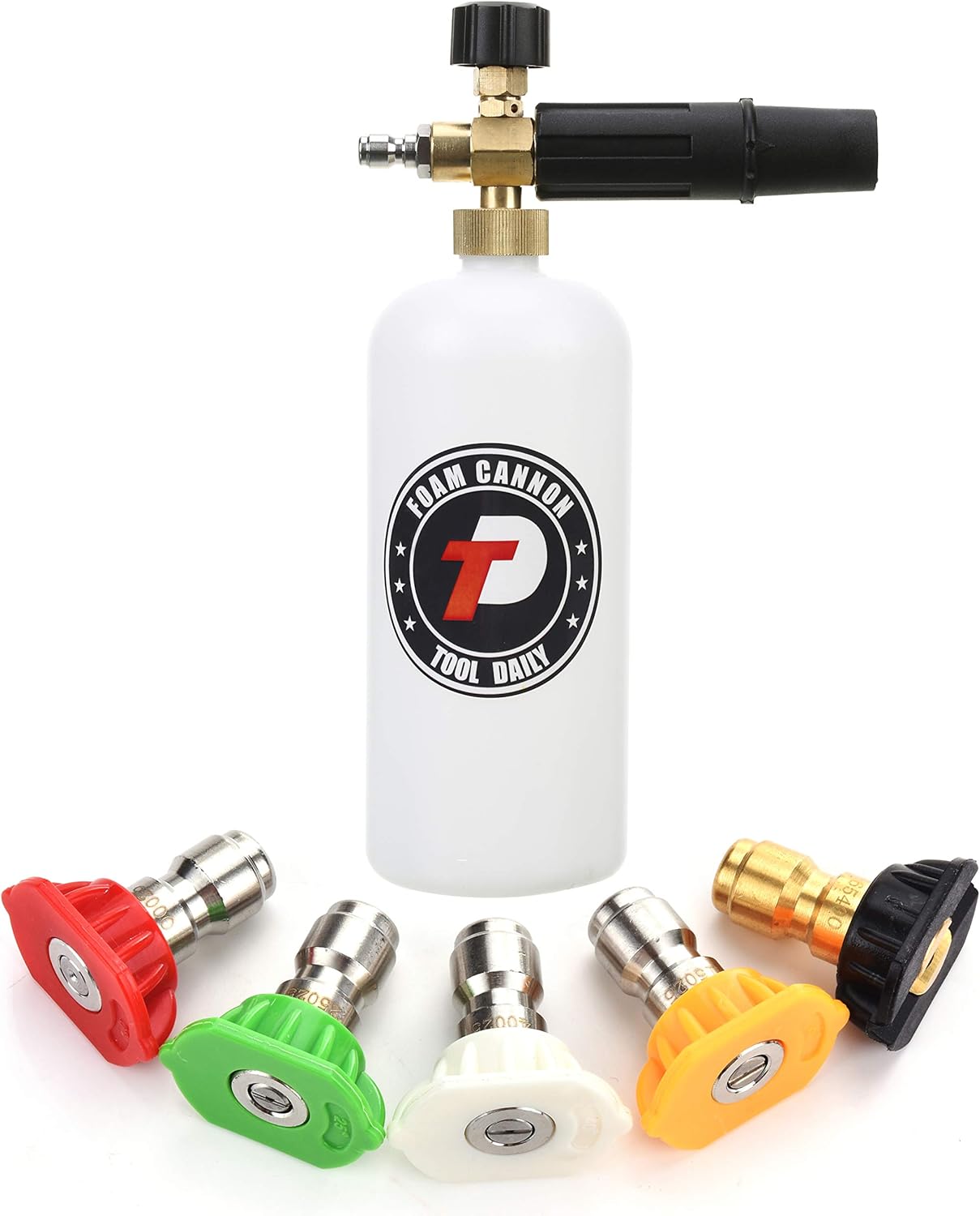
The greatest low-cost option for foam washing is the Tool Daily Foam Cannon.Instead of a car wash, you got a rinse with the pressure washer you purchased. The panel repels the soap that is emitted by the wand.To start, it comes with a 1-liter bottle and a 1/4-inch quick connect that can be quickly and easily attached to nearly any wand.The next step is to adjust the soap stream’s thickness using a knob on top; turn it thin for washing or thick for snow blankets.
Last but not least, the same package contains five nozzle tips ranging from zero to sixty-five degrees, which are used for rinsing.Downside: plastic instead of brass for superior cannons. Foam becomes very oozing at pressures below 1000 PSI. The small neck makes filling a bit of a debacle.Apt for: first-time purchasers and infrequent weekend washers. Not for use with gas engines or regular detailing.
6: AstroAI Foam Cannon Wide Neck

If you’re sick of soap water everywhere, the AstroAI Foam Cannon is your best bet on a budget.Cheap cannons all share the same skinny neck. You pour the concentrate, and half of it flows down the edge.To start, there’s no need to waste a funnel because the extra-wide neck can flow directly from the jug.Then, instead of runoff, the mixture lands as sticky lather thanks to a sturdy foam core that compresses it even more.
The nozzle also allows you to customize the foam’s thickness and spray pattern independently, so you can use a narrow jet on wheel arches and a large fan on panels.Drawbacks: Unsuitable for gas machines due to its 1000 to 3000 PSI rating. Do not have an extra orifice nozzle. It has a very little 1 liter tank.Ideal for: driveway washers seeking a more sudsy wash. Do not purchase if you have a gas setup or a larger tank.
5: Westinghouse Foam Cannon 3600 PSI

For gas-powered pressure washers, the Westinghouse Foam Cannon is the most cost-effective option.The pressure limit for most inexpensive cannons is 3000 PSI. The component that was never designed for a gas machine is being overworked.To begin, it has a maximum pressure rating of 3,600 PSI, which is sufficient for a gas washer but would be too much for a regular cannon.Plus, there’s only one 1/4-inch female quick connect for both gas and electric machines, so you won’t have to waste time looking for an adapter.
Lastly, the full wash may be controlled by a single dial, which also changes the concentration of the spray and suds.The lack of nozzle tips is a drawback. Careful filling is required due to the typical width of the neck. The foam is not as thick as the premium.Gas washer owners and those looking to upgrade will find this the best option. Those looking for the thickest foam should go elsewhere.
4: Tool Daily Short Gun with Foam Cannon

When facing off against a long stock wand, the Tool Daily Short Gun is your best bet.Doors panels are not the intended use for factory wands. Obstacles such as two feet of lance make foaming a roof a challenge.To start, instead of a standard wand, you have a short trigger gun that rests just inches from your palm.After that, attach M22 fittings with thread sizes of 14 and 15 millimeters to the hose; this is where it joins, not to the wand.
Lastly, the set comes with a 1-liter cannon and five different nozzle tips, so you can foam and rinse with just one purchase.The only hoses that it will fit are M22, so take that into consideration before purchasing. Handle with more dexterity. As before, 3000 PSI is the limit.This is the best option for people who own sedans or hatchbacks and live in cramped quarters. This hose is not compatible with gas equipment or hoses that are not M22.
3: McKillans Foam Cannon Wide Mouth

For weekly washers, nothing beats the McKillans Foam Cannon, a top-tier mid-premium option.Cannons on a budget can last for a season. Then the thread runs, the knob stops working, and you end up having to buy it again.First, the metal connectors, rather than plastic ones, carry the pressure; this is where inexpensive cannons often break.Then, a bottle with a wide base will stay upright without toppling over, and the see-through body will let you know how much mix you have.
Last but not least, you can tweak the foam volume and spray angle independently; one is wide for paint, and the other is narrower for wheels.Cons: Low-pressure machines have difficulty due to the lack of an aperture nozzle swap. Clearly heavier when brimming with food. Rinse tips are not provided.Who it’s best for: regular washers looking for a durable cannon. Not recommended for idle users or machines with low flow rates.
2: Adam’s Polishes Premium Foam Cannon

For fans who like a little more control over their spray, Adam’s Polishes has the greatest premium foam cannon.One fan form and one soap dial are often provided by cannons. Nice for a fast wash, but you’ll want to cut back once you detail.A lofty curtain for doors or a flat sweep across a hood are the two possible patterns created by the two independently adjustable spray fans.The next step is the improvement of the pieces that fail on cheaper cannons—the internal brass and stainless steel components that manage constant pressure cycling.
As a last point, a full-size car will require less refills from a 32-ounce container made of concentrated soap.Disadvantage: flush nozzles are not provided. Holds fewer than one liter of bottles in the canister. Those low-pressure machines do not have a spare orifice.This is the ideal solution for serious detailers and people with two cars who live in two-car families. I wouldn’t recommend this to someone who isn’t serious about buying a home.
1: MTM Hydro PF22 Foam Cannon

With its commercial-grade construction and universal fit, the MTM Hydro PF22 is the greatest foam cannon of 2026.There is a pressure window on every gun in this location. Foam transforms into water below it. On top of that, you’re highlighting the plastic.You can use it with a little electric washer or a gas unit that would overpower anything else; the range is 1.4 to 5.3 GPM.Second, the foam fan may be turned from vertical to horizontal using a two-stage nozzle; instead of using your wrist, align the fan with the panel.Finally, the third feature is that the spray pattern and the amount of soap may be independently adjusted using the fan blades and the soap injection knob, respectively.
Fourth, a durable, everyday-use 32-ounce wide-mouth bottle made of fiberglass-reinforced plastic with an anti-tip base.Downside: inventory is limited and items sell out quickly. There is a limit of one liter in the bottle. The best foam requires fine-tuning.This product is ideal for gas washer owners and dedicated do-it-yourself detailers. Do not purchase if this is your first or only purchase.
Things to Consider Before Buying a Foam Cannon:
Most car enthusiasts appreciate the convenience and effectiveness of foam cannons when washing vehicles. Choosing the right one requires attention to factors that influence compatibility and performance, ensuring optimal cleaning results without damaging your car’s surface. Understanding these elements can make your investment more rewarding.
High-Pressure Washer Attachments
These attachments connect directly to high-pressure washers, optimizing foam production. Ideal for vehicles and large surfaces, they can generate a thick, clingy foam that adheres for extended cleaning periods.
Standard Garden Hose Foam Guns
Suitable for lighter cleaning jobs, garden hose foam guns mix water and soap effectively. They generally produce a less dense foam compared to high-pressure attachments but remain viable for everyday tasks, such as washing cars or decks.
Garden hose foam guns are commonly used for their simplicity and convenience. They allow for quick foam application without the need for specialized equipment, making them accessible for casual users. Easy to manipulate, they often feature adjustable nozzles for varying foam intensity. Many models also come with built-in soap dispensers, facilitating a seamless washing experience.
Minimum PSI and GPM Requirements
Pressure settings influence how well a foam cannon operates. Usually, a minimum of 1,500 PSI is recommended, while 2.0 GPM (gallons per minute) ensures enough water flow for effective foam production. These specifications adjust performance to meet various cleaning needs.
Orifice Size and Connector Compatibility
Matching the orifice size with your pressure washer’s output is vital for foam density. An orifice that is too large may produce watery foam, while one that is too small could restrict flow. Ensuring compatible connectors also facilitates a proper attachment, which maximizes functionality and efficiency.
Orifice sizes generally vary between 1.1 mm and 1.5 mm. A mid-sized foam cannon typically suits most home pressure washers, while commercial units might require larger orifices. Connector compatibility is equally crucial; different pressure washers and hoses may require specific fittings. Avoiding mismatches here not only improves connection stability but also enhances the performance and longevity of your foam cannon.
Benefits for Paint Safety and Lubrication
Foam washing reduces the risk of scratching your vehicle’s surface by providing a thick layer of foam that acts as a lubricant. This protective barrier lifts dirt and grime away from the paint, allowing for a gentler wash. Such an approach minimizes damage while ensuring effective cleaning.
Potential Drawbacks and Equipment Costs
Expenses surrounding foam washing can mount due to the cost of the foam cannon, specialized soaps, and supplemental equipment. Investing in quality gear may feel steep initially but can lead to long-term savings through improved anti-scratch measures.
Pricing often reflects the quality of the equipment. For instance, a high-end foam cannon might cost significantly more than a basic model, yet it can produce better results. Consider the ongoing expenses for maintenance and compatible cleaning products, which can influence the overall cost-effectiveness of the foam washing method.
Proper Chemical Dilution and Mixing
Following the manufacturer’s instructions ensures effective cleaning while preventing damage to surfaces. Accurate measurements contribute to the desired foam consistency and cleaning power, which is often a 1:10 concentration for most soaps.
Adjusting Spray Patterns for Maximum Coverage
Adjusting the foam cannon’s spray pattern maximizes the coverage area and ensures an even application across various surfaces. Experimenting with different settings allows for optimal cleaning results based on the vehicle’s size and dirt level.
Different foam cannons feature various nozzle designs that can influence spray patterns. Adjusting these settings can achieve a wide mist or a focused spray, depending on your needs. For larger vehicles, a wider spray pattern may be more efficient, while a tighter pattern ensures thorough cleaning in detailed areas.
Managing Water Hardness and Soap Selection
Water hardness significantly affects foam quality. Hard water contains high mineral levels, which can disrupt the soap’s ability to foam. Opt for a water softener if your water is particularly hard, or select a soap that specifically addresses hard water issues.
Troubleshooting Common Stream Issues
Experiencing weak foam or inconsistent spray can be frustrating. Often, blockages in the foam cannon or improper soap dilution are to blame. Ensuring that you clean the nozzle and adjust the dilution can lead to improvements.
To effectively troubleshoot, start by inspecting the foam cannon’s nozzle for clogs. Cleaning it with warm soapy water can often restore optimal performance. If foam continues to be inadequate, examine your soap mix ratio; even a minor adjustment can impact the foam’s thickness. Any changes in water pressure can also influence how the soap is dispensed. Addressing these common issues can enhance your car washing routine significantly.
Cleaning the Internal Agitator and Filter
Inspecting the internal agitator and filter regularly is necessary to avoid buildup that can hinder performance. A simple rinse after each use removes soap residue and debris, which helps maintain the effectiveness of the foam cannon.
Proper Storage and Rinsing Procedures
Storing the foam cannon in a cool, dry space protects it from extreme temperatures. Flushing the unit with clean water after each use will help remove leftover soap and prevent corrosion.
Cleaning involves more than just rinsing; ensuring that all soap and water are expelled can prevent damage over time. Avoiding direct sunlight and extreme temperatures during storage is also vital, as it keeps seals and plastic components from degrading. Maintaining these practices ensures that the foam cannon remains ready for action whenever you need it.
Summing Up
Carefully considering factors such as compatibility with your pressure washer, the type of soap you plan to use, and the build quality will enhance your foam cannon experience. Investing time in research can lead to better washing results, ultimately transforming the way you maintain your vehicle’s appearance.
Leave a Reply