
Best Garage Door Opener options can end your frustration with noisy, unreliable openers. Our expert-tested reviews compare quiet motors, smart openers, and secure Wi‑Fi models so you can buy with confidence. Save time, avoid costly mistakes, and get reliable performance every day. You’ll love the instant relief and peace of mind a dependable opener brings. Read on to find the best match for your garage and budget.
Contents
- Top 7 Garage Door Opener:
- 7: Genie Chain Drive 550
- 6: Genie ChainMax 1000
- 5: Genie Chain Drive 750
- 4: Chamberlain 3/4 HP Chain Drive Smart with Camera
- 3: Chamberlain 3/4 HP Belt Drive myQ with Camera
- 2: Chamberlain 1-1/4 HP Belt Drive Smart with Camera
- 1: LiftMaster Premium Jackshaft
- Things to Consider Before Buying a Garage Door Opener:
- Chain and Belt Drive Mechanisms
- Screw and Wall-Mount Drive Systems
- Determining Necessary Horsepower and Lifting Capacity
- Evaluating AC vs. DC Motor Efficiency
- Advantages of Smart Home and Wi-Fi Integration
- Limitations of Entry-Level Manual Models
- Photoelectric Sensors and Auto-Reverse Functions
- Rolling Code Technology and Signal Encryption
- Regular Lubrication and Balance Testing
- Identifying Component Wear and Tear
- Summing up
Top 7 Garage Door Opener:
7: Genie Chain Drive 550

If you’re a homeowner looking for an affordable option to silence that annoying noise, consider the Genie Chain Drive 550.The house is rattled and grinded by your ancient opener. Without paying too much, the 550 can take its position.To start, there is a sturdy chain drive that uses a 140-volt DC motor; it is reliable and built to last.In the afternoon, the majority of homeowners can install the 5-piece snap-together rail and pre-assembled chain because there is no need for cable rigging.
Two remote controls, a wireless keypad, and a wall console are included in the package, and it is compatible with HomeLink and Car2U.One disadvantage is that chain drives are noisier than belt drives; they can be audible even from a distance and can be rather noisy when used in a bedroom. There is no power backup or WiFi.Ideal for: inexpensive replacements, detached garages. Forget about app-control fans or garages that are next to bedrooms.
6: Genie ChainMax 1000

When space is at a premium in your garage yet the ceiling is low, go with the Genie ChainMax 1000.A large overhead rail may not be suitable for all garages. For it, the ChainMax was designed.To begin, we need a c-channel rail with a low profile that can be flush-mounted near the ceiling, providing access where regular openers cannot.Next, the door moves with a gentle start and stop thanks to a 140-volt DC motor, which eliminates the harsh jolt of previous models.
Last but not least: a Safe-T-Beam sensor, which comes with a keypad, console, and remote controls, will reverse the door if anything crosses the opening.Cons: it isn’t the most silent option since it is still a chain drive. I am without WiFi and an app. Not a backup battery.Ideal for installations with restricted clearance or low ceilings in garages. Buyers seeking app control or silence should not purchase this.
5: Genie Chain Drive 750
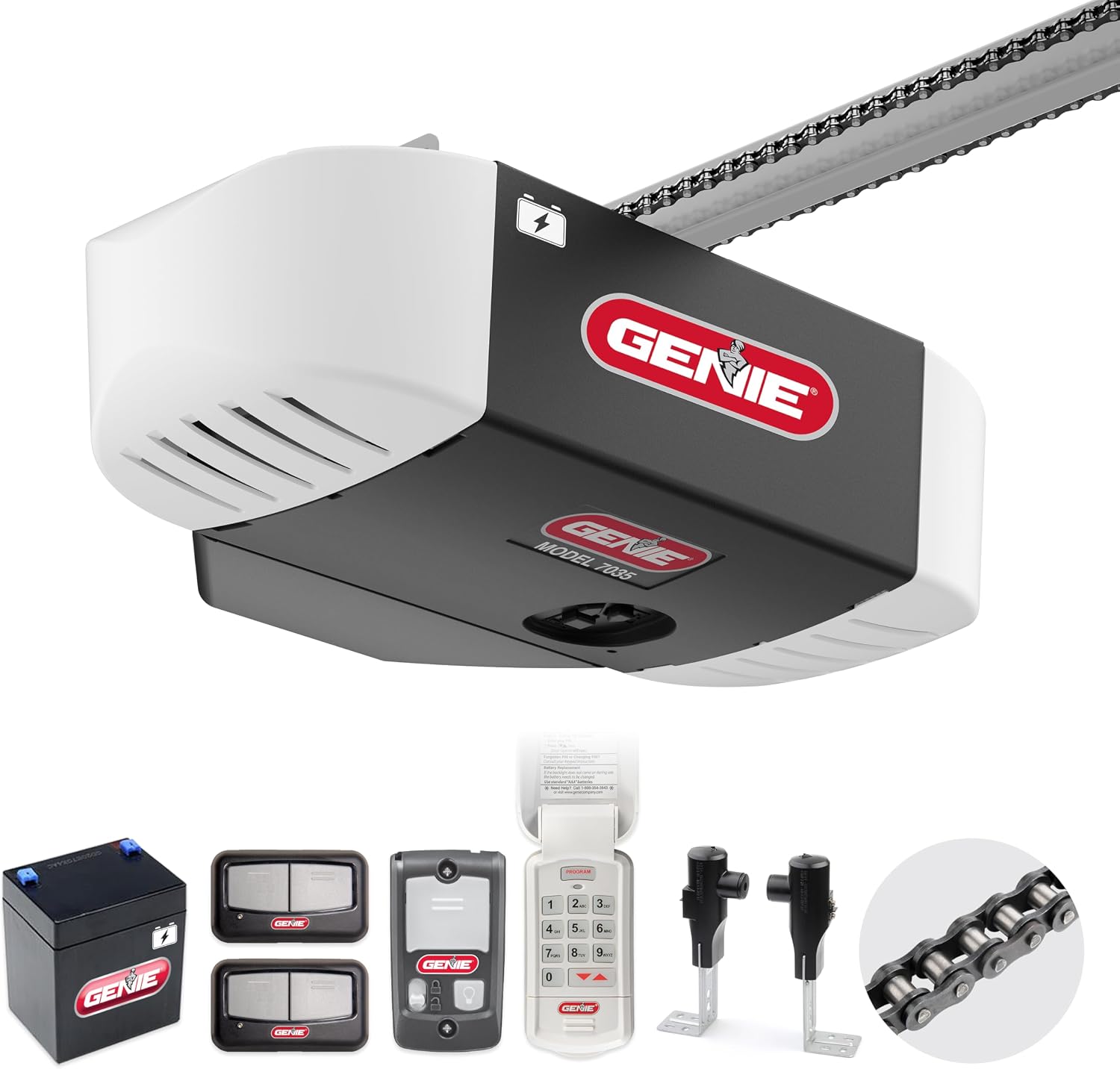
In the event of a power outage, the Genie Chain Drive 750 is the most reliable heavy-duty opener on the market.Most openers will leave your vehicle stranded inside in the event of a grid outage. Even when the power goes out, the 750 keeps going.Firstly, you’re never left high and dry thanks to the integrated battery backup, which provides power for up to 50 cycles following an outage.After that, a 3/4 horsepower DC motor attached to a robust chain will provide additional power to handle heavier and wider doors.
Lastly, it comes with Safe-T-Beam sensors, a wall console, two remote controls, and a wireless keyboard.Downsides: stupidity, not reliability; no app or WiFi. Although it is heavy to mount, the chain runs noisier than a belt.Heavy doors and regions prone to power outages are not good candidates. Apt for: connected garages that require silence, not for smart-home enthusiasts.
4: Chamberlain 3/4 HP Chain Drive Smart with Camera

The most cost-effective way to get into a smart garage is with the Chamberlain Chain Drive Smart.You desire a camera and app control but can’t justify the high price tag; intelligent features, at last, within reach.To start, it has built-in WiFi so you can use the myQ app to open, close, and monitor your door from any location.Secondly, you can keep tabs on your home at all times thanks to the integrated camera that broadcasts live footage of your garage.
Thirdly, a 3/4 horsepower DC motor remains quieter than previous models, and an inbuilt battery backup rides out blackouts.The belt makes less noise than the chain, which is a drawback. Stable WiFi is required for the camera. Certain functions require a paid subscription.Intended users: people looking for a smart garage for the first time, and those looking to save money. Not suitable for homes without Wi-Fi or those who prefer silence.
3: Chamberlain 3/4 HP Belt Drive myQ with Camera

For most homes, the best all-around opener is the Chamberlain Belt Drive.One major issue is noise if your garage is located under a bedroom. Here is the solution.The first component is a DC motor that is so quiet it won’t disturb the neighbors; it’s a strengthened belt drive. The lifts are smooth and practically silent.The following is a built-in camera and WiFi myQ app that is identical to the ones mentioned earlier—live video and phone access.
Lastly, the garage is illuminated and operational during power outages thanks to an integrated battery backup and two-bulb LED illumination.The price of a belt is more than that of a chain. You might need to pay for access to some features. Large or insulated doors make it difficult.For the majority of homeowners, attached garages are the best option. Super hefty doors or limited finances won’t work.
2: Chamberlain 1-1/4 HP Belt Drive Smart with Camera
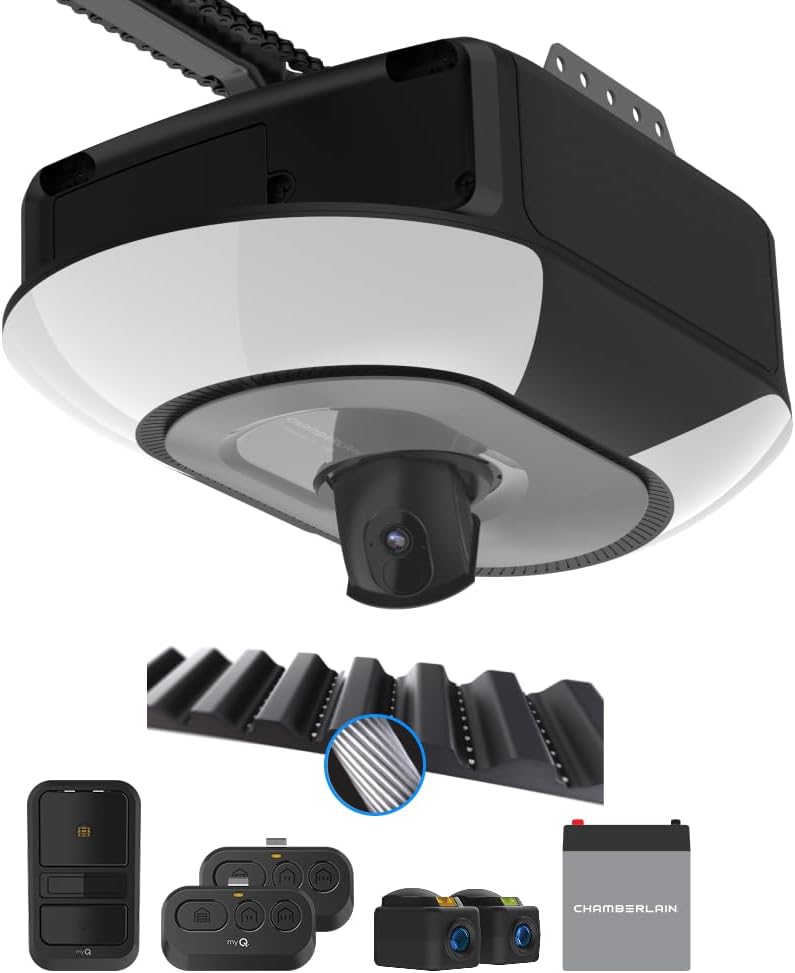
For thick, broad, or insulated doors, nothing beats the Chamberlain 1-1/4 HP Belt Drive.Large, insulated panels and two-car doors put too much strain on openers that aren’t up to the task. That one is stronger than them.At the top of the list is a 1-1/4 horsepower DC motor, which provides the maximum lifting power and effortlessly pulls heavy doors.The following step is an ultra-quiet strengthened belt drive, which allows for a stronger motor with no audible garage noise.
Completing the package is a built-in camera, dual LED lights, and battery backup, all of which can be controlled fully via WiFi myQ.Downside: the additional power ends up costing much more. You might have to pay to access some of the features. For a regular single door, it’s too much.Ideal for: extra-large, insulated, or two-door openings. Forget about it if you have a tiny garage door or a limited budget.
1: LiftMaster Premium Jackshaft

As far as garage door openers go, in 2026 the most cutting-edge and safest option is the LiftMaster Premium Jackshaft.As of right now, any opener can operate your door. That one watches over it.As soon as your door closes, an automatic garage door lock will deploy an actual deadbolt, protecting your home from intruders.Second, you can use the whole ceiling space for storage with a wall-mount jackshaft design that attaches alongside the door.Third, it’s one of the quietest openers available thanks to its DC motor, and it’s easy to install because there are no cables.
Lastly, in the event of a power loss, you will still be able to use the myQ app and WiFi, thanks to the battery backup.Downside: it’s the priciest option available. One may need to pay for access to all of the smart features. We advise having a professional handle the installation.Ideal for: garages that require extra headroom and homeowners that prioritize security. Neither basic detached garages nor limited finances are suitable.
Things to Consider Before Buying a Garage Door Opener:
Over time, garage door openers have evolved significantly, offering various features and technologies. Understanding your specific needs and available options is important for selecting the right model. Key considerations will help you make a wise investment that enhances both convenience and security.
Chain and Belt Drive Mechanisms
Chain and belt drive mechanisms dominate the garage door opener market. Chain drives utilize a metal chain for movement, proving durable and budget-friendly, while belt drives use a rubber belt for a quieter operation. Considering noise levels and maintenance requirements can guide your choice.
Screw and Wall-Mount Drive Systems
Screw and wall-mount drive systems provide distinct advantages. Screw drives feature a threaded steel rod that moves the door, requiring less maintenance due to fewer parts. Wall-mount systems, installed beside the garage door, free up ceiling space, making them ideal for garages with limited overhead clearance.
The versatility of screw and wall-mount systems caters to a variety of garage setups. Their design not only minimizes wear and tear but also streamlines installation, making these systems convenient for homeowners seeking efficiency without sacrificing quality.
Determining Necessary Horsepower and Lifting Capacity
The horsepower required will vary based on your garage door’s weight and size. Standard doors often operate well with 1/2 HP, while heavier doors may need 3/4 HP for optimal performance.
Evaluating AC vs. DC Motor Efficiency
AC and DC motors each offer distinct characteristics that can affect performance and efficiency. AC motors usually provide higher lifting power, while DC motors operate quietly, making them ideal for residential areas.
AC motors are known for their reliability and strong torque capabilities, often handling the weight of heavier doors. In contrast, DC motors are typically more energy-efficient and allow for features like soft start and stop, reducing wear and tear over time. Evaluating these characteristics can guide you toward the right choice based on your specific garage setup and preferences.
Advantages of Smart Home and Wi-Fi Integration
Smart home integration offers streamlined access to control your garage door from anywhere. With Wi-Fi capabilities, adjustments can be made on-the-go, promoting convenience and security. Features like geofencing, which alerts you when the door is left open, significantly enhance user experience.
Limitations of Entry-Level Manual Models
Entry-level manual models often lack advanced features, making them less convenient. Functions such as remote access and smartphone notifications are typically unavailable, which limits your control and awareness of the door’s status.
Many entry-level manual models sacrifice features for affordability. Without smart capabilities, homeowners miss out on real-time monitoring and remote control options. Moreover, these models may require more physical effort to open, diminishing user convenience significantly compared to automated options. Over time, the absence of advanced safety and security features could become a more pressing concern as technology advances.
Photoelectric Sensors and Auto-Reverse Functions
Photoelectric sensors are imperative for detecting obstructions in the door’s path. When an object is detected, the auto-reverse function engages, allowing the door to reverse its motion, preventing accidents. This feature significantly enhances safety, especially in households with children or pets.
Rolling Code Technology and Signal Encryption
Security features like rolling code technology and signal encryption protect your garage from unauthorized access. These systems change the access code automatically each time the door is operated, making it nearly impossible for intruders to replicate the code.
Rolling code technology involves using algorithms that generate a new code for each operation of the garage door opener. Signal encryption complements this by scrambling the transmission between the remote and the opener, thus enhancing resistance against hacking attempts. Together, these features create a secure environment, especially in areas where garage break-ins might be prevalent. Choosing systems with these technologies can significantly bolster security measures for your home.
Regular Lubrication and Balance Testing
Keeping the moving parts lubricated prevents friction and wear. Balance testing can be done by disconnecting the opener and lifting the door halfway; if it stays in place, it is balanced properly.
Identifying Component Wear and Tear
Inspecting parts such as springs, rollers, and cables for signs of wear is crucial. A careful look for fraying cables, rusting springs, or worn-out rollers can prevent bigger issues down the road.
Identifying component wear is not just about visual inspections; listen for strange noises while the door operates. Unusual sounds often indicate problems, such as a misaligned track or a worn bearing. Scheduling periodic checks ensures that any deterioration is caught early. A small investment in maintenance can save significantly in repair costs and improve safety and efficiency.
Summing up
Choosing the right garage door opener involves assessing features such as power, noise levels, and security options. It’s beneficial to consider your specific needs and the compatibility with your existing garage door system. Investing time in research can lead to a more reliable and efficient opener that meets your requirements.
Leave a Reply