
Best Garage Heaters can turn a freezing workshop into a cozy, usable space fast. If you hate shivering through projects, our expert-tested garage heating guide finds safe, energy-saving space heaters that actually work. You’ll love coming back to a warm, protected garage that keeps tools safe and saves money. We promise clear reviews and simple buying tips-read on to see our top picks.
Contents
- Top 7 Garage Heaters:
- 7: Comfort Zone CZ798BK Milkhouse Utility Heater 1,500W
- 6: Comfort Zone Ceiling Mount Dual Quartz Heater with Halogen Light
- 5: Mr. Heater 9,000 BTU Portable Buddy Radiant Propane Heater
- 4: Comfort Zone CZ220BK Ceiling Mount Garage Heater 5,000W 240V
- 3: Heat Storm HS-1500-PHX-WIFI Infrared Wall-Mounted Heater
- 2: InoKraft 7,500W Electric Garage Heater
- 1: Mr. Heater 50,000 BTU Forced-Air Unit Heater
- Things to Consider Before Buying a Garage Heater:
- Square Footage and Ceiling Height
- Insulation Quality and R-Value
- Forced Air and Convection Units
- Radiant and Infrared Heating Systems
- Electric vs. Natural Gas Models
- Propane and Portable Options
- Proper Ventilation Requirements
- Clearance from Combustible Materials
- Calculating Necessary BTU Output
- Determining Mounting and Placement
- Routine Cleaning and Filter Care
- Thermostat Optimization for Cost Savings
- Final Words
Top 7 Garage Heaters:
7: Comfort Zone CZ798BK Milkhouse Utility Heater 1,500W

The most cost-effective option for your current situation is the Comfort Zone CZ798BK.It is unnecessary to heat up the entire garage. Two hours of manual labor is required.To start, a regular 120-volt outlet can provide 1,500 watts of forced heat. There is no electrician, no wiring, and no mounting.The next feature is an adjustable thermostat with three settings that allows the element to cycle rather than run continuously at full power.
A steel casing including a carry handle and a tip-over safety switch is the last component. Designed for use in garages.Downside: 1,500 watts won’t heat a whole bay, only a zone. It uses up a lot of power and makes a lot of noise.This is the best option for do-it-yourselfers who only need to heat a single workstation or for tenants who are unable to remove the garage door. Not suitable for: a 2-car garage.
6: Comfort Zone Ceiling Mount Dual Quartz Heater with Halogen Light

For a garage that has short on floor space, go no farther than the Comfort Zone Dual Quartz.A toolbox or tire occupies every square foot of such area. One more thing: a floor heater.At the top of the list are two quartz radiant elements. Your workpiece and yourself are warmed by radiant heat, rather than by the air around you.Following that, the same package has an integrated halogen work light that may be used with or without heat.
Lastly, set the heat on the bench or the automobile with the pull-string controls and 90-degree tilt.Cons: radiant heat can only warm objects directly in front of it. Elemental quartz is delicate. Mounting your ceiling requires effort.People who operate well with a set work area include mechanics and woodworkers. Do not use for heating an entire room or for individuals who frequently move around.
5: Mr. Heater 9,000 BTU Portable Buddy Radiant Propane Heater

If your garage doesn’t have electricity, get the Mr. Heater Portable Buddy.It is common for detached garages and sheds to just have one circuit for the lights. Here, every electric heater serves no purpose.The first is a radiant propane heater that covers around 225 square feet and has a BTU rating of 4,000 or 9,000. There is no wire, no cord.To follow: an indoor-safe certification, a sensor to detect when oxygen levels drop, and a tip-over shut-off. Combustion heat safety engineering in practice.
Lastly: connect it to a bulk tank via hose or use a one-pound cylinder for 5.4 hours on low.Downside: naked cast iron doesn’t do well in an environment where water vapor is present due to vent-free combustion. The cylinders are dead.Ideal for: standalone garages, unwired work areas, construction sites. Avoid keeping instruments that are susceptible to rust in enclosed garages.
4: Comfort Zone CZ220BK Ceiling Mount Garage Heater 5,000W 240V

The Comfort Zone CZ220BK is an affordable option for whole-garage heating.There is a hard ceiling on 1,500 watts and 120 volts in a standard socket. After that, you’ll require 240 volts.To start, it’s three times stronger than any plug-in heater in the area at 5,000 watts on a 240-volt circuit.So that you aren’t stuck with all-or-nothing mode on moderate days, we’ve included three heat levels: 3,000, 4,000, and 5,000 watts.
Lastly, a ceiling-mounted thermal cut-out switch and heavy-gauge steel with overheat protection are included to keep the floor clear.Disadvantages: needs a 240-volt circuit and likely an electrician due to being hardwired. No thermostat dial, no timer, and no remote control.Insulated attached garages and enthusiastic buyers are the ideal candidates. No one who is renting or trying to avoid a new circuit should use this.
3: Heat Storm HS-1500-PHX-WIFI Infrared Wall-Mounted Heater
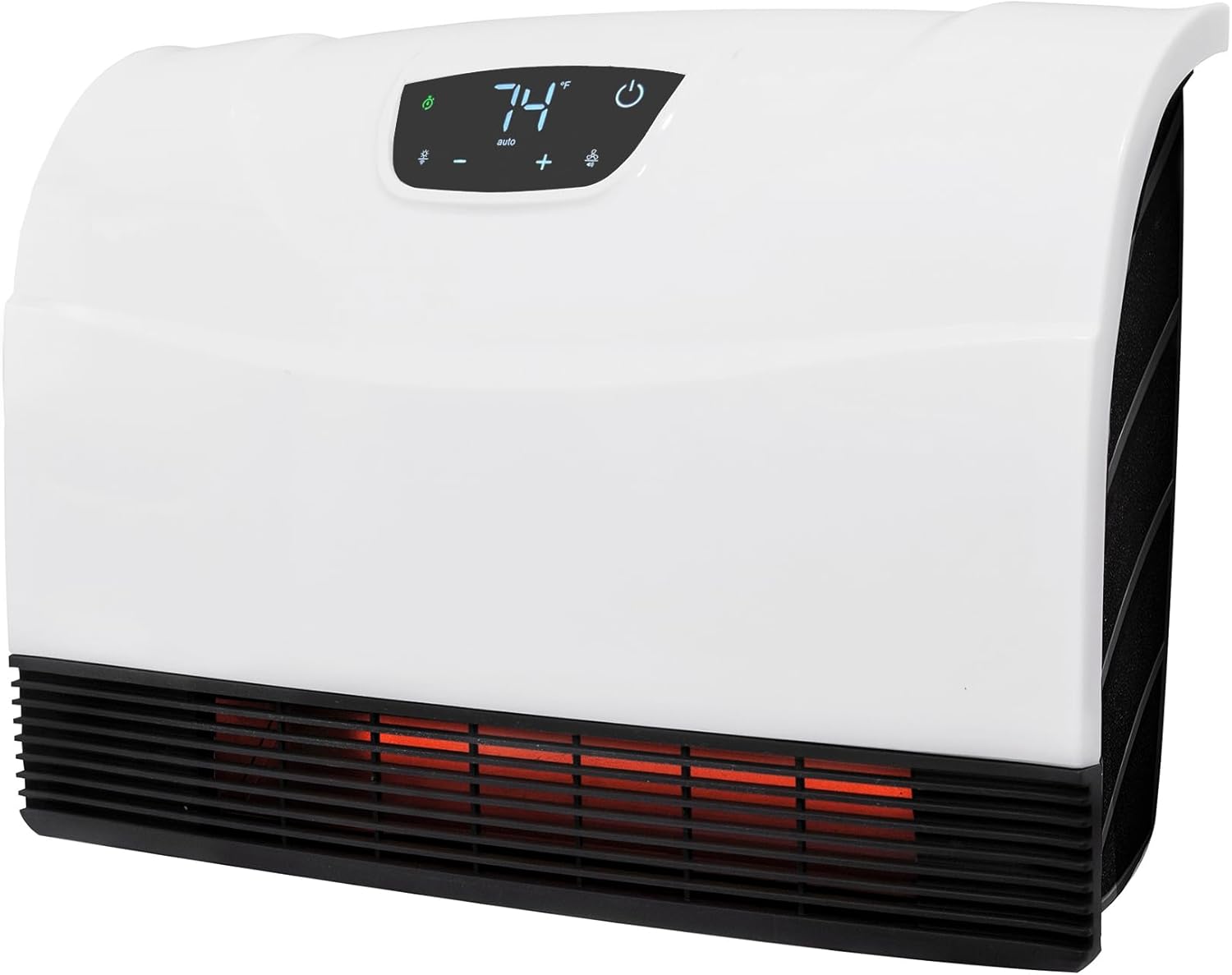
The best option, the Heat Storm Phoenix, is also the only one that can be started indoors.Having to wait in a chilly garage for the first half an hour is the worst.Next up: managing your Wi-Fi apps. In the morning, before you even eat, use your phone to adjust the temperature in your garage.Following that, a standard outlet would support 1,500 watts of infrared, which is approximately 5,200 BTU. Objects, not only air, are warmed by it.
Last but not least: a sleek, wall-mounted design that conceals the cord. Neither the wall nor the grill gets hot.Negatives: It’s still only supplementary in a large bay because its power output is 1,500 watts. Many people find the process of setting up Wi-Fi to be troublesome.No anchors allowed.Home gyms, attached garages, and anyone who prefers a toasty welcome are the best places to put it. Avoid: bays without insulation.
2: InoKraft 7,500W Electric Garage Heater
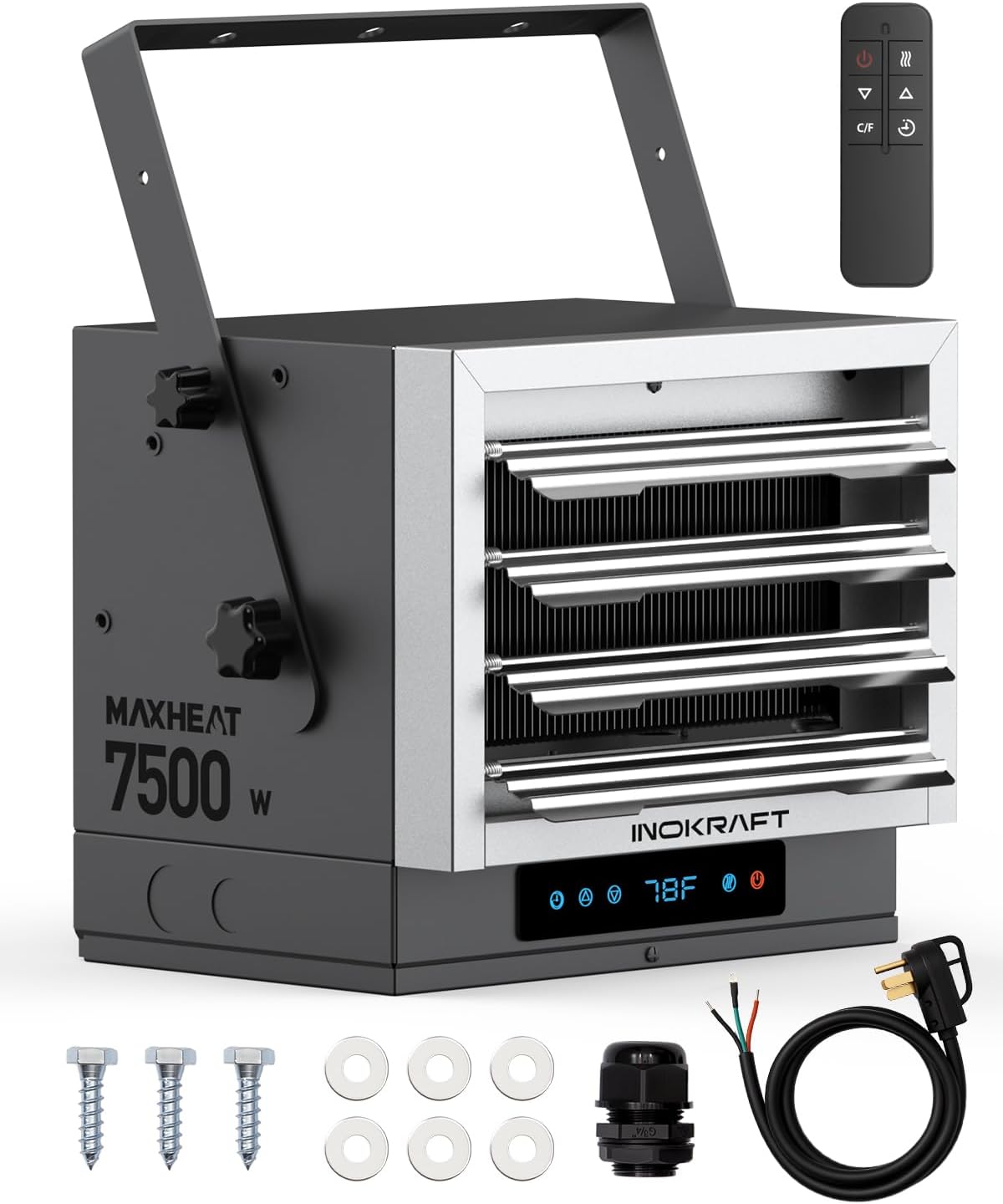
You can obtain the most electric heat without employing an electrician with the InoKraft 7,500-watt.A wiring schematic and several exposed wires are the standard delivery items for each high-quality 240-volt garage heater. Here, it does not.To start, it comes with a NEMA 14-50 plug and 8 AWG wire already attached. Is a welder or gas stove available? Turn it on.Next up: a 7,500-watt model with three levels of automatic energy conservation, covering an area up to 750 square feet.
At last, a digital thermostat with a 24-hour timer and a remote control—just set it to 55 degrees and it will stay that way all nite long.Drawback: there needs to be an existing 14-50 outlet, or else you’ll have to start wiring again. The noise level is really high, at about 65 dB. Limited experience.The ideal users are those who prefer not to deal with electricity, such as do-it-yourselfers who have access to a dryer or welder outlet. Avoid: garages that only use 120 volts.
1: Mr. Heater 50,000 BTU Forced-Air Unit Heater

Designed for use all year round, forced-air unit is the greatest garage heater on the market.Every other heater in this area releases all of its contents into the room. Electric is sparse but not nonexistent. Although it’s powerful, vent-free propane will flood your tools.It has been vented first. Your tools will remain dry since the combustion gas and any moisture escape through the wall.The second is that 50,000 BTU can heat up to 1,667 square feet, which is about the size of a three-car garage, using either propane or natural gas.Thirdly, it maintains a constant temperature in the garage by connecting to a regular 24-volt or Wi-Fi thermostat.
Fourth, a compact device that does not obstruct the door track but does have a gas safety flame sensor and a high-temperature shut-off is available.Downside: you’ll need a gas connection, a wall vent, and a minimum of 10 feet of ceiling space for this installation. You can purchase the thermostat independently.Who this is ideal for: restorers, avid hobbyists, and anyone who uses their garage as a workshop all year round. Do not install on weekends or for tenants.
Things to Consider Before Buying a Garage Heater:
Buying a garage heater requires careful evaluation of your specific needs. Factors such as garage size, insulation, and climate will influence your choice. Understanding these elements ensures you select a heater that effectively warms your space and fits your lifestyle.
Square Footage and Ceiling Height
Calculating square footage and ceiling height helps determine the heating capacity needed. Larger spaces require more powerful units to maintain comfortable temperatures.
Insulation Quality and R-Value
Understanding insulation quality and R-value is imperative for effective heating. Higher R-values indicate better insulation, which retains warmth efficiently within your garage.
Poorly insulated garages lose heat quickly, leading to higher energy costs and diminished comfort. An R-value between 13 and 21 is typically recommended for walls and ceilings. Investing in higher-quality insulation materials can enhance energy efficiency and reduce the workload on your heating system, ultimately resulting in long-term savings on heating bills.
Forced Air and Convection Units
Forced air units quickly raise the temperature by pushing warm air through a space. In contrast, convection heaters rely on natural air circulation to achieve comfort. Each type has its own strengths, offering options for efficient heating based on specific needs.
Radiant and Infrared Heating Systems
Radiant heating systems focus heat directly on objects and people rather than warming the air. Infrared heaters utilize similar technology to create localized warmth, effectively heating up the surroundings without significant energy loss. This makes both options suitable for efficient heating in larger or drafty spaces.
Understanding how radiant and infrared heating systems function reveals their effectiveness in large garages. Infrared heaters can provide instant warmth by targeting areas directly, ensuring you warm up right where you need it. Meanwhile, radiant heating panels often offer a more permanent solution, ideal for those looking to maximize long-term heating while minimizing energy usage.
Electric vs. Natural Gas Models
Operating costs often influence the choice between electric and natural gas models. Electric units require no venting, making them simple to install. In contrast, natural gas units typically provide more heat output, making them better for larger spaces. Weighing installation ease against heat efficiency can help clarify your decision.
Propane and Portable Options
Portable propane heaters offer unique benefits, especially for those needing flexibility in heating locations. These models can easily be relocated, making them suitable for temporary setups or multi-use spaces, such as workshops or construction sites. Propane also affords users the ability to heat spaces without relying on local energy infrastructure. Many portable options are designed for easy transportation and quick assembly, ensuring you can achieve the desired warmth in various environments. Safety precautions, however, remain critical; always ensure proper ventilation and adherence to local regulations when using propane heaters.
Proper Ventilation Requirements
Ensuring adequate ventilation is necessary for the safe operation of any garage heater. Proper airflow prevents the buildup of harmful gases and enhances efficiency. Consider a heater with built-in ventilation features, or install additional vents to promote fresh air exchange.
Clearance from Combustible Materials
Maintaining adequate clearance from combustible materials is necessary for fire safety. Most heater models recommend varying distances, typically ranging from three to five feet, depending on the type. Adhering to these guidelines significantly reduces fire hazards.
Assessing the specific clearance requirements based on heater type is necessary. For instance, infrared heaters typically need more space around them compared to electric models. Create a designated area free from any flammable materials such as cardboard boxes, gasoline, or propane tanks within the recommended distance. Always double-check the manufacturer’s specifications before installation to ensure compliance with safety standards.
Calculating Necessary BTU Output
Assessing the BTU requirements helps ensure that your garage remains adequately heated. Consider factors such as garage size, insulation levels, and regional climate when determining the needed output. For instance, a well-insulated garage in a colder area may need higher BTUs than a drafty space.
Determining Mounting and Placement
Evaluating where to mount the heater is vital for effective heat distribution. Aim to position the heater at a height and location that maximizes airflow, avoiding obstructions. Common placements include above workbenches or near vehicle parking areas for best results.
Wall-mounted heaters typically require less floor space, while ceiling-mounted units can distribute heat more evenly across larger areas. Thoughtful placement should account for direct airflow paths, ensuring that heat reaches all corners of the garage. Balancing accessibility for maintenance with optimal heating performance enhances overall efficiency.
Routine Cleaning and Filter Care
Dust and debris can accumulate in your garage heater, affecting its efficiency. Scheduling routine cleanings, along with replacing or cleaning filters as recommended, will keep the unit functioning optimally. Aim for at least a quarterly check, particularly if your garage is prone to dirt and dust.
Thermostat Optimization for Cost Savings
Adjusting your thermostat can lead to significant savings on energy bills. Setting it to a comfortable yet efficient temperature minimizes unnecessary heating while maximizing comfort in your garage space.
Finding the sweet spot for your thermostat involves monitoring temperature fluctuations and adjusting accordingly. For instance, lowering the temperature during times when the garage is not in use can reduce energy consumption significantly. Utilizing programmable thermostats adds convenience; setting schedules based on your usage patterns ensures that your garage remains warm when you need it, without wasting energy during off-hours.
Final Words
Before purchasing a garage heater, consider factors such as heating capacity, energy efficiency, and safety features. Assess your garage size and intended use to select the most suitable model. Investing time in research ensures that you choose a heater that meets your specific needs and enhances comfort during colder months.
Leave a Reply