
Best Hitch Cargo Carriers deliver instant extra space when your trunk is full and road trips loom. Our expert-tested picks focus on durable hitch-mounted cargo carriers and cargo baskets that fit SUVs, trucks, and small cars. Feel the freedom and relief of stress-free packing with these must-have, rock-solid carriers that protect gear and save time. Read on for top-rated options, buying tips, and quick setup advice to find the perfect carrier.
Contents
- Top 7 Hitch Cargo Carriers:
- 7: MaxxHaul 70107 53″ x 19-1/2″ Hitch Cargo Carrier
- 6: WEIZE 53″ x 19″ Hitch Mount Cargo Carrier Basket
- 5: MaxxHaul 50881 Aluminum Hitch Mount Cargo Carrier
- 4: MaxxHaul 50641 2-in-1 Cargo Carrier and Bike Rack
- 3: CURT 18153 Folding Hitch Basket Cargo Carrier
- 2: REESE Explore 63153 Rambler Hitch Cargo Carrier
- 1: MaxxHaul 80779 Aluminum Hitch Cargo Carrier with Ramp
- Things to Consider Before Buying a Hitch Cargo Carrier:
- Open Basket Carriers for Versatility
- Enclosed Cargo Boxes for Weather Protection
- Specialized Carriers for Bikes and Heavy Equipment
- Hitch Receiver Class and Tongue Weight Capacity
- Ground Clearance and Departure Angle Considerations
- Exhaust Pipe Positioning and Heat Shielding
- Advantages of Aerodynamics and Ease of Loading
- Limitations Regarding Vehicle Length and Rear Access
- Calculating Total Payload Capacity
- Testing Rear Camera and Sensor Clearance
- Preventing Corrosion and Finish Degradation
- Folding Mechanisms and Compact Storage Solutions
- Conclusion
Top 7 Hitch Cargo Carriers:
7: MaxxHaul 70107 53″ x 19-1/2″ Hitch Cargo Carrier

The greatest ultra-budget carrier for first-time buyers is the MaxxHaul 53 by 19 inch.Because you’re only planning a single trip, you don’t yet have the space for a complete setup.To start, a 53 by 19-inch steel basket holding 500 pounds. Take the camp chairs and coolers out of the rear.Secondly, it only takes one person to lift it into the receiver because of its light weight of 22.3 pounds.
Last but not least: black powder coating and high side rails—road spray won’t eat the frame, and cargo stays put.Drawback: it remains extended until you release the pin, thus it can’t be folded. Not included: bag, net, or straps. Make sure to secure any loose gear.For those who are buying for the first time or who only pack once a year, this is the best option. The people who drive it every day and need it to fold flat are not recommended.
6: WEIZE 53″ x 19″ Hitch Mount Cargo Carrier Basket

If you’d rather have everything in one place, the 53 by 19-inch size is ideal.Your shopping spree for bag, net, straps, and hardware will begin once you purchase a plain basket. WEIZE encompasses everything.As a first point, you get a waterproof cargo bag to keep your belongings dry.Next, you’ll find two methods to secure a load: a cargo net and ratchet straps—in the box.
The hitch stabilizer seals the receiver around the shank, eliminating the rattle that occurs with inexpensive carriers.Drawbacks: the bag is just 4 inches deep, thus it will lean on tall loads. Neither is it foldable; it weighs 41 pounds.When only one item is desired and no extras are desired, this is the best option. Not for: those who already have straps.
5: MaxxHaul 50881 Aluminum Hitch Mount Cargo Carrier

Perfect for wet weather, salty roads, and sea breezes—MaxxHaul Aluminum.As soon as the powder coat cracks, steel baskets begin to rust internally. In other words, aluminum doesn’t.To begin, the basket is made of extruded aluminum and weighs only 6.1 pounds. It is easy to mount with one hand and will never rust.Continuing, the load is supported by a 2-inch shaft mounted on a steel under-support frame, allowing it to retain its full 500-pound capability.
The hitch tightener ensures that the shank remains securely clamped, eliminating any swaying that may occur on uneven roads.Downside: when subjected to severe forces, aluminum dents more readily than steel. Here, the 60-inch baskets are larger than the deck. No net or bag.Customers in the snowbelt and those living near the ocean who want to keep it installed all year round are the ideal applicants. Avoid using: construction loads with sharp edges.
4: MaxxHaul 50641 2-in-1 Cargo Carrier and Bike Rack
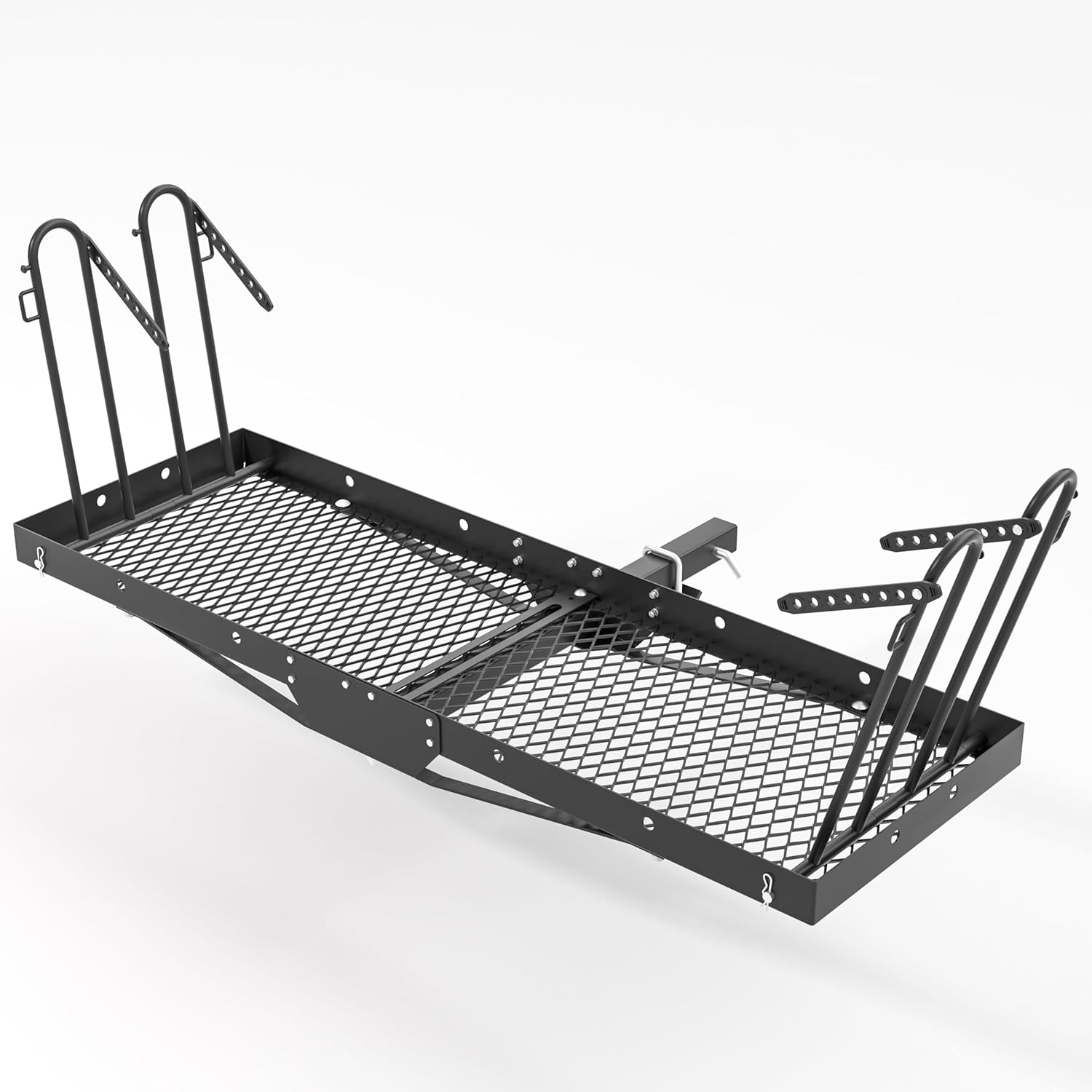
When it comes to transporting bikes and accessories, the MaxxHaul 2-in-1 is the way to go for families.Two issues, one snag. With a bike rack, your bags can remain safely inside. Bikes remain at home when placed in a basket.To start, on a 60 by 20-inch steel platform, two cradles are placed with straps; the bikes are placed on top, and the gear is placed below.The next step is to transform the rack into a flat cargo basket by folding or removing the cradles entirely.
Finally, a hitch tightener is provided, which is especially useful when carrying a heavy swinging bike.Downside: I can only have two motorcycles. Garding the 4-inch walls is necessary. The 500-pound capacity is quickly depleted by bikes and baggage.Those who like to camp and ride their bikes to their destination will love it. Avoid: homes with three bicycles.
3: CURT 18153 Folding Hitch Basket Cargo Carrier

You should invest in the CURT Folding as your go-to premium carrier for your daily driver’s vehicle.In garages and drive-thrus, it’s annoying when the rack is always protruding two feet from your bumper.The first is that, when not in use, the folding shank raises the basket so it rests against the car. Takes minimal effort, no removal required.The next step is an angled shank that raises the deck, eliminating scraping on steep driveways and speed bumps.
The last piece is a 60×24 tubular steel frame with 6-inch sides and a mesh bottom; nothing little will be able to fall through.Negative: You can’t install it by yourself because it’s the heaviest at 70 pounds. The package contains no contents. Grit is caught by the mesh.Perfect for people who use it every day and store it in the garage; it will endure longer than the car itself. Do not attempt this installation on your own.
2: REESE Explore 63153 Rambler Hitch Cargo Carrier

For tough, long-distance journeys, nothing beats the REESE Explore Rambler.Every weak weld on a cheap basket is exposed after miles and miles of cross-country dirt roads. You can expect that kind of mileage from the Rambler.A 60 by 24-inch platform with 5.5-inch rails is the first item to be mentioned. This is more than enough deck space for bikes, coolers, and camping gear all at once.The second feature is the increased ground clearance on gravel campground roads made possible by the two-piece design, which elevates the basket above the shank.
And last but not least: welded alloy steel with a full 500-pound dispersed capacity and a simple 2-inch receiver fit.Downside: the shank does not fold neatly; instead, it remains prolonged until you remove it. This is a standalone item. Mounting is easier with two individuals.Ideal for: rough-road campers and those who travel long distances by car. City drivers who require a folding rack should not purchase this.
1: MaxxHaul 80779 Aluminum Hitch Cargo Carrier with Ramp

The MaxxHaul Aluminum with Ramp, the one hitch cargo carrier you’ll never want to lift a load into, is ranked number one in 2026.The beginning is the same for the other carriers. You bring the hefty object up to your waist and place it in a basket. People give up on generators, scooters, and coolers at that point.To start, the deck’s rear features a 47-inch fold-down ramp. Prop a hand truck or scooter up on its wheels. Just this one thing does it everything.
Second, a mobility scooter or wheelchair may fit squarely on the 29.5-inch wide deck.Third, the entire 500 pounds may be supported by its rust-proof aluminum top and steel bottom support frame.The fourth piece of equipment is a set of high side rails that can be fastened to a rolling load in various ways.Drawbacks: the ramp increases the stored weight and length. Metal scratches at the points where the wheels rub against one another. Most of the decks here are longer than the 50-inch one.Ideal for: those who are carrying big gear or equipment with wheels on their own. Those who like to carry their belongings in duffel bags disregard this advice.
Things to Consider Before Buying a Hitch Cargo Carrier:
Most vehicle owners underestimate the importance of choosing the right hitch cargo carrier. Understanding the various options available can significantly impact your travel experience and vehicle performance. Before making a purchase, consider factors such as capacity, compatibility, and safety features to ensure you select the best fit for your needs.
Open Basket Carriers for Versatility
Open basket carriers provide a flexible solution for carrying various items. Their design accommodates oversized loads and can be easily accessed, making them ideal for spontaneous trips or last-minute gear additions.
Enclosed Cargo Boxes for Weather Protection
Enclosed cargo boxes protect your belongings from the elements. Sturdy construction and locking mechanisms keep your items secure while shielding them from rain, snow, and dust.
Choosing an enclosed cargo box offers peace of mind, especially during prolonged travels. Designed with robust materials, these boxes typically feature weather-resistant seals and reinforced bases. Options range from lightweight models for easy handling to heavy-duty variants suitable for rugged use, ensuring that all your gear arrives in pristine condition.
Specialized Carriers for Bikes and Heavy Equipment
Specialized carriers cater to unique transportation needs. Options like bike racks or carriers intended for heavy machinery ensure that items are transported safely without compromising vehicle dynamics.
These specialized carriers come with custom features tailored for specific loads. For instance, bike carriers often include cradles to secure bicycles without damaging them, while heavy equipment carriers may have ramps for easy loading and unloading. Selecting the right model guarantees that your gear travels securely and conveniently, adapting to the challenges of transportation.
Hitch Receiver Class and Tongue Weight Capacity
Choose a hitch receiver class that matches your cargo carrier’s specifications. For instance, Class III hitches typically handle up to 6,000 pounds with a tongue weight of 600 pounds, while Class II is limited to around 3,500 pounds. Knowing these details aids in selecting the proper carrier for your needs.
Ground Clearance and Departure Angle Considerations
Assess the ground clearance of your vehicle to avoid potential scraping or damage while driving. A low ride height could lead to difficulties when navigating uneven terrains, especially if the carrier protrudes significantly below the vehicle’s frame.
Manufacturers often recommend specific clearances to prevent contact with the ground, especially during inclines. Vehicles designed for off-road use typically have enhanced clearance to accommodate cargo carriers better. When purchasing, consider a carrier that maintains the necessary height above the ground to prevent wear and tear, which can otherwise lead to costly repairs.
Exhaust Pipe Positioning and Heat Shielding
Understand the exhaust pipe’s position relative to the hitch cargo carrier. Ensure there’s sufficient space to avoid heat damage to the carrier and its contents. Heat shielding can mitigate risks but does not eliminate the need for careful positioning checks.
Adjusting the carrier’s positioning may be necessary if the exhaust outlet is close. Excessive heat can cause deterioration of materials, especially for plastic or fabric cargo bags. Consider carriers designed with heat shields or variations that position the carrier away from exhaust emissions for better protection.
Advantages of Aerodynamics and Ease of Loading
Aerodynamic designs minimize wind resistance, enhancing fuel efficiency. Easy loading and unloading further streamline the process, making it simple to access gear quickly. Some models come with features like ramps or foldable designs, contributing to overall convenience during trips.
Limitations Regarding Vehicle Length and Rear Access
Vehicle length plays a significant role in how a hitch-mounted carrier performs. Longer vehicles may experience mobility issues or tighter turns, while access to rear compartments can become restricted. It’s crucial to account for these factors to ensure practical functionality when using a hitch cargo carrier.
Restricted rear access can lead to complications during loading, unloading, or even routine tasks like accessing the trunk. If your vehicle has a shorter design, this can mitigate issues, but many larger vehicles struggle with the added length of a hitch-mounted carrier. Owners must consider these limitations to avoid inconvenience during travel. Prior planning and measurements will help identify potential challenges and ensure that the carrier integrates smoothly with the vehicle’s overall design.
Calculating Total Payload Capacity
Assess your vehicle’s payload capacity, which includes the weight of the carrier plus any cargo. By knowing your vehicle’s limits, you can avoid overloading and ensure safe transport on the road.
Total payload capacity varies among vehicles. For instance, a mid-sized SUV might handle around 3,500 pounds, while a compact car may only support about 1,000 pounds. Always consult your owner’s manual for specific limits, as exceeding these can lead to dangerous situations and legal issues.
Testing Rear Camera and Sensor Clearance
Confirm that the cargo carrier allows unobstructed use of your vehicle’s rear camera and sensors. Limited visibility can affect driving safety and parking precision.
Clearance tests are imperative, especially in modern vehicles equipped with advanced sensors and cameras. Utilizing a measuring tape, assess the distance from the carrier to these sensors or cameras when installed. A minimum gap of several inches can help maintain functionality, ensuring your vehicle’s safety features remain operational while carrying additional loads.
Preventing Corrosion and Finish Degradation
Corrosion poses a significant threat to hitch cargo carriers, especially those exposed to moisture. Applying a protective coating, like rust-inhibiting paint or a sealant, can shield the metal from harsh weather. Cleaning the carrier regularly, using mild soap and water, also helps maintain the finish and prevents degradation over time.
Folding Mechanisms and Compact Storage Solutions
Folding mechanisms offer significant advantages for storage, allowing the carrier to occupy minimal space. Many models feature a simple lever or latch system, making it easy to collapse the carrier when not in use.
When choosing a hitch cargo carrier, examine folding designs that facilitate easy storage. Some models can be reduced to half their size, making them ideal for tight garages or small storage areas. Investigating options with integrated wheels can further simplify transportation and movement. Compact folding carriers ensure that space is not wasted and provide convenience when the carrier is not in service.
Conclusion
Evaluating factors such as weight capacity, compatibility with your vehicle, and intended use ensures a suitable choice in a hitch cargo carrier. Assessing these aspects not only enhances safety but also improves your travel experience, allowing for efficient transportation of gear or luggage.
Leave a Reply