
Searching for the best long-distance walkie talkies that won’t fail when you need them most? It’s incredibly frustrating when your signal drops mid-adventure. Reliable two-way radios are essential for staying connected off-grid. We’ve tested the top models to find devices with an impressive communication range, guaranteeing you can explore with confidence. Let’s dive into the radios that truly go the distance and discover which one is perfect for you.
Contents
- Top 5 Long-Distance Walkie Talkies:
- 1. DEWALT DXFRS800 Walkie Talkies
- 2. Cobra RX680 Walkie Talkies
- 3. Midland GXT1000VP4 Walkie Talkies
- 4. Cobra ACXT645 Waterproof Walkie Talkies
- 5. Retevis RB48 Waterproof Walkie Talkies
- Things to Consider Before Buying a Long-Distance Walkie Talkie:
- Analog vs. Digital
- FRS vs. GMRS vs. Ham Radio
- Range and Signal Strength
- Battery Life and Power Options
- Advantages of Using Walkie Talkies
- Limitations to Keep in Mind
- Brand Reputation and Reviews
- Setting Up Your Walkie Talkie
- Communicating Effectively
- Keeping Your Device Functional
- Troubleshooting Common Issues
- Final Words
Top 5 Long-Distance Walkie Talkies:
1. DEWALT DXFRS800 Walkie Talkies
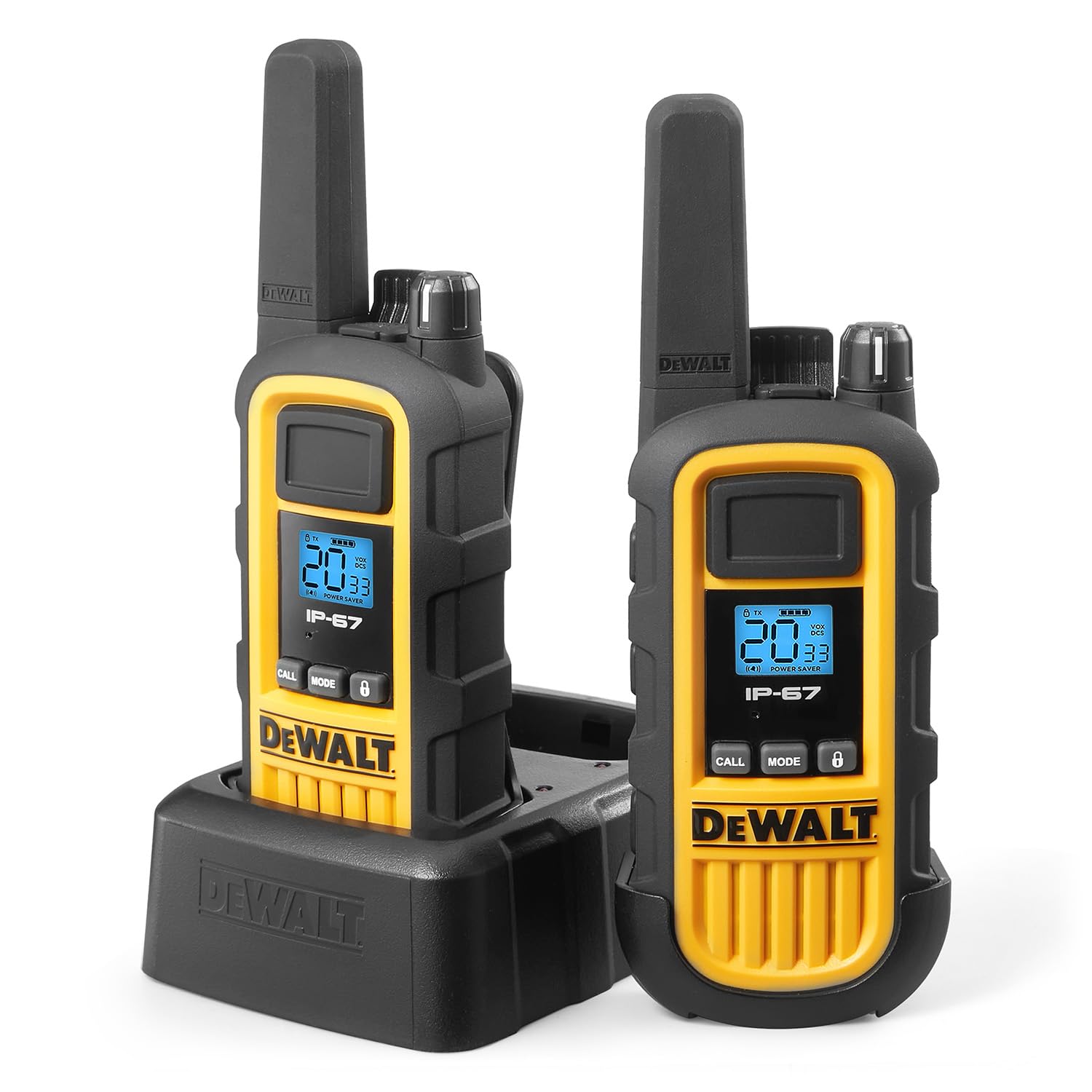
If you’re looking for reliable long-range communication in the midst of a bustling jobsite, then the DEWALT DXFRS800 was made just for you. With 1W of RF power, you can get blanket coverage for as many as 250,000 sq. ft., or 20 floors under typical conditions, and up to 2 miles in open field line of sight—you depend on it when looking to deliver results across work operations.
You have the control to keep conversations clear in private. The radio features 22 FRS channels with 121 privacy codes to minimize interference, and an auto-squelch feature to filter out background noise for clear instruction the first time.
Durability is a given. IP67 rated, the radios are waterproof and fine with rain, grit and jobsite dust. Its heavy duty, anti-slip housing protects your communication line to a depth of 2 meters from a drop so you’re never out of reach.
Power handling is useful and no-nonsense. The 3.7V DC system and battery-saver technology provide a minimum of 12 hours of use, so you won’t be chasing your charger all shift long. That reliability helps you spend less time paused, and get work done throughout the day.
In other words, you get long range, clean audio and serious toughness all in one package. If you’re looking to keep groups connected and well-organized; the DXFRS800 is truly made for job site conditions As a leader on the jobsite, you deserve a two-way radio that can help you move people, materials, supplies and information easily and efficiently from point A to point B.
2. Cobra RX680 Walkie Talkies

If you need long-range communication to accompany those outings, the Cobra RX680 is your solution. You receive up to 38 mile maximum range in perfect conditions so you can stay in touch and contact your family or friends no matter down open run trial, lakes or wild camp. Thanks to the splashproof Ipx4 construction, both radios are able to survive a little rain and a lot of dust.
You have many different channel options to maintain clean chatter. Choose from 60 privacy codes (also included) to find an available channel.Unlike other GMRS radios on the market, Midland’s dual power option allows the use of rechargeable battery packs (included) or 4 “AA” Batteries16-Mile Range22 Channels with Easy Button AccessWhether you’re at a park, the mall or even hiking, if your family is large or small, the LXT118 has you covered! The two-way handheld radio allows hands-free communication using Voice-Activated Transmission (VOX) and makes shutting out noise due to weak signals or interference easier, ensuring audio clarity.
And you also get some handy safety accessories in case things take a turn for the worse. Become weather informed Stay safe and informed with one of the most reliable sources of weather updates. OSError Alert is ideal for receiving the latest weathe alerts and warnings.In addition, this radio features an LED flashlight. There’s also a built-in LED flashlight to find your way around the campsite or read maps on the trail and an SOS function so you can signal for help easily.
It is easy and convenient to power up, thanks to rechargeable coin-cell battery with 20 hours of battery life, and quick access control means you can spend less time with your hands on the headset, and more time playing. If you’re seeking a reliable range,long lasting protection and features designed around your needs,the RX680 helps keep you connected and confident at every destination.
3. Midland GXT1000VP4 Walkie Talkies

If you want reliable, long-range communication on an outdoor adventure or in your neighborhood, the Midland GXT1000VP4 is a sure bet. You can take advantage of up to a 36-mile maximum range under ideal conditions, to keep in touch with the kids or your buddy while you re doing your thing out in nature across fields, trail systems or at that legendary multi-stage festival for your favorite artists. The radio offers up to 3,000 channel combinations with about 51 GMRS channels made available by the NOAA government alert for active frequency easily with channel scan and a push button.
You’ll be so hands-free. EVOX voice activation with 9 sensitivity levels help eliminate need for hand-botton pressing when communicating with dun/delicate situations such as hiking, biking and hunting. JIS4 water resistance repels splashes and light rain, while the lightweight design won’t slow you down during all-day trips.
And you have smart controls that prevent error. Keypad lock prevents accidental changes, Silent Operation quiets beeps and tones when it matters (like in the Big Buck woods), and NOAA Non-Stop Weather Alert keeps you abreast of breaking weather news. Sound remains crisp, as does the interface — which means being less fiddly and more kinetic.
Power is flexible, too. Use included rechargeables in your home or car, or on the go with standard alkaline batteries. If you’re seeking reliable range, practical durability and ease of use, the GXT1000VP4 is a highly effective way to stay connected with family or friends while in the outdoors on trips, during group activities and more.
4. Cobra ACXT645 Waterproof Walkie Talkies
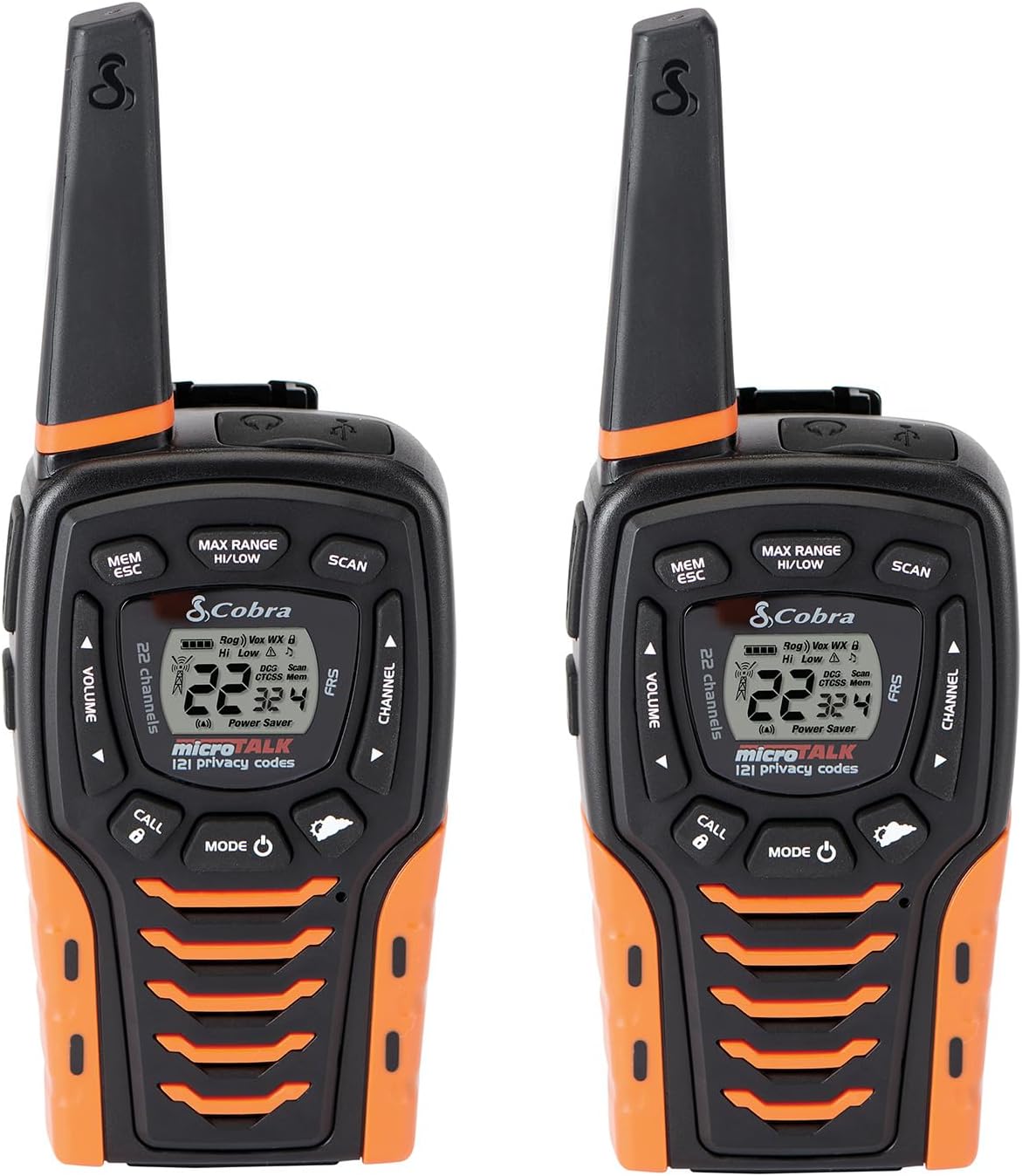
If you are in need of a heavy duty and easy to use radio that is ready for the next challenge and outperforms all other radios on the market, the Cobra ACXT645 has what you have been looking for. You are able to get up up to a 35 mile maximum range in favorable conditions, which provides you with comfortable communication when on the trails, working or exploring new areas of your property. Built splash resistant IPX4 and drop tested technology provides extended use, no matter what the weather has in store, after a cutting charge time of 5 hours you can work for up to 40 minutes on this cordless trimmer.
You guide the dialogue with simplicity and privacy. Select from 22 channels and 121 privacy codes to help eliminate interference around other hikers or hunters. With a range of 400-512 MHz UHF, the ACXT645 delivers clear audio around obstruction better than most low power users.
Hands full? VOX (Voice-Activated Transmission) can automatically transmit when you speak, perfect for hands-free activities, or use the radio’s keypad lock to prevent key tones from activating as you carry the radio. Cobra’s exclusive VibrAlert provides a silent alert for incoming calls whenever quiet operation is required.
The on-board LED flashlight is handy when you’re in a dark place or need a makeshift strobe light, and the handy SOS function is pr-grammed to flash an SOS distress signal with a simple press. The controls are familiar and intuitive meaning there’s less time fiddling with settings and more plane flying to be had!
If you’re in need of reliable long range performance, look no further than the midland 36 mile GMRS two way radio.
5. Retevis RB48 Waterproof Walkie Talkies

If you’re looking for a tough license-free radio you can rely on in lousy weather and worse work, the Retevis RB48 delivers. You receive IP67 “triple-proof” protection—complete water and airtight sealing—around a tested 2-meter drop-rated body so rain, dust and hard knocks don’t compromise your comms. Around extensive sites or large buildings, you can extend up to 300,000 sq. ft., or 25 floors stable, clear FRS/GMRS transmission covering distances of up to 18 miles on water conditions, and greater output than FRS on this channel.
Power is built for long days. The 2000Mah battery provides up to 20 hours of power supply on a single charge, so you can stay charged up wherever you go – all day long!with USB-C charging and a sleek desktop stand/charger, your Feets to headphones are ready to go when you are. The high visibility yellow body is easy to see in low-light conditions, and silicone coated buttons are easy to use with gloves on. Enable the roger beep to confirm transmissions without having to have an after thought.
Gloves on? Large dual PTT buttons on the front are easy to find, read and operate with gloves, and a Key-Lock secures your channels to prevent accidental channel changes. An emergency siren makes solo tasks or remote locales safer. Reinforced back clip with tri-rib design stays clipped to boots and resists flexing when you walk, bend, squat or climb as it keeps your socks tucked in simple hikes, hunts or constant wear during long field days.
If you’re supervising crews, leading a team or on a jobsite, the RB48 delivers durability, range and all-day power so you can stay connected and focus on the job.
Things to Consider Before Buying a Long-Distance Walkie Talkie:
Most users underestimate the impact of range, battery life, antenna design, frequency band and licensing, durability, and accessory compatibility; you should evaluate your required communication distance, operating environment, power options, and legal constraints to select a reliable long-distance walkie talkie.
Analog vs. Digital
Analog FM gives you straightforward, low-cost radios that work well within 1–10 miles in open areas, but suffer static and weaker reception at range; digital standards like DMR and P25 deliver cleaner voice, time-division or trunking features, up to about 30–40% better usable range in tests, plus text/data capabilities and often longer battery life thanks to efficient signaling.
FRS vs. GMRS vs. Ham Radio
FRS suits casual users with unlicensed 2W limits and sub-2-mile urban ranges; GMRS requires an FCC family license in the U.S., supports higher power and repeaters for practical 5–25+ mile links; amateur radio needs a license exam but opens HF for hundreds of miles and flexible VHF/UHF repeater networks, so you choose based on required range, legal access, and features.
Licensing distinctions matter: GMRS licenses cost about for 10 years in the U.S. and cover your immediate family, letting you run mobile radios with higher wattage and external antennas; ham licenses start at Technician (no fee beyond test) and unlock repeaters, simplex and HF privileges as you upgrade; tactical setups often pair GMRS for local ops with an amateur HF/UHF plan for regional reach. After you secure the appropriate license you can legally use higher power, repeaters, and antennas to maximize reliable long-distance communications.
Range and Signal Strength
Line‑of‑sight claims like “up to 50 miles” are marketing; realistic range depends on terrain: you can expect 0.5–2 miles in urban areas, 5–15 miles in hilly country, and 20–30+ miles across flat open water with high antennas. UHF penetrates buildings better while VHF carries farther over open ground. Choosing 3–5 W transmit power and a high‑gain or external antenna can multiply the practical reach you achieve versus a stock portable.
Battery Life and Power Options
Battery chemistry and capacity shape how long you can operate: Li‑ion packs (1500–3000 mAh) typically deliver 12–24 hours standby and faster recharge; NiMH packs (2000–2500 mAh) are heavier but often user‑replaceable; AA alkaline or rechargeable cells provide universal backup. USB‑C fast charging, vehicle 12V adapters, and swappable spare batteries let you plan multi‑day use. Higher TX power and frequent transmission notably reduce runtime.
Estimate runtime by duty cycle: with a 2000 mAh Li‑ion pack and a 10% transmit/30% receive/60% standby profile, you can expect roughly 10–14 hours; raising transmit time to 30% can cut that to 5–7 hours. Li‑ion holds about 80% capacity after 300–500 cycles and loses efficiency below 0°C unless insulated. Carry a 12V car adapter, a 20–30 W solar panel, or a high‑capacity power bank for extended remote operations.
Advantages of Using Walkie Talkies
You achieve immediate team coordination with sub‑second PTT response, reliable group calls across designated channels, and autonomy from cellular networks. Many long-range models offer configurable power up to 15W (GMRS/PMR variants), IP67 sealing, and battery options delivering 8–24 hours depending on duty cycle, making them ideal for search-and-rescue, event logistics, and off-grid operations where predictable, low-latency comms matter.
Limitations to Keep in Mind
Obstacles like hills, buildings, and dense foliage can reduce advertised range dramatically; in cities expect 0.5–3 miles versus 20–50+ miles line-of-sight with elevated antennas. You may also face channel crowding, limited encryption/privacy, and regulatory requirements for higher-power bands that affect legal use and setup.
In practice, a handheld rated for 20 miles rarely reaches that in valleys or urban canyons; mounting a high-gain antenna on a mast or vehicle often multiplies effective distance. Battery management matters—carry spare packs or use USB charging for extended ops—and verify local licensing (GMRS/other bands) before deploying higher-power units to avoid fines and interference issues.
Brand Reputation and Reviews
You should vet manufacturers and read pattern-based reviews: Motorola and Midland dominate consumer two-way radios, while Kenwood and Icom are common in business and amateur markets. Scan retailer reviews, YouTube range tests, and community forums for recurring issues like battery degradation or charging faults, and prefer brands that offer clear warranty terms (1–3 years) and accessible customer support.
Dig deeper into reviews by prioritizing long-term user feedback that measures battery capacity after 12–18 months, real-world range tests in similar terrain, and reports of firmware updates or hardware recalls. Compare independent lab or teardown tests for receiver sensitivity and measured output, verify FCC certification markings, and check replacement-part availability—these specifics reveal whether a brand’s short-term praise translates into reliable service life.
Setting Up Your Walkie Talkie
Charge the unit, insert battery, and power on; choose UHF for urban/indoor use or VHF for open rural areas, set the same channel and CTCSS/DCS code on all units, select High power (around 5W) for long-range needs, attach the antenna securely, configure NOAA/weather and emergency channels if available, and run a quick range test in an open field to verify expected performance.
Communicating Effectively
Speak directly into the mic about 2–3 inches away, press PTT then pause ~0.5 seconds before speaking to avoid clipping, use short, structured messages (e.g., “Base to Team Alpha: Route clear, ETA 10 min, over”), employ the NATO alphabet for clarity on critical letters, and keep transmissions under 20 seconds to free the channel.
Establish channel etiquette: assign a primary channel and a dedicated emergency channel, schedule check-ins (every 30–60 minutes on lengthy ops), avoid conversational chatter on operational channels, log channel use and battery swaps, and if you rely on GMRS/FRS features verify local licensing—GMRS in the U.S. typically requires a license for higher power or repeater use.
Keeping Your Device Functional
You should maintain batteries by cycling Li‑ion packs every 300–500 charges and avoid storing them fully depleted; keep storage charge around 40–60% and temperatures between -20°C and 60°C. Wipe contacts and antenna base with 70% isopropyl weekly after heavy use, tighten loose connectors, and run firmware checks every 3–6 months. Aim for IP67/68-rated units if you operate in wet environments to reduce corrosion and ingress failures.
Troubleshooting Common Issues
Start by confirming battery voltage with a multimeter—many handheld packs sit at 7.4–7.6V—and verify the antenna is fully seated and not kinked; misaligned antennas can cut range by 50–90% in obstructed environments. Switch channels to avoid local interference, lower squelch to detect weak signals, and inspect RX/TX LEDs to confirm transmit function before pursuing repairs.
For deeper fixes, perform a soft reset (hold power for ~10 seconds), reflash firmware using the manufacturer’s USB tool, and reprogram channels with the correct frequency offsets. Replace worn rubber seals to prevent moisture entry, log error codes and serial numbers, and if transmit power seems low have a service center measure output watts and SWR to isolate PA or antenna faults.
Final Words
Taking this into account, you should evaluate range, frequency band, power output, antenna quality, battery life, durability (IP rating), legal restrictions, and interoperability with your existing radios. Test real-world performance in your terrain, verify encryption and privacy features, and factor in weight, mounting options, and support warranties. Choose a model that balances reliable long-range communication with ease of use and compliance with local regulations to meet your operational needs.
Leave a Reply