
Discover the Best MP3 Players that combine sleek design with amazing sound quality right from the start. If you’re frustrated by bulky gadgets and subpar audio, this guide offers a refreshing solution. We reveal top portable MP3 players known for stellar battery life and crisp clarity—a true game-changer for your music experience. Get ready to upgrade your tunes and enjoy every beat as we dive into the heart of high-quality audio options.
Contents
- Top 5 MP3 Players:
- 1. Sony NW-A306 Walkman Digital Music Player
- 2. HiBy R4 MP3 Player
- 3. SHANLING M6 Ultra MP3 Player
- 4. Surfans F20 MP3 Player
- 5. Hifi Walker H2 Touch MP3 Player
- Things to Consider Before Buying a MP3 Player:
- Sound Quality vs. Features: Finding Your Balance
- Storage Capacity: How Much is Enough?
- Codec Compatibility: The Unsung Hero of Sound Quality
- Battery Life: Power for the Long Haul
- Screen Size and Interface: Choosing for Convenience
- Durability and Portability: Built for Your Lifestyle
- Wireless Technology: Embracing Bluetooth and Beyond
- Software and Updates: Ensuring Longevity of Your Device
- To wrap up
Top 5 MP3 Players:
1. Sony NW-A306 Walkman Digital Music Player

If you’re taking your music life off the phone, the NW-A306 Walkman Digital Music Player is her to accompany you in all the high-quality you need. Sony opted for Android 12 when building the interface, so you’re going to see the same menus and apps you’re already used to — very handy, but if you want your music-listening experience to be separate from phone tasks, that can feel like overkill. You might also perceive the touchscreen as a touch less responsive than you’re accustomed to.
And what matters most — sound — falls squarely in your favor. What you do get is a pleasant, enjoyable presentation that seems to handle both everyday tracks and hi-res files with the same nurturing touch, encouraging long, immersive listening sessions.
Be aware of storage. It’s marked as 32GB, but Android 12 opens up about 18GB for your own use. If your preference sways lossless or you’re up for regularly carrying many albums, you may need to expand. It also has a microSD slot that accepts 512 GB cards — and, reportedly, 1 TB cards should work as well.
Opt for the NW-A306 if you like your music to be free from notifications and distractions, and believe a player that’s small sounds better than it should. Suffer the minor trade-offs — things like some duplicated phone functions and not entirely smartphone fast touchscreen response — and you’ll get a compact system that lets you keep your attention focused on the one thing in front of you: your music. Throw on a bigass microSD card, load your library, and you’re set for actual on-the-go listening.
2. HiBy R4 MP3 Player

If you’re in the market for a high-end digital audio player that actually comes through, the HiBy R4 is one to watch. The Standard eschews the usual compromises for tight, fast and ripping player you’d expect to pay a lot more for.
You’ll find a Snapdragon 665 and Android 12 on board, ensuring you get speed and fluidity and good app support. That’s because your local library and all your favorite streaming services are also represented here, and whether it’s the latter or Spotify, both are quick to load, meaning you spend more time listening and less time waiting. Still, battery life stands strong: you can look forward to approximately 10.5 hours from the 3.5mm output, and close to 8.5 hours from the balanced 4.4mm output, according to testing. Of course, your actual results will differ based on the volume level, headphones, gain and so on, as well as whether you’re streaming or playing local files.
If you’re power hungry, the R4 has plenty of headroom even for hard-to-drive headphones and IEMs and also minimal noise with sensitive models. Menus are responsive, playback is reliable, and what you have is the reassuring feel of a device designed for serious listening and not bailing out on quirks.
If you’ve been kicking around choices at this price, you will find that the R4 — able to compete with, and consistently beat. For a small, agile player that spans local libraries and current streaming without skimping on muscle or value, the HiBy R4 is a no-brainer.
3. SHANLING M6 Ultra MP3 Player

If you want a sweet mid-range digital audio player that is mature, fast and musical, you want the Shanling M6 Ultra. Years of development are evident in its slim, comfortable-to-hold design and its whisper-quiet yet mighty internals, netting you a player that falls out of the way and lets the music take the lead.
Internally, quad DACs and dual amps ensure a clean dynamic drive with excellent headroom. With competent headphones, you’ll get a lively, detailed and authentic presentation that does justice to the source. Support is high-res uncompromised, with 16x MQA unfolding and DSD512 playback meaning your library – streamed or local – gets the treatment it deserves.
You feel the upgrade in daily use. The reasonably priced Snapdragon 665 platform offers a snappy, reliable interface that excels more expensive players. Smooth and stable App launches, library browsing and streaming allow you to get to your music playlist with minimal frustration.
Battery life is long enough to prevent over-use: about 13 hours from the 3.5 mm single‑ended output, and 10 hours or so on the balanced—pretty good considering the size and power here. Whether you’re commuting, working or winding down, you receive the consistency you can rely on.
If you’re ready for on-the-go audiophile sound without the silly sacrifices so many of the old, traditional DAPs seemed to demand, the M6 Ultra makes it easy to step up—and stay focused on what matters most: just the music.
4. Surfans F20 MP3 Player

If you’re after a no‑nonsense HiFi player that prioritizes your music library, the Surfans F20 does the job. It’s made for collectors who have their music on an SD card, who like having files to own and don’t want to juggle the pesky streaming apps the rest of us enjoy. What you do get, though, is high‑resolution playback supporting all the major lossless formats, and Bluetooth output for when you want to be free of cables.
You’ll experience a spacious, open soundstage, a lovely clean, inky-black background, and more than enough oomph to power a great number of wired headphones with assurance. The lack of a touchscreen isn’t a downside here — it’s the reason. You keep your eye on the music, not swiping against distractions.
The F20’s tank‑like build, tactile, clicky buttons and satisfying scroll wheel mean that its everyday use is intuitive. Your fingers as the input devices just trip out, so you can use the thing by feel, in your pocket, on your commute, on your desk. It’s built to last, reliable and does one thing, play your music.
If you prioritize reliability, simplicity and quality of sound over app stores and eternal updates, the player is a strong purchase. It is a true audiophile DAP at an affordable price, and is extremely popular among budget DAPs. Load your SD card, press play and have the kind of laser-focused listening experience that reminds you why you built a library in the first place.
5. Hifi Walker H2 Touch MP3 Player
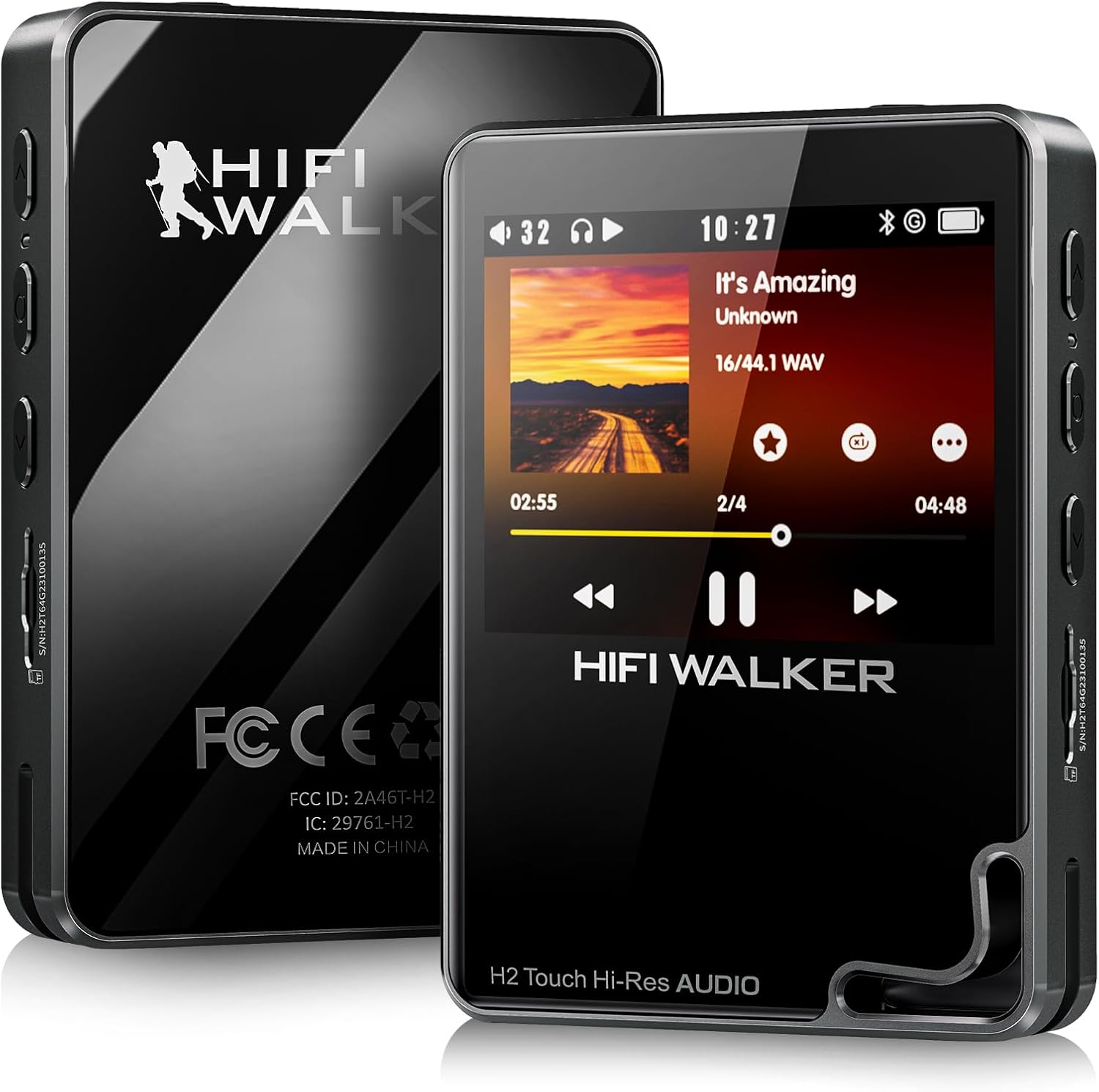
If you are looking for a low cost way to hear more from your music without compromising on portability, H2 Touch Hi Res MP3 Player has the answer. And it has some impressive shoes to fill: the highly-rated Hifi Walker H2 which keeps the compact size and clean, engaging sound you want while turning things high-tech with a responsive touchscreen for quicker, more intuitive control.
You have wide support for high-res music files, which means that your high-end collection plays as deep and nuanced as it was meant to be experienced. At the heart is a widely respected Sabre DAC, selected due to its’ clear, low noise and extremely dynamic sound. That means more detail, better timing, and a more natural presentation regardless of whether you’re listening at home in peace or on the move.
There’s a feeling of simplicity when navigating: you swipe through albums and artists, build playlists, and get to what you want as fast as possible. The small, pocketable design makes it convenient to have with you on a daily basis, and the interface is functional enough to keep you listening without getting lost in menus.
Deliver us from boredom with an intelligent companion just waiting to jump into high-resolution audio—or out from the basic DAP model, into a gyro of unceasing creativity.Handler of DSD Doxology, ransomer of the Inaudible and the Visible;gateway from the Lifestyle-Into-something-New: Here is the H2 Touch. It’s an affordable, enjoyable option when you want to hear your music as it was intended to sound.
Things to Consider Before Buying a MP3 Player:
Over time your listening needs evolve, so you should evaluate storage, battery life, audio quality and codec support, portability, build durability, user interface and connectivity to ensure the MP3 player matches your routines, device compatibility and budget.
Sound Quality vs. Features: Finding Your Balance
Choosing top sound means checking DAC chip, output impedance, SNR, and support for 24‑bit/96–192 kHz or DSD playback, which often increases size, cost, and power draw. Opting for features like Wi‑Fi streaming, aptX/LDAC Bluetooth, touchscreen, and apps enhances convenience but can compromise raw signal purity. If you want both, target midrange DAPs around $200–$400 that pair competent onboard DACs with wireless codecs—otherwise decide whether you’ll value pristine output or everyday usability more.
Storage Capacity: How Much is Enough?
Your storage needs hinge on file formats: a 4‑minute MP3 at 128 kbps is roughly 4 MB, at 320 kbps about 10 MB, while lossless FLAC typically runs 20–30 MB per track. Using those figures, 16 GB holds roughly 3,500–4,000 128 kbps songs, about 1,500–1,600 at 320 kbps, or only 500–800 FLAC tracks. Prefer players with microSD slots if you expect your collection or hi‑res purchases to grow.
Estimate usage patterns before committing: if you mainly stream with occasional offline playlists, 16–32 GB suffices; if you buy hi‑res albums, plan for 128 GB or more—24‑bit/96‑kHz files can range ~50–150 MB per 4‑minute track depending on compression, so a 128 GB card might hold roughly 1,000–2,500 such tracks. Factor in long podcasts and audiobooks (tens to hundreds of MB each). Prioritize expandable storage (many players accept microSD up to 1 TB) when you want a full lossless library on the go.
Codec Compatibility: The Unsung Hero of Sound Quality
Check file and Bluetooth codec support: FLAC/ALAC for lossless, MP3/AAC for space-savers, and DSD or MQA if you pursue studio masters. For wireless pairing, LDAC and aptX HD deliver higher bitrates than SBC or standard AAC, but both player and earbuds must support them. You’ll get subtle but audible differences—320 kbps MP3 vs FLAC is noticeable to trained ears, while LDAC at 990 kbps approaches lossless over Bluetooth.
Battery Life: Power for the Long Haul
Look beyond advertised hours and consider usage: local MP3 playback on basic players often yields 20–50 hours, touchscreen DAPs with Wi‑Fi and high-res decoding typically run 8–15 hours. Bluetooth streaming, high sample rates (96–192 kHz), and active EQ drains battery faster. You’ll want accurate real-world figures—manufacturer claims are often measured under ideal conditions with screen-off, wired earbuds, and no wireless connections.
Battery capacity (mAh) and device power draw determine runtime: a 3000 mAh, 3.7 V cell equals about 11.1 Wh, so if the player consumes ~0.5 W you’d expect ~22 hours. Lithium-ion cells generally retain ~80% capacity after 300–500 full charge cycles, so plan for gradual decline. Fast-charging via USB-C can top you up quickly, but wireless streaming, high-output amplification for planar-magnetic headphones, and decoding DSD/MQA increase drain significantly. You can extend runtime by lowering screen brightness, disabling Wi‑Fi/Bluetooth, using wired lossless files instead of streaming, or pairing with efficient IEMs rather than power-hungry over-ears.
Screen Size and Interface: Choosing for Convenience
Smaller screens (1–1.5″) with tactile buttons let you operate the player with gloved hands or during runs, while 2.4″–3.5″ color touchscreens provide album art and playlists at a glance. You’ll trade off battery life—color touch interfaces often reduce runtime by 20–40%—and responsiveness; look for OLED for deep blacks, 240×320 or higher for crisp menus, and physical controls if you exercise frequently.
Durability and Portability: Built for Your Lifestyle
Rugged options with IP67/IPX7 ratings survive sweat, rain, and accidental drops—IP67 means dust-tight and 1 m immersion for 30 minutes—while MIL‑STD‑810G certifications indicate military-grade shock resistance. You should prefer rubberized edges or silicone sleeves for workouts, metal bodies for daily wear, and models under 100 g if you carry the player on runs or commutes to minimize bulk.
Tradeoffs matter: aluminum bodies dissipate heat and resist scratches but add weight, whereas plastic keeps devices light and inexpensive. MicroSD expansion (commonly up to 512 GB) preserves storage without swapping files, and removable batteries are rare—expect sealed units. Choose wired 3.5 mm jacks for lossless listening or Bluetooth 5 with aptX/LDAC support if you want wireless high-res audio while staying active.
Wireless Technology: Embracing Bluetooth and Beyond
Bluetooth 5.2 introduced LE Audio and Auracast for multi-stream and broadcast listening, while Sony’s LDAC can push up to 990 kbps for higher-quality wireless audio. You should prioritize LDAC or aptX Adaptive support, multi-point pairing, and Auracast compatibility; still expect USB-C wired output or Wi‑Fi streaming for true 24‑bit/96kHz lossless playback and low-latency needs.
Software and Updates: Ensuring Longevity of Your Device
Seek players from brands that publish firmware updates for at least 2–3 years; ideally 3–5 years of support. Updates commonly add codec support, battery optimizations, and app compatibility. You should check manufacturer changelogs and community forums—brands like Sony, FiiO, and Astell&Kern have histories of periodic firmware releases that extended device features beyond launch specs.
Confirm whether updates are delivered OTA or require a PC and whether firmware is signed—OTAs simplify security patches and help keep Widevine/PlayReady DRM working with Spotify, Tidal, and other apps. Examine update cadence (monthly vs. quarterly), review past changelogs for concrete fixes, and scan Head‑Fi or XDA threads for community-driven patches; active user communities often provide unofficial ROMs or workarounds that extend a player’s usable life.
To wrap up
As a reminder, you should weigh storage capacity, battery life, audio format support, and sound quality against size and durability; check user interface, file transfer options, and compatibility with your devices and streaming services; consider expansion slots, waterproofing, and extra features like Bluetooth or EQ presets; set a realistic budget so you get the features you need without overspending.
Leave a Reply