
Finding the best portable air conditioner shouldn’t be a struggle during a sweltering heatwave. If you’re tired of tossing and turning in a stuffy bedroom, you need reliable cooling power that moves with you. We’ve tested the top energy efficient models to ensure you get instant relief without the high utility bills. This guide reveals the ultimate picks to transform your home into a crisp, refreshing sanctuary. Let’s dive into our top-rated choices.
Contents
- Top 7 Portable Air Conditioner:
- 7: Feelfunn 8000 BTU Portable Air Conditioner
- 6: Shinco 8000 BTU Portable Air Conditioner
- 5: hOmeLabs 12,000 BTU Portable Air Conditioner
- 4: Frigidaire 10,000 BTU Portable Air Conditioner
- 3: BLACK+DECKER 12,000 BTU Portable Air Conditioner
- 2: Whynter ARC-14S 14,000 BTU Dual-Hose Portable AC
- 1: Whynter ARC-1230WN 12,000 BTU SACC Dual-Hose Smart Portable AC
- Things to Consider Before Buying a Portable Air Conditioner:
- Single-Hose vs. Dual-Hose Configurations
- Evaporative Coolers vs. Refrigerant-Based Units
- Calculating BTU Requirements for Room Dimensions
- Evaluating Noise Levels and Decibel Ratings
- Selecting the Optimal Window for Venting
- Securing the Exhaust Hose and Window Kit
- Routine Filter Cleaning and Replacement Schedules
- Managing Condensation and Manual Drainage
- Understanding EER and CEER Ratings
- Utilizing Programmable Timers and Eco Modes
- Summing up
Top 7 Portable Air Conditioner:
7: Feelfunn 8000 BTU Portable Air Conditioner

The Feelfunn 8000 BTU is an excellent choice for renters looking for a budget-friendly portable air conditioner.Steam is rising from your apartment. Spending won’t get you the true cooling you need.Here you may get the Feelfunn for the best price.The first is the 8,000 BTU ASHRAE, which is enough to chill a 350 square foot bedroom or studio. Quick alleviation.Next, a device that can chill, fan, and dehumidify all at once. Eliminates as much as 45 quarts of water every day.
Never again will you need to babysit it thanks to the 24-hour timer and full-water warning. Included is the remote.Drawbacks: less efficient than dual-hose devices due to single-hose design. Absence of intelligent regulation. The 350 square foot ceiling severely restricts the accessibility of more expansive areas.Roommates on a tight budget will love this place. Larger flats or individuals desiring app control are not suitable.
6: Shinco 8000 BTU Portable Air Conditioner
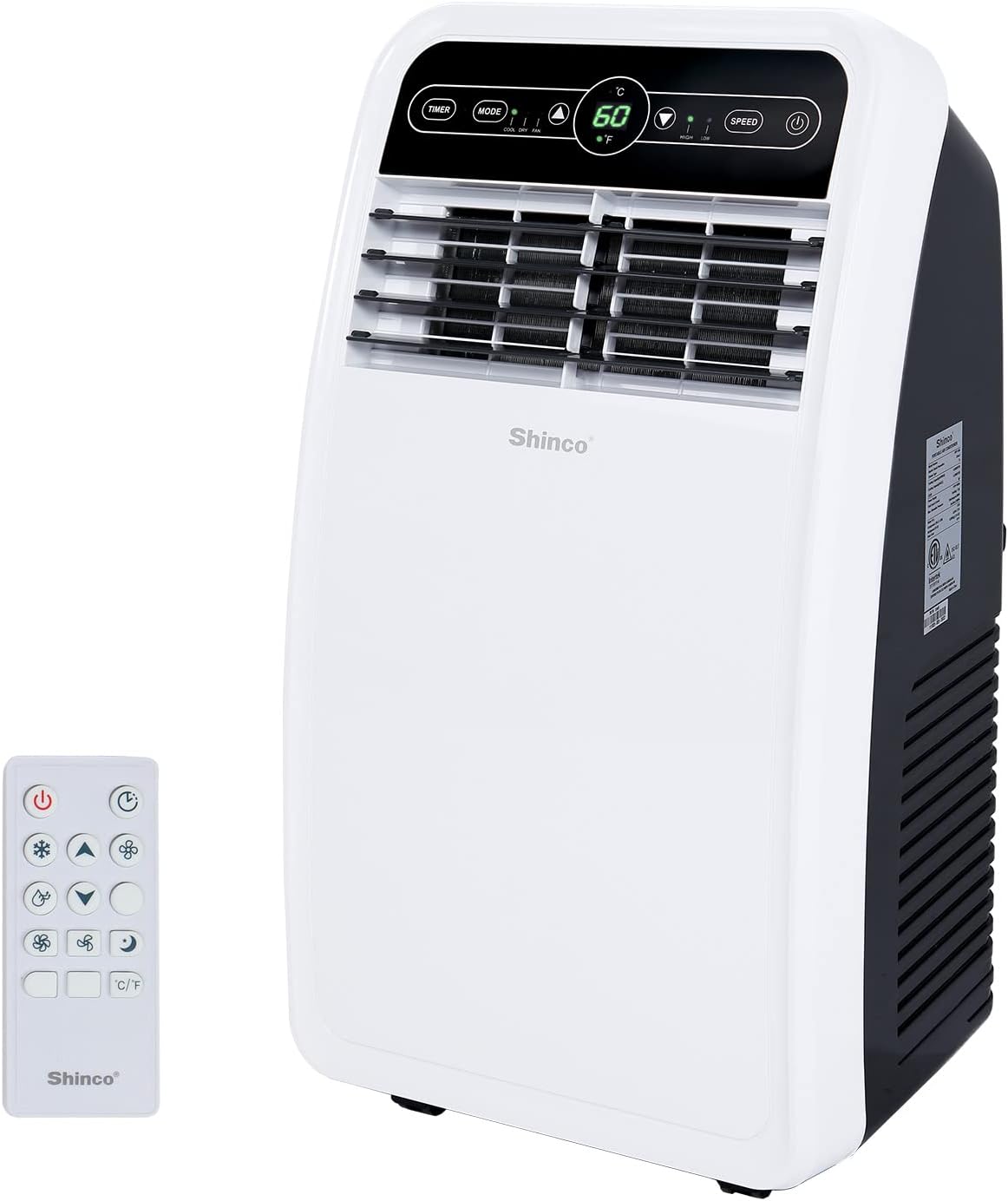
One of the most reliable and affordable portable air conditioners is the Shinco 8000 BTU.Spend less with the Feelfunn. Reviews, however, speak louder than specs ever will when it comes to reliability.One option is a single-hose model with 8,000 BTUs, which is sufficient for cooling 350 square feet of space, such as a bedroom or studio unit. The BTU and track record are same.The next process is self-evaporation, which leads to the automatic release of moisture through the vent pipe. There is no water tank that needs to be emptied in the middle of the session.
Lastly, a full remote for total control without getting out of your seat, a 24-hour timer, and three-in-one modes.Disadvantages: less efficient than dual-hose devices; only one hose available. A lack of control over the app. Rooms with a 350 sq. ft. ceiling are very spacious.Ideal for: tenants on a tighter budget who value dependability. Large areas or those requiring WiFi will not be accommodated.
5: hOmeLabs 12,000 BTU Portable Air Conditioner

As a mid-range upgrade, the hOmeLabs 12000 BTU is ideal for bigger apartments.Standard 8000 BTU is the maximum capacity of inexpensive air conditioners. They aren’t suitable for spaces larger than one room.In order to avoid charging premium prices, hOmeLabs increases to 12000.At the top of the list is the 12,000 BTU ASHRAE system, which can chill an area as large as 450 square feet. Taken care of: spacious bedrooms, open-concept studios, and living rooms.The next feature is a multi-function appliance that can cool, fan, and dehumidify all at once. Managing both temperature and humidity simultaneously.
Last but not least: set it and forget it installation—window kit and programmable timer included. Quick to prepare.Reduced efficiency at this BTU level due to the single-hose design is a drawback. Lack of WiFi and ability to operate using an app. More than 8,000 pieces.Ideal for: apartment dwellers looking for extra BTUs without paying a premium price for them in larger units. Not compatible with sophisticated controls or efficient use of two hoses.
4: Frigidaire 10,000 BTU Portable Air Conditioner

Renters’ go-to midrange portable air conditioner, the Frigidaire 10000 BTU.No one knows what Feelfunn, Shinco, or hOmeLabs are just yet. Over a century ago, Frigidaire was a household name in the United States.To start, there’s the 10,000 BTU model with 8-way air direction, which offers superior cooling control compared to the others. With the cold, you aim.The next step is to use the ReadyCool app to remotely adjust the temperature, switch modes, and create a schedule. There isn’t another item on this list that costs this much that offers that.
Last but not least, the vent pipe is used to release moisture by auto-evaporation. Flush the tank.Downside: just uses one hose. the ceiling is 450 square feet. Expensive compared to hOmeLabs for equivalent BTU.Preferred by: mid-range renters who are loyal to the brand and value app control. Maximum BTU per dollar is not applicable.
3: BLACK+DECKER 12,000 BTU Portable Air Conditioner

Here we have the BLACK+DECKER BPACT12WT, the most rugged 12000 BTU portable air conditioner on the market.On paper, mid-range units look fantastic. However, genuine reviews in such a competitive area can reveal information that isn’t available on specifications.One, a 12,000 BTU unit can chill up to 550 square feet. We examined studios, open floor plans, and larger flats.The following features: a 24-hour timer, a complete remote control, and three fan speeds. Simply program your cooling plan and then turn it off.
Lastly, the moisture is expelled through the exhaust hose by auto-evaporation. In the majority of cases, draining by hand is unnecessary.Downside: just uses one hose. Lack of WiFi and ability to operate using an app… Not easy to transport from room to room due to its heavy weight.The ideal choice for larger-scale tenants looking for a proven 12K performance system at an affordable price point. Smart features like dual-hose efficiency are not applicable.
2: Whynter ARC-14S 14,000 BTU Dual-Hose Portable AC

The Whynter ARC-14S, a portable air conditioner with two hoses that has received rave reviews.All of the units below this one use a single hose to recirculate the air in the room, which wastes cooling power without your knowledge.That is fundamentally addressed by the ARC-14S.To start, there is a genuine dual-hose system: one line delivers outside air to the compressor, and the other hose removes heat. Negative pressure does not accumulate. It turns out that the room gets cooler.
What follows is a 14000 BTU unit, which can chill an area as large as 500 square feet. Below number one on this list is the greatest BTU.As a last point, this unit is unique among its competitors because it has an activated carbon filter that may eliminate odors and airborne particles.One drawback is that you can’t operate it with an app or WiFi. Units lower in the ranking have a smaller footprint. Compared to the BLACK+DECKER, it is costly.Renters seeking a cooling system with a history of success may consider this option. People who require intelligent control should not use this.
1: Whynter ARC-1230WN 12,000 BTU SACC Dual-Hose Smart Portable AC

The Whynter ARC-1230WN is the greatest portable air conditioner of 2026 because it is the only one on the market that provides complete WiFi smart control in addition to dual-hose efficiency.There are two hoses on the ARC-14S. Check out the app on the Frigidaire. Only the ARC-1230WN has both features.First and foremost, complete WiFi control—from any location, you can adjust the temperature, establish a schedule, and switch modes. Works with both Google and Alexa. Get the apartment cool before you step foot inside.
Second, it has a genuine dual-hose design and 14000 BTU ASHRAE ratings; it uses outside air to power the compressor and releases the excess heat. There is no adverse pressure. Up to 600 square feet can be cooled.Finally, the third feature is fully automated self-evaporation and programmable scheduling.The price is the highest here, which is a negative. Maximum imprint size. There is no ARC-14S-style activated carbon filter.Renters looking for intuitive control and dual-hose efficiency will find this equipment to be the best option. Not suitable for: limited funds.
Things to Consider Before Buying a Portable Air Conditioner:
Conditioners come in various types and capacities, making it important to understand your specific needs before purchasing. Evaluate factors such as space size, energy efficiency, and installation requirements to ensure you choose the right model for your comfort. This guide will help you make an informed decision.
Single-Hose vs. Dual-Hose Configurations
Single-hose units are simpler but can create negative pressure, drawing in warm air. In contrast, dual-hose systems maintain cooling efficiency more effectively by using one hose for intake and another for exhaust.
Evaporative Coolers vs. Refrigerant-Based Units
Evaporative coolers are ideal for dry climates, relying on water to lower temperatures, while refrigerant-based units excel in humid conditions with mechanical cooling processes.
Evaporative coolers operate best when humidity is low, utilizing a fan to pull air through wet pads, which cools it by evaporation. They are energy-efficient but may struggle in high humidity. Refrigerant-based units, on the other hand, use a closed-loop system to transfer heat out of the space, making them versatile for various environments but typically requiring more energy to operate effectively.
Calculating BTU Requirements for Room Dimensions
Estimating BTU needs involves measuring your room’s dimensions accurately. Each room type and size requires a specific BTU to ensure efficient cooling, balancing comfort and energy consumption.
Evaluating Noise Levels and Decibel Ratings
Noise levels can significantly impact your comfort, especially in quiet spaces. Assess the decibel ratings of units, as lower values indicate quieter operation.
Looking closely at decibel ratings helps you choose a model that aligns with your lifestyle. Appliances typically range from 50 to 70 dB, where 50 dB is comparable to a quiet room and 70 dB is similar to heavy traffic. Prioritizing models at the lower end of this scale can enhance your comfort, especially during night hours or while working. This consideration ensures a cooling solution without compromising peace and quiet.
Selecting the Optimal Window for Venting
Identifying the best window for venting is necessary for effective cooling. Opt for a sliding or casement window that allows easy installation of the window kit, ensuring minimal gaps to prevent air leaks.
Securing the Exhaust Hose and Window Kit
Ensuring the exhaust hose is firmly attached to the window kit is necessary for efficient air circulation. Use the supplied clamps or connectors to prevent any disconnections during operation.
Follow these steps to secure the exhaust hose properly. Align the hose with the window kit, ensuring it fits snugly. Tighten any connectors or clamps to avoid leaks. This will enhance the cooling efficiency while preventing hot air from re-entering your space.
Routine Filter Cleaning and Replacement Schedules
Cleaning or replacing the air filter at regular intervals is vital for keeping the air conditioner functioning efficiently. Aim for a cleaning every two weeks and a replacement every one to three months, depending on usage. This simple task leads to improved air flow and energy efficiency.
Managing Condensation and Manual Drainage
Dealing with condensation is necessary to maintain your air conditioner’s efficacy. Regularly check the drainage system and be prepared to manually drain excess water if your unit lacks a built-in drainage option.
Without proper management, the condensation can accumulate, causing water damage or reduced cooling efficiency. Each time the air conditioner operates, moisture is removed from the air, so frequent inspection of the drainage area is important. If your model requires manual drainage, set a schedule that aligns with its usage to avoid overflow and maintain optimal performance.
Understanding EER and CEER Ratings
EER measures the cooling output per watt of electricity consumed in hotter conditions, while CEER accounts for energy use during different conditions. Higher ratings in both categories signify a unit that provides superior efficiency, helping reduce overall energy expenses.
Utilizing Programmable Timers and Eco Modes
Incorporating programmable timers and eco modes can significantly enhance energy efficiency. These features allow you to customize cooling schedules based on your daily routine, reducing unnecessary energy consumption during inactive hours.
Setting timers ensures your portable air conditioner operates only when needed, optimizing power usage. Eco modes operate the unit at reduced capacity or raise the set temperature, maintaining comfort while cutting energy costs. Regularly utilizing these settings can lead to noticeable savings on your utility bills, making your investment more economical over time.
Summing up
On the whole, assessing your space, energy efficiency, noise levels, and maintenance needs will guide you in selecting the right portable air conditioner. Budget considerations and warranty options are also important. Making informed choices ensures your investment meets your cooling requirements effectively and efficiently.
Leave a Reply