
Best Solar Power Banks are essential when your phone dies during hikes or power outages. If you crave reliable, off-grid charging and long battery life, this guide-based on expert-tested reviews-pinpoints durable, high-capacity portable chargers. They deliver fast, emergency power and life-saving peace of mind. You’ll learn how to choose the right solar charger for your needs and avoid weak buys. Ready to find the perfect pick? Let’s dive in.
Contents
- Top 7 Solar Power Banks:
- 7: Durecopow Solar Charger Power Bank 20,000mAh
- 6: BLAVOR Solar Power Bank 10,000mAh
- 5: Hiluckey Solar Charger 25,000mAh
- 4: BLAVOR Solar Power Bank 20,000mAh Built-in Cables
- 3: SOARAISE Solar Power Bank 48,000mAh
- 2: ToughTested 24,000mAh Solar Power Bank
- 1: FEELLE Solar Power Bank 50,000mAh
- Things to Consider Before Buying a Solar Power Bank:
- Integrated Single-Panel Compact Units
- Expandable Foldable Multi-Panel Chargers
- Battery Capacity and Milliampere-hour (mAh) Ratings
- Photovoltaic Conversion Efficiency and Wattage
- Port Variety and Fast-Charging Protocol Support
- Advantages of Off-Grid Power Independence
- Limitations Regarding Charging Speed and Weather Dependency
- Calculating Total Daily Device Consumption
- Matching Power Bank Output to Device Requirements
- Best Practices for Heat Dissipation and Safety
- Maximizing Solar Intake Through Proper Positioning
- To wrap up
Top 7 Solar Power Banks:
7: Durecopow Solar Charger Power Bank 20,000mAh
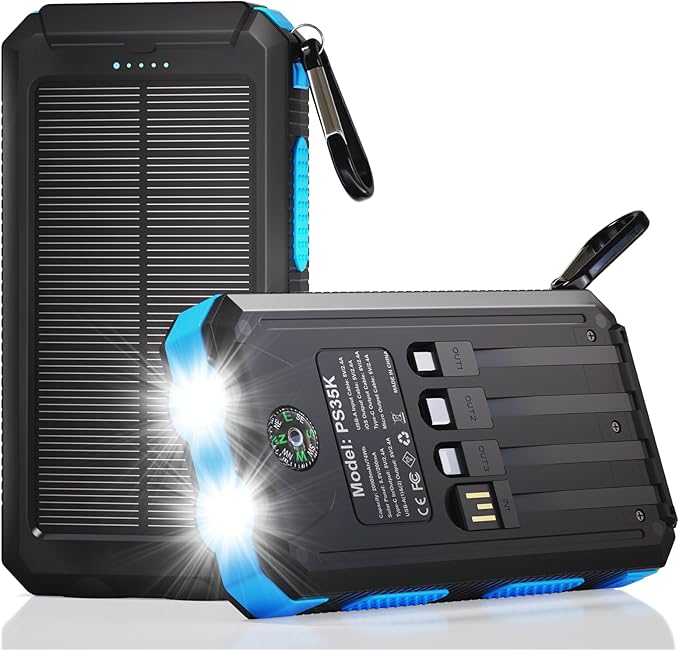
When you’re on a tight budget and want to go off the grid for the first time, the Durecopow 20,000mAh is your best bet.After the second nite, most first-timers realize they bought a cheap charger and it had died.To start, there’s the 20,000mAh, which is equivalent to about four complete phone recharges before the sun makes a difference.Next, you can charge your phone, flashlight, and GPS watch all at once using the four built-in cables and three ports.
Last but not least: a watertight port cover and a sturdy ABS exterior with thick silicone corners—the journey continues even when it rains or gravels.Disadvantages: Not a true recharge, only a trickle top-up from the one panel. Its weight exceeds its capacity. Micro-USB input isn’t very fast.Who it’s best for: first-time buyers, weekend campers, and those who camp in their cars. People who rely solely on solar power should not attempt this, nor ultralight hikers.
6: BLAVOR Solar Power Bank 10,000mAh

For hikers who are watching their weight, the BLAVOR 10,000mAh is the ideal ultralight option.At the end of a lengthy climb, a 20,000mAh brick is just extra weight. It disappears into a pocket on the hip.You can quickly top up at a rest stop with the 20W USB-C output, rather than having a sluggish drip.After that, a Qi wireless face pad—leave your phone in the tent; there’s no need to fumble with cables in the dark.
Lastly, it has a body that is waterproof to an IPX5 standard, two spotlights, and a carabiner that attaches directly to your backpack strap.However, a 10,000mAh battery won’t last a week—it will only last two phone charges. Keep solar power as a last resort only; the panel is quite little.Ideal for: light packers, day hikers, and thru-hikers. Things it won’t power: a tablet or a multi-day group excursion.
5: Hiluckey Solar Charger 25,000mAh
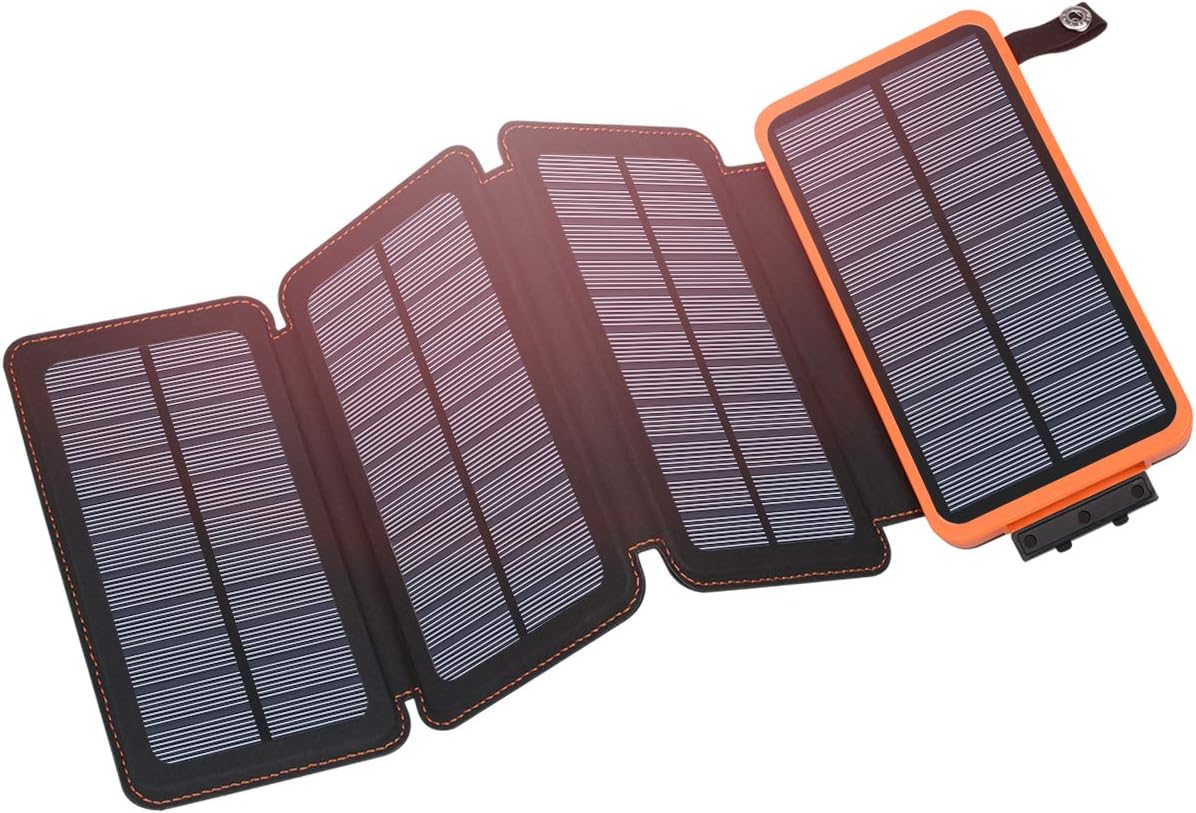
In cases where the solar panel needs to provide electricity, the Hiluckey 25,000mAh is the way to go.The lid of most solar banks contains a single small panel. It doesn’t gather nearly anything. Surface area is the answer given by Hiluckey.In the first place, there are four flat-opening foldable solar panels, which is four times the collecting face of a brick with one panel.Next up: a 25,000mAh battery that can power three persons for a day thanks to its 3A quick charging capabilities and three USB ports.
Lastly, it is safe to leave charging unattended because it has a built-in flashlight, over-charge prevention, and short-circuit protection.Downside: you can’t just plug in four panels; they require long periods of direct sunlight. After folding, it becomes somewhat cumbersome. No way to charge wirelessly.Ideal for: anyone who plan to be off the grid for more than a day, such as festival goers or hikers. This is not for you if you are a minimalist or if you never unroll anything.
4: BLAVOR Solar Power Bank 20,000mAh Built-in Cables

If you’re the type who can’t live without a charging cable, the BLAVOR 20,000mAh is an excellent all-in-one option.You find out the cable is on your kitchen counter two hours before you’re even two miles from the automobile. We can’t do that because of this.To start, it has three ports and four built-in cables: two USB-C, one Lightning, and one USB-A. Six gadgets with no dangling cords.The next step is USB-C 20W fast charging, which will restore a phone’s use in approximately 30 minutes.
The last piece of the puzzle is wireless charging for your Apple Watch and phone, which is something that most banks leave you hanging on.Negative: The built-in cables are the first to wear out and are not replaceable. 20,000mAh in a hefty package. The solar energy sector is still in its early stages.Apt for: Those who own Apple Watches, families with multiple bank accounts, and those who forget to plug in their cable every time. Those who rely heavily on solar power or are meticulous gram counts should not use this.
3: SOARAISE Solar Power Bank 48,000mAh

For extended journeys and group camping, nothing beats the SOARAISE 48,000mAh.Only one weekend, four individuals, and four phones. Dead weight occurs on the first nite when little banks die.First, a 48,000mAh lithium-polymer battery—not a portable charger, but rather the power source for an entire tent.After that, there are four built-in connections and wireless on top, followed by four solar panels and PD plus QC 3.0 rapid charging.
At last, a housing that is not only dustproof, shockproof, and waterproof, but also features two LED camping lights and automatically turns off when there is no power.Downside: it’s not lightweight like a car or base camp bank; it’s designed for hiking. The longer the wall recharge, the bigger the capacity. Solar hardly scratches it.Van life, storm kits, group adventures, and base camps are the best. Avoid: taking it on long hikes or if you’re hiking alone.
2: ToughTested 24,000mAh Solar Power Bank

Second place goes to the ToughTested 24,000mAh, the go-to choice for really extreme environments.Waterproof is what every other bank in this area claims. That denotes a splash, not fording a river, a boat flip, or dusting off in the desert.First and foremost, it must have a complete IP67 rating, meaning it is dustproof and watertight. This is the only option that offers such a range.Secondly, it has a 24,000mAh battery that can be charged eight to ten times via a QC 3.0 USB connector and an 18W USB-C PD port.
At long last: an LED flashlight with four settings, including the strobe and SOS modes that are really useful in an emergency.Pros: the capacity is free, but the sealing is not. In relation to its contents, it is thick and heavy. Panels with integrated electronics need a long time to drain.Ideal for: search-and-rescue packages, desert and winter excursions, mountaineers, and kayakers. Reserved for serious campers with ample funds.
1: FEELLE Solar Power Bank 50,000mAh

As far as off-grid chargers go, in 2026 the FEELLE 50,000mAh is the best of the best.In the absence of sunlight, all solar banks are ineffective. Clouds aren’t bargaining chips. It is eliminated by FEELLE.To begin, there is a hand crank. No matter the weather—rain, nighttime, or a period of cloudy skies—just turn the handle and create power.Second, the high-density lithium-polymer battery has 50,000mAh, which is more than enough power three or four individuals for an extended weekend.Thirdly, it has four built-in connections, four solar panels, and magnetic wireless charging, so you can charge six gadgets simultaneously without breaking a sweat.
The fourth feature is an integrated compass and camping light—the component that keeps your phone charged also functions when your phone isn’t.Disadvantages: Cranking takes a long time—minutes of turning equals minutes of talking. In this case, it’s the heavy hitter.Recharging a wall takes a long time.Van life, storm kits, groups, and multi-day camping are the best. Short overnight treks or ultralight hikers should not attempt this.
Things to Consider Before Buying a Solar Power Bank:
Most consumers overlook important factors when selecting a solar power bank. Understanding your specific needs can make a significant difference in performance and efficiency. From capacity to size, several aspects merit careful consideration before making your purchase. Choose wisely to ensure optimal energy support.
Integrated Single-Panel Compact Units
Compact units are great for casual users who need a reliable way to charge small devices. Their lightweight design makes them easy to carry, perfect for day trips or short hikes. Most can easily fit in a backpack side pocket, providing convenience without bulky equipment.
Expandable Foldable Multi-Panel Chargers
Multi-panel chargers are particularly effective for extended outdoor activities. By unfolding and positioning multiple panels towards sunlight, they capture more energy for faster charging. This versatility offers significant advantages when more power is needed, especially for larger devices or multiple gadgets.
Consider factors such as solar efficiency, size, and power output before making a choice; many models feature varying wattages. When using expandable foldable chargers, optimal sunlight exposure significantly enhances their performance. This type enables users to strategically set up their chargers, ensuring maximum energy absorption during outdoor adventures. Make sure the model you select aligns with your power requirements, especially for devices needing rapid charging.
Battery Capacity and Milliampere-hour (mAh) Ratings
Battery capacity directly influences how much energy a solar power bank can store. Higher mAh ratings generally provide longer usage times.
Photovoltaic Conversion Efficiency and Wattage
Efficiency ratings indicate how effectively a solar panel converts sunlight into usable energy. Higher wattage ratings often lead to quicker charging times.
For instance, a solar power bank with a 25% efficiency rate and 20W rating will harness sunlight more effectively than lower-rated models, enabling faster recharging of devices under optimal conditions. Real-world performance can greatly depend on sunlight intensity, so the most efficient models perform well even in cloudy conditions.
Port Variety and Fast-Charging Protocol Support
Diverse port options ensure compatibility with multiple devices, while fast-charging protocols can significantly reduce recharge times.
Having multiple USB ports is crucial for charging more than one device simultaneously. If your solar power bank supports technologies like Quick Charge or Power Delivery, charging can be accomplished in a fraction of the usual time, enhancing the overall user experience during outdoor activities or emergencies.
Advantages of Off-Grid Power Independence
Having a solar power bank provides the freedom to charge devices anywhere, without reliance on traditional electrical outlets. Whether during a power outage or while camping in remote areas, the ability to harness solar energy means you can remain connected when it matters most.
Limitations Regarding Charging Speed and Weather Dependency
Although practical, solar power banks often charge devices more slowly than conventional power banks. Performance is heavily influenced by weather conditions, with cloudy or rainy days significantly hindering energy absorption. Charge times can extend considerably, making it crucial to plan ahead.
Given their reliance on sunlight, charging speed can vary widely based on weather and time of day. On sunny days, some models may efficiently charge a phone in a few hours, while overcast conditions could stretch that time to nearly twice as long. Meanwhile, heavy rain can render them virtually ineffective until the sun returns, emphasizing the need for alternative charging methods in unpredictable weather.
Calculating Total Daily Device Consumption
Start by determining the wattage of each device you plan to charge. Multiply the device wattage by the number of hours you use it each day to find your total daily consumption. This figure will guide you in selecting a solar power bank with suitable capacity.
Matching Power Bank Output to Device Requirements
Checking the output specifications of your solar power bank ensures compatibility with your devices. Look for the power bank’s voltage and amperage ratings to avoid damaging your electronics.
Matching the output ratings of the solar power bank to your device requirements is important for optimal performance. Devices may have specific charging parameters, such as requiring 5V/2A for rapid charging. Selecting a power bank that delivers this output will ensure efficient charging without the risk of overloading or undercharging your devices.
Best Practices for Heat Dissipation and Safety
Excess heat can damage battery performance and reduce lifespan. Ensure your solar power bank is placed in a shaded area while charging. Avoid covering it with objects that can trap heat, as it is necessary to maintain an optimal operating temperature for better efficiency and safety.
Maximizing Solar Intake Through Proper Positioning
Positioning your solar power bank correctly can significantly influence its charging efficiency. Aim to place it direct sunlight for optimal energy absorption during the day.
Optimal positioning involves tilting the bank towards the sun, ensuring that solar panels face the sun directly. If possible, adjust its angle throughout the day to capture sunlight effectively. When camping or hiking, consider the terrain to avoid obstructions like trees or buildings that can block sunlight. A consistent check on weather conditions and sun trajectory will aid in maximizing your solar intake.
To wrap up
Buying a solar power bank requires careful consideration of factors such as capacity, output power, and portability. Considering your specific needs, is it for camping, emergency backup, or daily commuting? Assessing brand reputation can also reveal long-term reliability and efficiency. Prioritizing these elements will lead you to a product that meets your requirements effectively.
Leave a Reply