
Finding the best stand mixers for your home shouldn’t be a struggle. Are you tired of aching arms from kneading heavy dough by hand? You deserve a powerful kitchen appliance that transforms your baking into effortless, mouth-watering success. We reviewed top-rated models to help you achieve professional results without the stress. Let’s dive into the top picks that will revolutionize your cooking routine today.
Contents
- Top 5 Stand Mixers:
- 1. KitchenAid Artisan Series Tilt Head Stand Mixer
- 2. COOKLEE Tilt-Head Stand Mixer
- 3. Hamilton Beach Electric Stand Mixer
- 4. Aucma Tilt-Head Stand Mixer
- 5. KUCCU Tilt-Head Stand Mixer
- Things to Consider Before Buying a Stand Mixer:
- Tilt-Head Mixers
- Bowl-Lift Mixers
- Motor Power
- Bowl Capacity
- Advantages
- Disadvantages
- Assess Your Cooking Needs
- Check for Attachments and Accessories
- Storage Recommendations
- Conclusion
Top 5 Stand Mixers:
1. KitchenAid Artisan Series Tilt Head Stand Mixer

The KitchenAid Artisan Series Tilt-Head Stand Mixer is designed to enhance your time spent in the kitchen, whether you enjoy baking or are looking to upgrade from a hand mixer. If you’re planning on making a lot of cookies, bread, cake batter, or mashed potatoes for a small party or family supper, the 5-quart detachable bowl will come in handy. You won’t have to stop to scrape or split batches as often.
From a very slow stir for delicately blending dry ingredients to a constant medium speed for everyday mixing, and finally to a very fast whip for light meringues and whipped cream, the 10-speed slide control enables you dial in exactly how you want to mix. Instead of winging it with only one or two speeds, you maintain command of the texture.
Because of the tilt-head design, you can easily access the bowl, making tasks like adding ingredients, testing consistency, or scraping down the sides a breeze. With its 325-watt motor and durable zinc construction, this mixer can handle thicker doughs and longer mixing durations. The 36-inch cord length provides you plenty of freedom to put it wherever you like on your counter.
This Artisan model is an excellent, long-lasting stand mixer if you’re looking for a machine that can adapt to your cooking style and handle everything from basic batters to more complex recipes.
2. COOKLEE Tilt-Head Stand Mixer
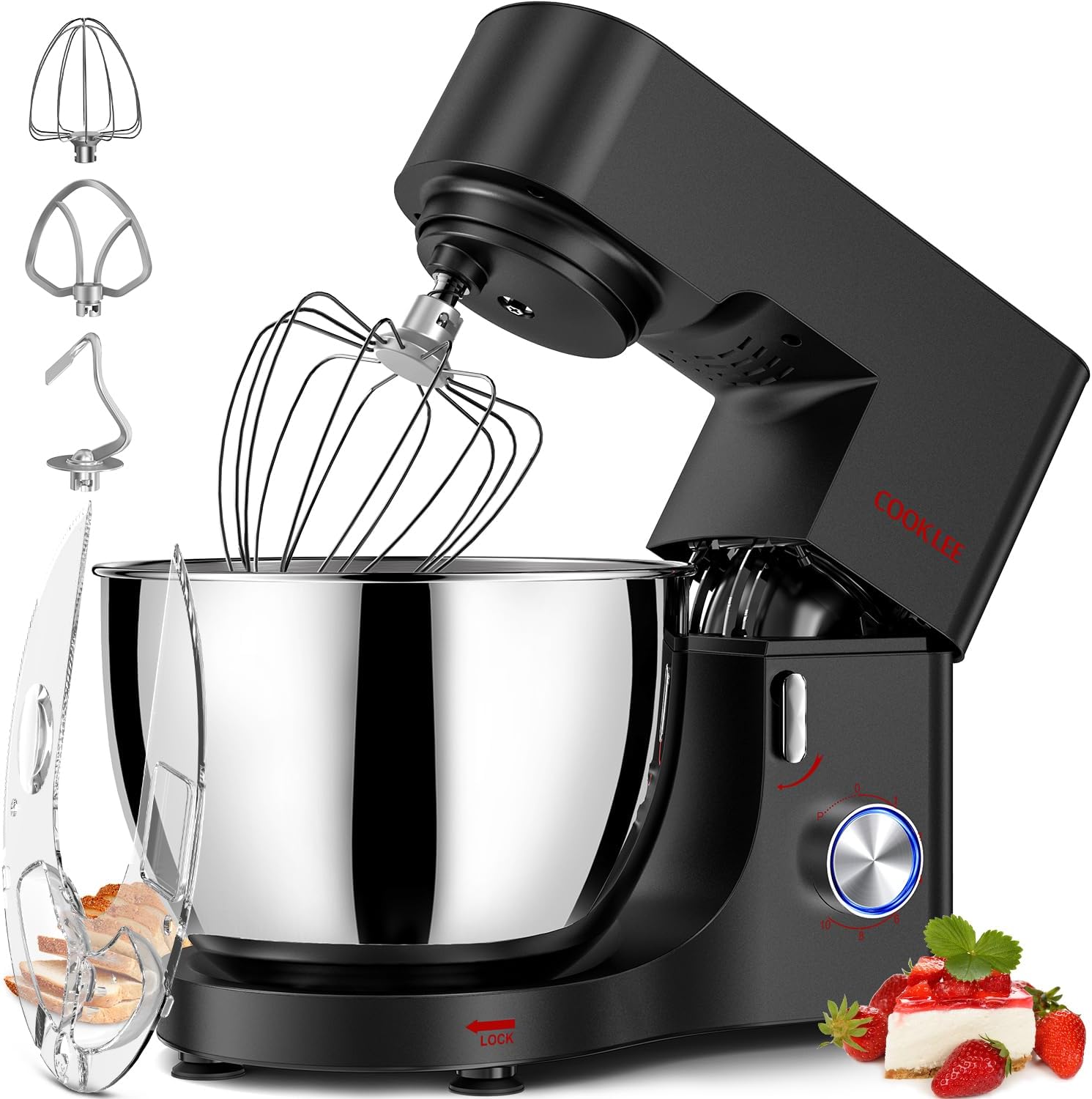
The COOKLEE Tilt-Head Stand Mixer can keep up with your hectic baking schedule, perfect for those who are often entertaining. Without having to stop and divide everything into smaller amounts, you can mix enormous batches of bread dough, cookie dough, cake batter, or mashed potatoes in the generous 9.5-quart stainless steel bowl.
This mixer’s 660-watt motor gives it the muscle to handle thick, heavy mixes with surprisingly little noise. Adding ingredients, changing attachments, and scraping down the sides is a breeze with the tilt-head design, and everything is blended equally from top to bottom thanks to the planetary mixing motion.
The texture will be under your control. For tasks like whipping cream or kneading hard doughs, use the faster speed option; for tasks like delicately folding or combining ingredients, use the slower speed setting. If you’re in a pinch and need to whip up some batter quickly, you can use the pulse mode, which provides a brief surge of power without overmixing.
The mixer is easy to clean and ready to use again whenever you are thanks to its durable build and attachments that are safe to put in the dishwasher. With this stand mixer, you can confidently tackle more difficult recipes, whether you’re still using a hand mixer or have outgrown a smaller bowl.
3. Hamilton Beach Electric Stand Mixer

With the Hamilton Beach Electric Stand Mixer, all of your baking needs will be met with ease, consistency, and no effort. Combine a 4-quart stainless steel bowl with a 300-watt motor, and you’ll have no trouble working with thick doughs like cookie, bread, cake, or cupcake mixes.With the planetary mixing action, the beaters spin around the whole bowl, incorporating ingredients from all directions for a thorough, hands-free mixing experience. With this stand mixer, you can achieve the same smooth, well-combined results as with more costly brands—all without stopping the machine continually to scrape.
With seven different speeds, you can adapt the power to any challenge. To prevent flour or powdered sugar splatters, start bread dough on the slow first speed, then delicately combine dry ingredients into wet on the second speed. You won’t have to estimate how fast to whip, beat, or knead ingredients anymore thanks to the mixing instruction written on the top of the mixer.
The dough hook and flat beater are two of the supplied accessories that will get you started on those quick and easy recipes.Whether you’re a seasoned baker or just starting out, this Hamilton Beach stand mixer is a great addition to any kitchen and will help you with everything from quick breads to more involved recipes.
4. Aucma Tilt-Head Stand Mixer

The Aucma Tilt-Head Stand Mixer will make your baking life easier and less taxing, whether you’re making treats for friends, family, or yourself. Its strong ABS shell ensures it won’t topple over, and its 660W high-performance pure copper motor has more than enough power for even the lightest mixes or thickest bread dough. Without overworking your materials, you can adjust the power to each job with the six optimum settings and pulse function. Use slow speed for delicate mixing and quick speed for whipping and kneading.
The stainless steel bowl can hold 6.5 quarts, which is more than adequate for larger quantities of breads, cakes, cookies, pastries, muffins, and waffles. When the bowl is full, the two handles make lifting, pouring, and carrying much easier. Dishwasher safety makes cleanup a breeze; both the bowl and the attachments may be placed in the dishwasher.
Better access and fewer mess are achieved by swiftly lifting the tilt-head to add ingredients, change attachments, or scrape the bowl. Its blue LED power indicator and stainless steel ornamental belt give it a contemporary flair, making it a stylish addition to any tabletop.This stand mixer can keep up with your inventive culinary endeavors if you’re ready to upgrade from a hand mixer and seek a dependable, powerful appliance to assist your baking routines.
5. KUCCU Tilt-Head Stand Mixer

You can take your home baking to the next level with the KUCCU Tilt-Head Stand Mixer. To save time and effort, you can mix large quantities of dough at once in its 6.5-quart stainless steel basin. This is ideal for making bread, cookies, cake batter, pastries, muffins, and waffles.This mixer’s 660-watt motor ensures powerful and reliable operation with light and heavy combinations alike. You can confidently work with delicate ingredients or power through dense doughs thanks to the six exact speed options, which range from a gentle stir to a quick whip. The ingredients are pulled from the sides and bottom of the bowl by the 360° planetary mixing action, resulting in smooth and equal results.
Quickly add ingredients or swap attachments with the tilt-head design, and for enhanced safety, push the button to automatically cease power. During vigorous mixing, the powerful silicone suction cups on the base will keep the mixer from “walking” across your counter and will reduce vibration.
You can bake with confidence thanks to its low-noise operation, protection against overload and overheating, and attachments that are safe to use in the dishwasher. Incorporate this model into your regular baking regimen if you’re looking for a strong, competent mixer that encourages your culinary imagination.
Things to Consider Before Buying a Stand Mixer:
There’s a lot to weigh when you choose a stand mixer: assess motor power and build quality for heavy doughs, bowl capacity for your batch sizes, included attachments and speed range for versatility, and weight and stability to prevent walking; also evaluate ease of cleaning, storage, warranty, and how the mixer fits your typical recipes and budget.
Tilt-Head Mixers
You’ll typically see tilt-head mixers in 3.5-5 qt sizes (the KitchenAid Artisan is a common 4.8-qt example), weighing roughly 10-20 lbs, which makes them easy to lift and store. They excel at whipping, creaming, and small-to-medium batters and include standard whisk, flat beater, and dough hook attachments. If you mostly bake cookies, cakes, or small loaves, a tilt-head often gives the best balance of price and convenience.
Bowl-Lift Mixers
If you regularly make bread or larger batches you’ll prefer bowl-lift mixers that secure the bowl with a lifting arm and usually provide 5-7+ qt capacity and stronger motors (often 0.5-1.3 HP). Their heavier build-commonly 25-35 lbs-adds stability during heavy kneading, and they handle dense doughs and continuous use better, though they take up more counter space and tend to cost more upfront.
When evaluating bowl-lift mixers you should compare motor horsepower, drive type (gear vs. belt), and ventilation: pro-style machines often use 0.5-1.3 HP motors to maintain speed under load and prefer gear drives for durability. Check that the model accepts the specific attachments you want-many accept commercial-grade pasta makers and slicers-and verify warranty length and parts availability, since repairs on heavy-use units can be more likely.
Motor Power
Motors typically range from roughly 250-1,000+ watts; for example, many consumer tilt-head models sit around 300-350 W while heavy-duty bowl-lift machines often exceed 500 W. If you knead bread frequently or mix dense cookie dough, aim for 500-1,000 W and higher torque-these handle continuous loads better. Also check whether the motor is direct-drive or belt-driven, since direct-drive often delivers more consistent torque under load.
Bowl Capacity
Bowl sizes commonly span 3.5-7 quarts: 3.5-4.5 qt suits singles and small families, 5 qt handles most household batches comfortably, and 6-7+ qt is ideal if you bake large batches or multiple loaves. Choose a larger bowl when you scale recipes regularly, and note that tilt-head mixers usually cap out smaller than bowl-lift models-so match capacity to the typical batch sizes you make.
Beyond raw volume, bowl shape and fill limits affect performance: avoid overfilling-leave roughly 30-50% headroom for dough to expand and for proper beaters clearance. Stainless steel bowls are lightweight and durable, while glass lets you monitor mixing but adds weight; heavier large bowls work best with bowl-lift designs. If you often double recipes, prioritize a 6-7 qt model to prevent splatter and ensure even mixing.
Advantages
You get consistent, hands-free mixing that scales: most home models offer 4-7 qt bowls and motors from about 300-1,000 W, so you can knead 3-5 lb dough batches or whip 8+ egg whites with ease. Brands like KitchenAid (5‑qt) and Bosch (6.5‑qt) demonstrate how attachments expand function-pasta, meat grinder, and spiralizer-turning a single unit into a multi-tool that speeds prep and improves repeatable results.
Disadvantages
You’ll contend with size, weight and cost: typical stand mixers weigh 20-30 lb and need clear counter space or cabinet room, while decent models start around and climb above for premium or commercial-capable machines. Noise and extra attachment expenses add up, and smaller bowls limit very large batches for frequent bakers.
When you use a mixer heavily, motor strain and maintenance become real factors-commercial or large-batch use often requires bowl‑lift or industrial models costing with service plans. Additionally, attachments can add each, and cleaning bulky heads or grease-prone parts takes more time than hand tools; if you bake only occasionally, the purchase and ongoing costs may outweigh the convenience.
Assess Your Cooking Needs
If you bake cookies, whip creams, and occasionally knead bread, a 4.5-5 qt mixer with 300-500 W handles most tasks; for daily bread or large batches, step up to 6-7 qt and higher torque. Consider how often you use the mixer: weekly hobbyists can prioritize compact size, while heavy users should prioritize motor durability, metal gears, and a higher rated dough capacity (many home models advertise kneading up to 4-8 lb dough).
Check for Attachments and Accessories
Verify which accessories come in the box versus sold separately-standard tools are paddle, whisk, and dough hook, while extras like pasta rollers, meat grinders, and grain mills often cost extra. Confirm the attachment hub type and whether third-party add-ons fit; note that high-draw attachments need stronger motors and reinforced gear trains to avoid premature wear.
Attachments vary by material and power demands: stainless-steel implements and die-cast pasta rollers last longer than stamped-aluminum pieces, and metal drive shafts resist stripping. You should check manufacturer specs for attachment load limits-grain mills and meat grinders can strain lower-torque motors-plus verify whether the mixer uses a direct-drive or external hub, since gear ratio and mounting style affect compatibility and longevity.
Storage Recommendations
Store your mixer on a low shelf or in an appliance garage to keep dust off; units typically weigh 10-30 lbs, so pick a spot you can access without heavy lifting-many 5‑qt tilt-head models are about 25 lbs. Keep attachments together in a labeled bin and cover the bowl with a towel or the manufacturer’s dust cover to prevent pantry dust and grease buildup.
For long-term storage, relieve pressure on gears by loosening the bowl-lock or tilt head, coil the cord loosely to avoid kinks, and tuck silica gel packets nearby in humid climates; apply a light food-grade mineral oil to exposed metal joints if your model shows surface rust tendency, and leave cabinet doors slightly ajar or add a vent to prevent moisture accumulation and extend seals and bearings life.
Conclusion
Drawing together, you should consider your baking habits, counter and storage space, motor power and speed range, bowl capacity, attachments, build quality, warranty and service options, and overall budget so you choose a stand mixer that matches your routine and stays reliable over time.
Leave a Reply