
Best Tire Pressure Gauges can save you money and keep your car safer by delivering accurate readings fast. If you hate guessing tire pressure, our expert tests and hands-on reviews cut through confusing specs to recommend reliable digital gauges and trusted analog options. These must-have tools give you instant confidence and protect your family on every drive. We’ll show top picks, simple buying tips, and how to use them next.
Contents
- Top 7 Tire Pressure Gauges:
- 7: ETENWOLF Pencil Tire Pressure Gauge 2 Pack
- 6: AstroAI Digital Tire Pressure Gauge 150PSI
- 5: TIRETEK 60 PSI Analog Dial Tire Pressure Gauge
- 4: Rhino USA Heavy Duty Tire Pressure Gauge
- 3: ETENWOLF T600 Digital Tire Pressure Gauge 250 PSI
- 2: JACO ElitePro Digital Tire Pressure Gauge 100 PSI
- 1: AstroAI Digital Tire Pressure Gauge with Inflator
- Things to Consider Before Buying a Tire Pressure Gauge:
- Digital Gauges for Precision and Backlit Displays
- Analog and Pencil Gauges for Durability and Portability
- Pros and Cons of Each Design
- Accuracy Ratings and PSI Range Requirements
- Build Quality and Valve Connection Types
- Battery Life and Display Visibility
- Preparing the Vehicle for a Cold Reading
- Connecting the Gauge and Recording Data
- Adjusting Pressure to Manufacturer Specifications
- Proper Storage to Prevent Sensor Damage
- Periodic Calibration and Battery Replacement
- Cleaning the Valve Connector
- Conclusion
Top 7 Tire Pressure Gauges:
7: ETENWOLF Pencil Tire Pressure Gauge 2 Pack

The ideal low-cost backup for any glovebox is the ETENWOLF Pencil Gage 2-Pack.A zero-tread gage is a common tool for drivers. Eventually, you won’t have anything to examine a tire that appears to be soft.You have two pressure ranges to consider first: 10–50 PSI and 20–120 PSI. Trucks and cars, both taken care of.Right up next: a fully metal construction. No batteries to die in cold weather, zinc alloy head, stainless steel body.
Last but not least: the barrel of each gage bears the calibration number, and each gage is hand-calibrated to ANSI Grade B.Negative: compared to a dial, the sliding stick is more difficult to read. Toward the extremities of every range, precision begins to droop.Recommended for: people on a tight budget, those with two cars, and backup buyers. Drivers requiring a quick readout should not use this.
6: AstroAI Digital Tire Pressure Gauge 150PSI

For low-cost, nighttime tire pressure monitoring, nothing beats the AstroAI Digital Tire Pressure Gage.It is difficult to locate a valve stem in a dark wheel well, and tire checks are typically done either before or after work.To start, the gage will seat the first time you use it since an illuminated nozzle will light up the valve stem.A lighted LCD, calibrated to within 1 PSI, follows. Avoid straining your eyes to read the numbers; they are legible.
At last, it’s battery-saving: after 30 seconds, it turns off, and a single button cycles four pressure units.Negative: A pair of AAA batteries could die just when you need them. Solid body, not made of metal. Missing bleed valve.Commuters, novice drivers, and early risers will find it the most useful. Disliked by: Those who insist on using only non-battery powered devices.
5: TIRETEK 60 PSI Analog Dial Tire Pressure Gauge

The greatest battery-free dial for regular autos is the TIRETEK 60 PSI Dial Gage.Great digital gages, but they stopped working in January.That is never an issue with a mechanical dial.The first is a 2% ANSI Grade B calibrated pressure gage that ranges from 0 to 60 PSI.All of the pressures experienced by passenger cars are measured using this scale.Up next: an integrated bleed button. Is it full? Hold the gage firmly against the valve as you press it.
Last but not least: a rubberized housing housing a 45-degree swivel chuck that features an enlarged tip for a seal that is impervious to leaks.Downside: Many heavy-duty truck and RV tires require higher pressures than 60 PSI. Tight wheels hose not available. Absence of illumination from behind.Who should buy it: motorcyclists, those have sedans or crossovers, and those who own them. Discontinued for recreational vehicle and heavy-duty truck owners.
4: Rhino USA Heavy Duty Tire Pressure Gauge

No other hose-style dial compares to the Rhino USA Heavy Duty Gage for pickups and SUVs.The valve stems of large wheels are concealed.You have to stoop down and read it backward when the gage is too short.My first item is a hose that is braided and won’t leak. Before you can see the dial, clip the chuck on.Next, an ANSI B40.1-certified, 2-inch, glow-in-the-dark dial that displays pressures from 0 to 75 PSI.
Lastly, the chuck can be aligned from any angle thanks to the robust brass hardware’s 360-degree swivel head.Drawbacks: occupies more space in the trunk and is thicker than a pocket gage. The RV and dual pressures are still not met.For those who own trucks or SUVs and have valves that are difficult to access, this is the device for you. Discontinued for RV owners and minimalists who prefer to keep their glove boxes bare.
3: ETENWOLF T600 Digital Tire Pressure Gauge 250 PSI

When it comes to RVs, trailers, and hefty tires, the ETENWOLF T600 is the greatest high-pressure digital.Tow vehicle and recreational vehicle tyre pressure gages can only measure so much. That range is designed for the T600.The first range is 0–250 PSI, with a precision of plus or minus 0.5 percent and a reading of 0.1 PSI.After that, there’s a kink-free bleeder and a flexible hose with an angled chuck that may be used in any direction.
With a lighted screen and a single button control, it can withstand temperatures ranging from -14 to 140 degrees Fahrenheit.Negative: You need to install the batteries before they come. Getting used to using a single button for all tasks requires time and effort. Our newest model, thus its performance history is brief.It is ideal for those who own recreational vehicles, trailers, and large trucks. People that drive a single automobile should not use this.
2: JACO ElitePro Digital Tire Pressure Gauge 100 PSI

For home-use accuracy comparable to that of a professional shop, nothing beats the JACO ElitePro Digital precision gage.To most people, one PSI won’t seem like much. Fuel economy, handling, and tread wear become noticeable after a few months.To start, there are two pressure sensors that have been approved for use up to 100 PSI, and they can detect pressures within half a point.Then, without having to reset the screen, the built-in bleeder lowers the pressure as you watch. To get it down to the exact quantity, slightly overfill and then bleed.
Last but not least: a 10-inch revolving hose, a 2.5-inch illuminated LCD that locks the reading, and components made of steel and brass housed in a shock-resistant protection.The most costly gage available here is a drawback. Some RV tires cannot be used due to a 100 PSI ceiling. Requires three-volt batteries.Ideal for: people that take pride in detail, love to drive fast, and are fanatics. Avoid: seasonal, casual checkers.
1: AstroAI Digital Tire Pressure Gauge with Inflator
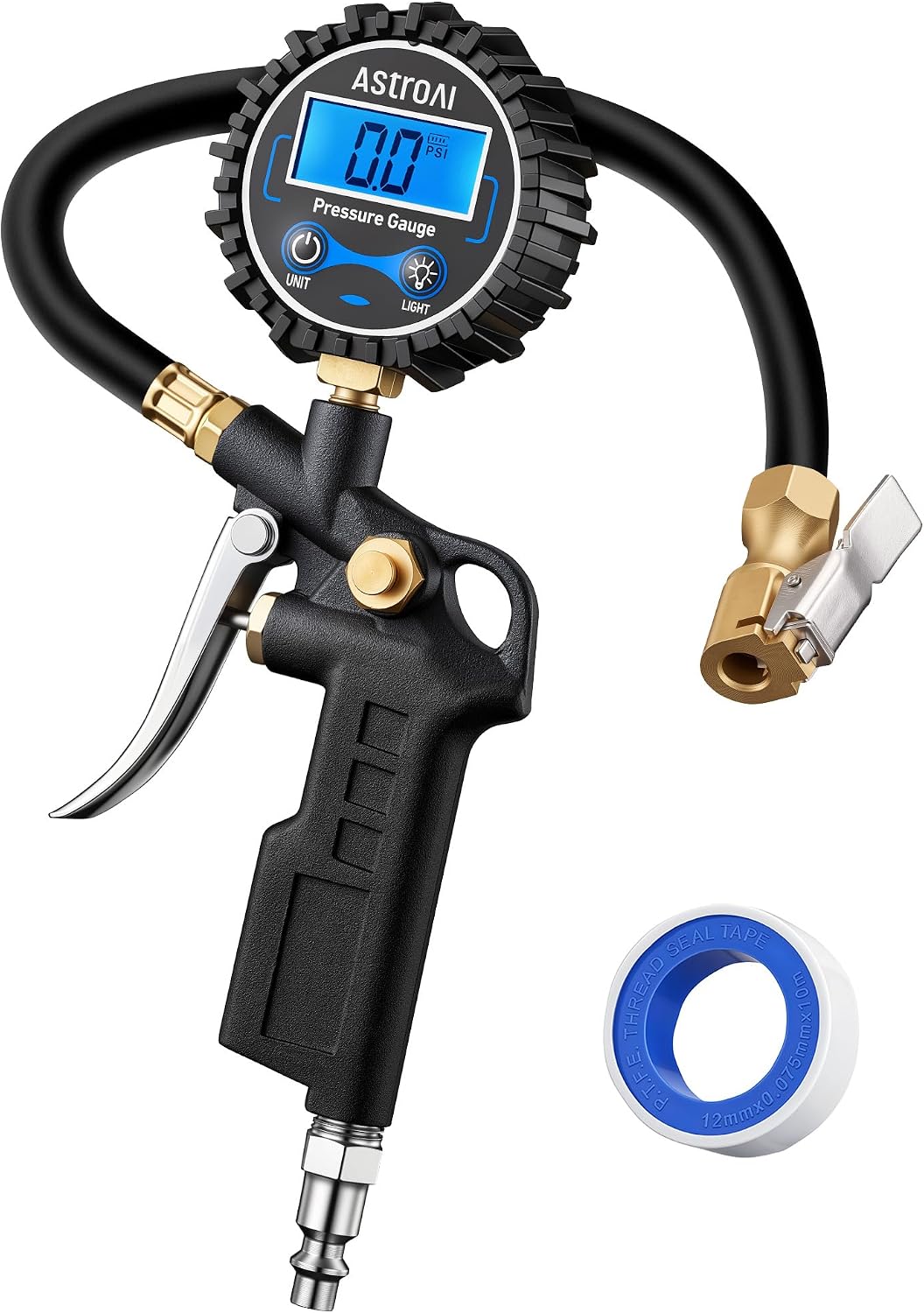
As far as all-in-one tire tools go, the AstroAI Digital Gage with Inflator is the ideal option for a home garage. It measures tire pressure and has an inflation function.This reading is the endpoint for all of the other gages. Tire pressure? Finding air, filling, and rechecking are still necessary steps.Firstly, it is a multi-function gadget that can inflate, deflate, and measure. Add air by pressing the button; release it by squeezing the trigger. Nothing else on this gage inflates.The second is an accuracy of plus or minus 0.5 percent with a reading of 0.1 PSI from 3 to 250 PSI.
The third step is to attach the compressor line to a regular quarter-inch fitting using a quick-connect coupler.The big ergonomic handle and four pressure units make up the fourth feature.The lack of self-sufficient air production means that an air compressor is required. Rather large to fit in a glove compartment. Requires batteries.Homeowners with a compressor in the garage, families with more than one car, and do-it-yourselfers are the ideal candidates. Users who do not have one should not drive apartments.
Things to Consider Before Buying a Tire Pressure Gauge:
Selecting the right tire pressure gauge can significantly impact your vehicle’s performance and safety. With various types and features available, knowing what to look for is essential. A comprehensive understanding helps ensure you choose a gauge that best meets your needs and enhances your driving experience.
Digital Gauges for Precision and Backlit Displays
Digital gauges provide precise tire pressure readings, often down to 0.1 PSI for accuracy. Many models feature backlit displays, enhancing usability even in dim conditions. The intuitive interface makes it easy to read the pressure at a glance, which is especially beneficial for those who may have difficulty with smaller or analog dials. Choosing a digital option can improve confidence in your readings, ensuring your tires are always at optimal pressure levels.
Analog and Pencil Gauges for Durability and Portability
Analog gauges are known for their durability, often constructed to withstand harsh conditions without requiring batteries. They provide straightforward reading through a dial, which many users find easier to interpret than digital versions. Pencil gauges, characterized by their compact size, are highly portable and ideal for traveling. Their simple mechanism reduces the chance of malfunction, making them a reliable choice for casual drivers or those who want a backup option.
Pros and Cons of Each Design
Every gauge type has distinct advantages and disadvantages. Digital gauges deliver high precision but may face battery issues over time. Conversely, analog gauges excel in durability yet can be less precise under certain conditions. Pencil gauges offer convenience and portability, but they sometimes sacrifice accuracy for simplicity. Understanding these trade-offs will help you choose the best gauge for your specific needs and preferences.
Accuracy Ratings and PSI Range Requirements
Prioritizing accuracy is essential when selecting a tire pressure gauge. Look for models that provide precise readings, ideally with an accuracy rating of ±1 PSI. The PSI range should also align with your vehicle’s needs; most passenger cars require gauges that measure between 0 and 60 PSI. A gauge with a lower range might be unsuitable for larger vehicles, such as trucks, which can require readings up to 100 PSI or more.
Build Quality and Valve Connection Types
Durability plays a significant role in the longevity of a tire pressure gauge. Seek gauges constructed from sturdy materials like stainless steel or high-quality plastic. Consider the valve connection types as well; those with a Schrader valve compatibility are common and more versatile for various vehicles. A robust build not only withstands wear and tear but also enhances the gauge’s overall accuracy over time.
Battery Life and Display Visibility
Examining the display is equally important, especially for gauges that use electronic readings. Opt for models with backlit or large LCD screens for easy visibility, particularly in low-light conditions. Battery life can vary significantly among different gauges, so choose one with extended battery performance to minimize the frequency of replacements. A gauge that balances visibility and longevity can streamline your tire maintenance routine.
Preparing the Vehicle for a Cold Reading
Start by ensuring that the vehicle has not been driven for at least three hours, allowing tire temperatures to stabilize. Ambient temperatures can impact pressure readings, emphasizing the importance of a cold tire measurement. Ideally, the reading should be taken in the morning after the vehicle has been parked overnight. By adhering to this guideline, you set the stage for an accurate assessment of tire pressure.
Connecting the Gauge and Recording Data
Firmly attach the tire pressure gauge to the valve stem, ensuring a tight seal to prevent air leakage during the measurement. The reading should appear immediately on the gauge; in the case of digital gauges, the display will light up. Note the pressure immediately, as even slight fluctuations can occur if the connection is not secure. Recording the data accurately sets you up for any necessary adjustments based on the manufacturer’s specifications.
Adjusting Pressure to Manufacturer Specifications
Consult the vehicle’s owner manual or the sticker inside the driver’s door for the recommended tire pressure, typically given in psi (pounds per square inch). If the measured pressure is higher than recommended, release some air until you reach the specified level. Conversely, if the pressure is low, add air until it matches the guidelines. Achieving the correct pressure not only enhances performance but also improves fuel efficiency and prolongs tire life.
Proper Storage to Prevent Sensor Damage
Storing a tire pressure gauge correctly protects its sensor from damage and inaccuracies. A designated storage case can shield the tool from impacts and extreme temperatures, both of which can lead to sensor failure. Avoid leaving the gauge in direct sunlight or humid environments, as these conditions may compromise its integrity. Instead, keep it in a dry, cool place, such as a glove compartment or toolbox, ensuring it’s ready for use whenever needed.
Periodic Calibration and Battery Replacement
Regular calibration of your tire pressure gauge ensures accurate readings over time. Many manufacturers recommend recalibration based on usage, typically every year or after significant impact. Additionally, keeping an eye on the battery status is essential for maintaining performance; a weak battery can lead to inconsistent measurements. Replacing the battery as part of your routine maintenance will keep the gauge functioning reliably, providing dependable results for safe driving.
Cleaning the Valve Connector
A clean valve connector is necessary for obtaining precise tire pressure readings. Dirt, grime, and debris can obstruct the connection, leading to inaccurate measurements. To clean it, simply wipe the connector gently with a soft cloth or a small brush. Regular cleaning, especially before each use, helps maintain a tight seal between the gauge and the tire valve, ensuring that you get the most accurate reading possible every time you check the pressure.
Conclusion
Evaluating your choices for a tire pressure gauge involves considering several important factors. Assess the accuracy ratings, gauge type, and ease of use tailored to your vehicle maintenance needs. Selecting a model that provides both reliability and readability can save you time and keep your tires in optimal condition. A worthy investment not only enhances your driving safety but also prolongs tire life, ultimately benefiting your wallet. With the right preparation, maintaining proper tire pressure can become an effortless routine.
Leave a Reply