
Finding the best whole house water filter is the ultimate way to protect your family’s health. Are you tired of smelly, chemical-filled tap water ruining your skin and hair? You deserve the peace of mind that comes with pure, refreshing water from every faucet. Our guide compares top filtration systems to help you remove harmful contaminants easily. Stop settling for poor water quality and start enjoying a healthier home today. Let’s explore the top-rated options.
Contents
- Top 7 Whole House Water Filter:
- 7: GE GXWH40L
- 6: Culligan WH-HD200-C
- 5: iSpring WGB21B
- 4: iSpring WCB32C-KS
- 3: iSpring WGB32BM
- 2: Aquasana Rhino EQ-1000
- 1: iSpring WGB32B
- Things to Consider Before Buying a Whole House Water Filter:
- Conducting a Comprehensive Water Test
- Common Contaminants in Municipal vs. Well Water
- Multi-Stage Carbon and Sediment Filters
- Specialized Systems for Heavy Metals and Hardness
- Flow Rate and Water Pressure Requirements
- Micron Ratings and Filtration Efficiency
- Benefits of Comprehensive Protection and Appliance Longevity
- Initial Investment and Ongoing Maintenance Costs
- Determining the Correct System Size for Your Household
- Preparing for Professional or DIY Setup
- Establishing a Routine Filter Replacement Schedule
- Verifying NSF and ANSI Certifications
- Final Words
Top 7 Whole House Water Filter:
7: GE GXWH40L

Among ultra-budget whole-house filters, the GE GXWH40L is the most effective at preventing silt buildup.Your toilet tank has rust flakes. Debris in the aerators of your faucets. The washing machine’s inlet is obstructed. Every appliance is being hit by untreated city water.It is prevented from spreading by the GXWH40L.To start, a heavy-duty FXHTC cartridge takes care of the most frequent issues with city water—sediment, rust, sand, and chlorine taste—all in one filter.
Secondly, you may change filters without turning off the water thanks to a three-position bypass valve. Avoid scheduling on a wet floor.Lastly, there are conventional 3/4-inch connections, so adapters aren’t necessary.Negatives: only works on a single stage; won’t remove heavy metals. No pressure sensors.The ideal choice for little houses that have complained about sediment and chlorine. Those concerned about lead, PFAS, or chloramine should not use this product.
6: Culligan WH-HD200-C

See what’s in your water with the help of the Culligan WH-HD200-C, the top clear-housing sediment filter.When sediment filters aren’t working properly, they leak quietly. After weeks of using a saturated cartridge, you will discover that yours is clogged when the pressure reduces in the washing machine or shower.Thanks to the WH-HD200-C, that is the past.Firstly, a see-through sump housing allows you to keep an eye on the sediment loading status at all times.
The next thing to note is that any standard 10×4.5-inch cartridge will fit with a 1-inch universal NPT design.And lastly, there is an integrated shut-off, bypass, and pressure-relief valve. This allows you to change filters without flooding the line.Disadvantage: Adds to total cost because filter is sold separately. No chlorine removal on its own; only one stage. Exchanges require a wrench.Ideal for: frugal households that want to see sediment levels. Those who require chemical or chlorine filtration should not use this.
5: iSpring WGB21B

The iSpring WGB21B, a top-tier, commercially available whole-house filter with a demonstrated ability to remove chlorine.Unnamed filters don’t work reliably. The system that the majority of plumbers are familiar with is the workhorse, and you want that.Specifically, it is the WGB21B.Prior to the second stage, a 5-micron polypropylene sediment cartridge is used to collect particles of dirt, silt, rust, and scale.After that, a CTO carbon block made of coconut shells may remove more than 90% of chlorine, along with other contaminants like pesticides, herbicides, and industrial solvents.
Lastly, it has a 50,000-gallon capacity, which is enough water to fill a full year’s worth of household needs (such as running a dishwasher or taking a shower) at a standard flow rate of 15 GPM.Con: there are no pressure gauges to monitor the filter’s life. No elimination of heavy metals. For swaps, you’ll need a housing wrench.Who it’s best for: City dwellers looking for a reliable sediment and chlorine filter. Ruled out: fans that rely on visual monitoring, lead, or PFAS.
4: iSpring WCB32C-KS

The iSpring WCB32C-KS is the top three-stage system for lead, PFAS, and chloramine-conscious households.Most modern homes aren’t scared of what standard carbon filters don’t catch. Chloramine is able to evade ordinary carbon. You would never guess that lead and PFAS, which are invisible, are showing up in municipal supplies.They are pursued by the WCB32C-KS.To start, lead, mercury, chloramine, hydrogen sulfide, and other heavy metals that simple carbon doesn’t target can be effectively removed using a customized FG25-KS cartridge that uses KDF and GAC medium.
Up next, we have a high-quality FC25 carbon block that can withstand chlorine, PFAS, and herbicides in addition to 30,000 gallons of water.Last but not least: a see-through sediment-stage housing to maintain chain visibility.Negative: a separate water softener is required for residences with high total dissolved solids (TDS). Periodically change the filters. No pressure sensors.Ideal for: city dwellers worried about PFAS, lead, or chloramine. Households with hard water that require scale control should not use this.
3: iSpring WGB32BM
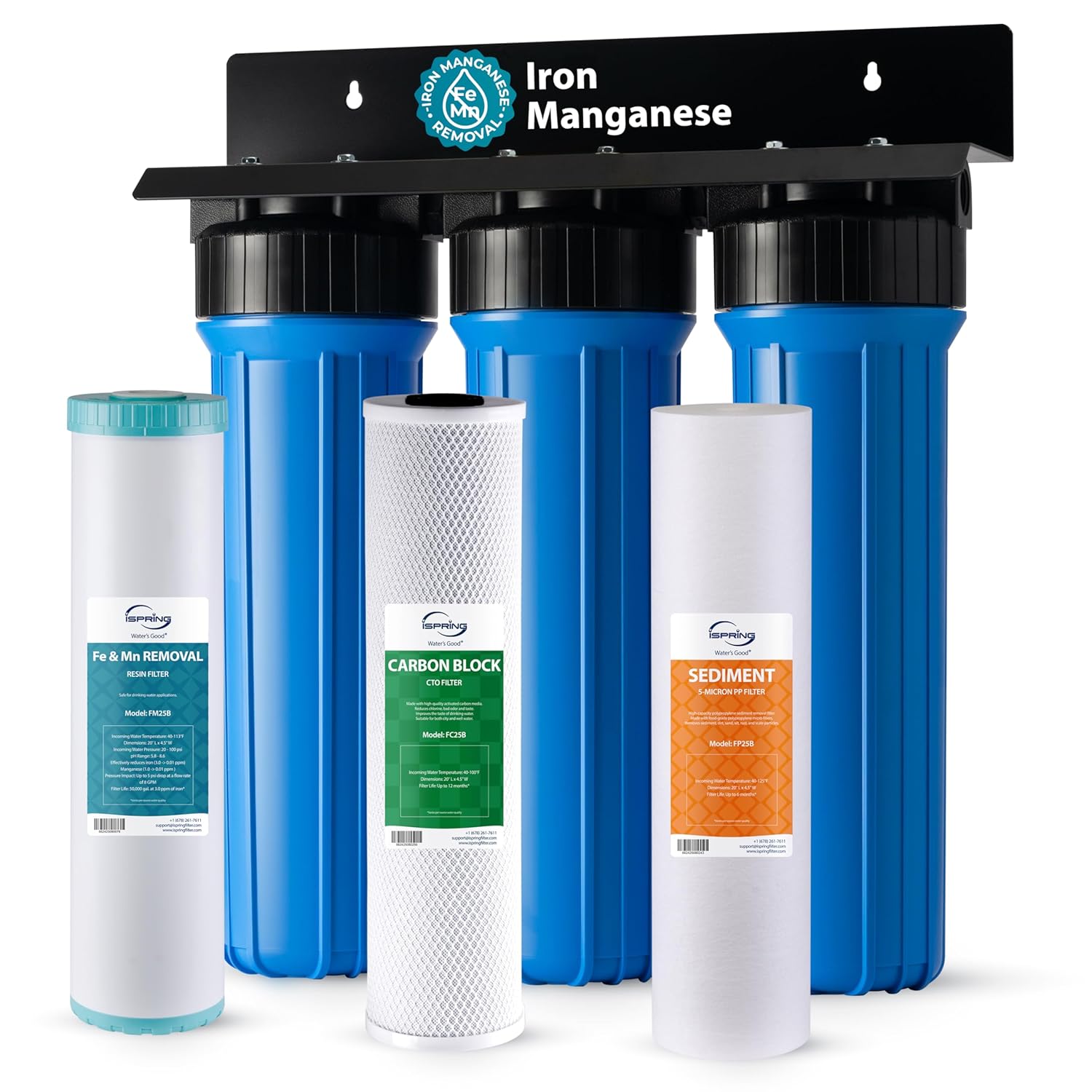
If your home has iron stains or a sulfur stench coming from the faucet, the iSpring WGB32BM is the ideal 3-stage system to use.Toilet bowls show rust stains. The laundry has yellow stains. Coming from the hot water faucet, a subtle odor of spoiled eggs. They are carried by older city pipes to a greater extent than you might expect, and carbon filters do not even touch them.For that, the WGB32BM is designed.A 20-by-4.5-inch three-stage design containing a 5-micron sediment, a CTO carbon block, and an FCRM25B reduction cartridge is the first item to be addressed.
Up next, the FCRM25B zeroes in on the trinity responsible for odors like rust and sulfur: iron, manganese, and hydrogen sulfide.The third and final stage is a 1-inch NPT inlet/outlet that maintains a constant flow rate throughout.Cons: the iron cartridge loads quickly; you’ll need to replace it every six months while it’s under load. We do not specialize in PFAS or lead. Systems with a 10-inch footprint are more compact.Ideal for: households plagued by rust stains, sulfur odor, or laundry that appears yellow. Those who do not have symptoms related to iron or manganese should not use this.
2: Aquasana Rhino EQ-1000

Those looking for a tank-style filter that they can set up and forget about may choose the Aquasana Rhino EQ-1000.Each 3 to 6 months, you should change the cartridges in your system. After 30 filter changes over the past decade, you still haven’t remembered much.Rhinos put an end to that loop.The first is a dual-tank upflow system that uses carbon and KDF media; this design eliminates channeling and maintains a constant rate of reduction over the years due to the lengthy water contact. Stage one: set it and forget it.
At last: a comprehensive installation kit consisting of Schedule 80 PVC, a shut-off valve, a drain valve, and pre- and post-filters constructed as permanent fixtures.Downside: requires actual floor space due of its enormous footprint. You still have to swap out the before and after filters. 7. GPM flow rate—not as fast as commercial 3-stage systems.This is the ideal option for homeowners who want to avoid changing filters often. Not recommended for: temporary tenants or small utility closets.Although the Rhino is the priciest option at, it outperforms all cartridge systems in terms of math during the past ten years. Are you sick of changing cartridges? Put this in place.
1: iSpring WGB32B

With its one and only commercial-grade three-stage design, the iSpring WGB32B is the greatest whole house water filter currently available. It can purify water for a whole year and comes in at number one on our list.Each of these filters compromises in some way, whether it’s flow rate, capacity, or the variety of contaminants it can remove. But the WGB32B isn’t.The first step is a 20-by-4.5-inch industrial filter set with three stages: a 5-micron polypropylene sediment filter and two CTO carbon blocks made of coconut shell that have been tested and approved by ANSI and NSF.Secondly, it can handle a flow rate of up to 15 GPM and has a capacity of 100,000 gallons, which is enough for a family of four to run four times a year before has to be replaced.
Third, we will remove 99 percent of chlorine and reduce all contaminants, not just the most common ones, including volatile organic compounds (VOCs), taste, smell, and industrial chemicals.Downsides: 3/4-inch houses require adapters, and 1-inch NPT ports necessitate corresponding piping. The floor and wall space used by houses is substantial. Replaces heavier systems with 10-inch ones.Who this is ideal for: homeowners looking for a tried-and-true commercial workhorse. Avoid if you own a small basement, a condo, or just want to avoid upkeep.
Things to Consider Before Buying a Whole House Water Filter:
There’s a lot to evaluate when choosing a whole house water filter. Understanding your water source, filter types, and budget can significantly impact the effectiveness and longevity of your investment. This guide will help you make an informed decision for optimal water quality.
Conducting a Comprehensive Water Test
Obtaining a comprehensive water test helps identify specific pollutants in your source. Consider utilizing professional services or at-home testing kits to measure parameters like pH, hardness, and contaminants. This data will guide your filtration choices effectively.
Common Contaminants in Municipal vs. Well Water
Municipal water often contains chlorine, lead, and microbiological impurities, while well water may be affected by nitrates, pesticides, and heavy metals. Understanding these variances is crucial for selecting an effective filter system tailored to your needs.
Municipal water treatment plants primarily focus on maintaining safe drinking water standards. However, they sometimes use chemicals like chlorine that could affect taste and odor. Conversely, well water is sourced directly from the ground and can be unregulated, potentially containing harmful substances from fertilizers or industrial runoff. Evaluating the specific contaminants in both types of water will help you make an informed decision about the appropriate water filtration system for your home.
Multi-Stage Carbon and Sediment Filters
Multi-stage carbon and sediment filters are designed to tackle various impurities in your water supply. These systems generally include pre-filters to capture sediments and activated carbon stages that can effectively absorb chlorine and other harmful chemicals.
Specialized Systems for Heavy Metals and Hardness
Specialized systems target specific contaminants like heavy metals and hard water minerals. These systems utilize advanced filtration technologies to ensure your water is safe for consumption and safe for plumbing fixtures.
Heavy metals such as lead, arsenic, and mercury can pose serious health risks. Specialized filtration systems, including reverse osmosis and ion exchange, effectively remove these contaminants, ensuring your water is pure. If hard water is an issue, consider a dual-system that softens while filtering, providing optimal protection against scale buildup and health concerns.
Flow Rate and Water Pressure Requirements
Flow rate and water pressure are imperative for ensuring a consistent supply of filtered water. Assess your household’s needs and verify that the system can deliver adequate performance without compromising efficiency.
Micron Ratings and Filtration Efficiency
Micron ratings directly impact a filter’s ability to remove specific contaminants. Higher filtration efficiency often correlates with lower micron ratings, indicating more effective filtration.
Evaluating micron ratings helps identify the filter’s suitability for your water quality needs. A lower micron rating generally signifies better removal of smaller particles, while some systems may effectively target specific contaminants like chlorine, heavy metals, or sediment. Understanding these aspects will aid in selecting the right filter for your household.
Benefits of Comprehensive Protection and Appliance Longevity
Investing in a whole house water filter provides extensive protection for all plumbing systems, extending the life of appliances. Clean water reduces scale buildup, minimizing repairs and replacements. Consequently, this leads to substantial long-term savings, allowing you to maintain your home’s value and function effectively.
Initial Investment and Ongoing Maintenance Costs
Initial expenditure for a whole house water filter can be significant, yet it often pays off through increased appliance longevity. Ongoing maintenance involves regular filter replacements and occasional servicing. Assessing these costs ensures you’re aware of budgetary requirements for proper system upkeep.
Evaluating the initial investment alongside ongoing maintenance costs is important for budgeting. While upfront costs may seem high, consider the long-term savings from reduced appliance damage and improved water quality. Regular maintenance, such as replacing filters, should be factored into your overall expenditure to maintain system efficacy and maximize your investment.
Determining the Correct System Size for Your Household
Assessing your household’s water usage is vital for finding the right filter size. Calculate daily consumption based on the number of family members and appliances. A suitable size ensures optimal filtration efficiency and longevity.
Preparing for Professional or DIY Setup
Choosing between professional installation and DIY requires careful consideration of your skills and the complexity of the system. Gather all necessary tools and materials in advance, and familiarize yourself with the installation process regardless of your choice.
Taking the DIY route can save money, but proper preparation is crucial. Read the manufacturer’s instructions thoroughly, watch tutorial videos, and ensure you have all tools ready. If you opt for a professional, researching reputable plumbers will ensure a smooth installation process. Either way, assess your plumbing system for compatibility to avoid surprises during setup.
Establishing a Routine Filter Replacement Schedule
Establishing a consistent filter replacement schedule prevents system overload and maintains water quality. Regular changes based on manufacturer recommendations help avoid ineffective filtration, ensuring clean water for your household.
Verifying NSF and ANSI Certifications
Verifying NSF and ANSI certifications guarantees that the water filter meets stringent safety and performance standards. These certifications signify that the product has undergone rigorous testing and can effectively remove contaminants, providing peace of mind for homeowners.
Checking for these certifications is an crucial step before purchasing. Products bearing NSF and ANSI labels have met high-quality benchmarks, enhancing confidence in their effectiveness. These organizations evaluate filters on various criteria, including contaminant reduction, material safety, and overall performance. Understanding these certifications can help you make an informed decision for your water filtration needs.
Final Words
Hence, evaluating factors such as water quality, filter types, maintenance requirements, and budget is imperative before purchasing a whole house water filter. Consider your household’s specific needs and the contaminants present in your water supply. Making an informed decision will ensure you select the right system for optimal water quality and safety.
Leave a Reply